Showing posts with label Paris Journal. Show all posts

Friday, September 25, 2015

When Autumn leaves start to fall

September 25, 2015 -- Chefs can be shy.  The softspoken “server” on Wednesday evening at L’Epopée gave me cause for concern; he was so reserved that he was barely projecting well enough to communicate with his guests.  I worried about his chance of succeeding as a server.

At the end of the evening, when I was telling him what was so good about the sauces in this dinner, he beamed and said, “I am the chef.  I have come up tonight to see how this part of the house is working.”

Looking down at the charcuterie and dessert bar at Le Café du Commerce

So the young man whom I had seen appearing out of the kitchen at L’Epopée must be the sous chef, and he must be good enough that the chef was comfortable with leaving the kitchen mostly to him on Wednesday evening.  I’m sure that by then, many of the preparations had already been made.

The starter course that we shared was made in one of those earthenware escargot baking dishes with a dozen round concave indentations.  Instead of escargot, a small shrimp was in each indentation, and the entire dish was covered with a rich, creamy, velvety tomato sauce that had just the right amount of seasonings, tasting mildly Spanish.  The shrimp were tender and juicy; not the least bit overcooked (photo below).


We each had roasted duck breast and polenta, served in a small puddle of fruity sauce.  Comfort food doesn’t get any more comforting than this.

We shared a dessert of profiteroles with that rich, dark chocolate sauce.  Then it was time to say goodbye to L’Epopée for this season.  This was where we began our summer dining in Paris this year; we’ll miss it.

Last night, we dined at another longtime favorite, Le Café du Commerce.  We each ordered a starter and main course, and thought we’d skip the dessert.  Tom had six good escargots, and I had the delicious terrine lapereau (young rabbit – aka bunny – terrine) topped with a confiture of prune.
Roasted duck breast and polenta at L'Epopée


Tom’s main course was a huge ravioli filled with duck confit and a little orange sauce.  He said the concoction was like a big shredded duck turnover – juicy, meaty, and really good.  Mine was skate (aile de raie) served with capers and butter.  I asked for puréed potatoes instead of steamed potatoes.  “No problem,” said the server.  This wing of skate was the largest I’ve seen yet.

I just do not understand why skate is so rarely served in south Florida.  It should be on the menu all the time, because it is prevalent in the Gulf waters.  Do Americans not understand how good skate is?

We didn’t skip dessert after all; instead, we shared a classic and good crème brûlée.
Large duck ravioli at Le Café du Commerce


When it was time to go, each server and host that we passed said thanks and good evening.  When we exited, the streets were cool and wet; we just missed a rain shower.

Earlier in the day, we had a good long walk on the Allée des Cygnes and in the neighborhood around us.  The Allée’s trees were looking autumnal; the line at the Eric Kayser bakery was almost long; the neighborhood is hopping with activity on the streets.

We’ve been enjoying the fall weather, but now we’re ready for Florida again.  Time to start packing!  Work is being done on our house, and we’re anxious to see it.  (Thank you for the permit, Sanibel.) We’re so fortunate to have our good friend Matty overseeing the place right now.


Thoughts are turning toward home, and you will soon be able to follow my musings in my Sanibel Journal again.
Aile de raie at Le Café du Commerce.

Thursday, September 24, 2015

The Recommended Restaurants

Mediocre food beautifully presented at an
unnamed restaurant (above and below).
September 24, 2015 -- For our last evenings in Paris this year, we’re focusing on our favorite places.  Last night was L’Epopée, tonight is Le Café du Commerce, tomorrow is for Axuria, and the final evening is l’Alchimie.

Thanks to Lafourchette.com and my rigorous use of that site, we have rarely eaten at ordinary brasseries like the Commerce Café (different from Le Café du Commerce, which is really a restaurant).  We’ve dined well, but not spontaneously.

For this year, here is a list of our favorite places.  They’re all in the 15th arrondissement.
  • L’Alchimie, 34 rue Létellier
  • Le Pario, 54 avenue Emile Zola
  • Bacco, 13 rue Mademoiselle
  • Axuria, 54 avenue Félix Faure*
  • Le Tipaza, 155 rue Saint Charles
  • La Table d’Hubert, 148 avenue Félix Faure
  • Le Père Claude, 51 avenue de la Motte Picquet
  • La Gauloise, 59 avenue de la Motte Picquet*
  • L’Epopée, 89 avenue Emile Zola
  • Le Blavet, 75 rue Lourmel
  • Le Bistrot d’en Face, 24 Rue du Docteur Finlay
  • O Fil Rouge, 69 rue Saint Charles
  • L’Accent, 123 rue de la Convention
  • Stéphane Martin, 67 rue des Entrepreneurs
  • Le Cap, 30 Rue Peclet
  • Bermuda Onion, 7 rue Linois
  • Eclectic, 2 rue Linois*
  • L’Ardoise du XV, 70 Rue Sébastien Mercier
  • Beurre Noisette, 68 rue Vasco de Gama

       *Not on Lafourchette.com, thefork.com.

We recommend making reservations.  Lafourchette.com (or thefork.com) makes this easy.  Remember that by making reservations, you not only make it easier on the restaurant, but you are also helping, in a small way, to avoid food waste.  With lafourchette.com, you avoid the inconveniences of using the telephone, and you have a record of your reservation in your email and/or text messages.

The few restaurants marked with an asterisk are not on lafourchette.com.  Look them up on the internet instead to reserve via the web site or by telephone.

Here’s a list of a few places in the 7th arrondissement where we only dined once this season, but we think they have real potential to make our list of favorites. 
  • Bistrot Belhara, 23 rue Duvivier
  • Le Florimond, 19 avenue de la Motte Picquet*
  • Le Petit Troquet, 28 rue de l’Exposition.

Back in the 15th, we only tried Intuition Gourmande (4 rue Petel) and Guylas (68 rue des Entrepreneurs)* one time ;  both may be good enough to make our list of favorites, but we just need to try them out again a time or two.  Next year . . . .
Tiny round potatoes at Le Pario are delicious!

We did not have the opportunity to return to some of our favorite restaurants in the 6th this year, except for Le Procope and La Vagenende – both of which we recommend.  But based on last year’s experiences, we would add La Boussole, Coté Bergamote, Bouillon des Colonies, Bouillon Racine, and La Bastide d’Opio to that list for the 6th.  All of these are in lafourchette.com (thefork.com).

Even when a discount is not offered, lafourchette.com is useful as a reservation service, and its web site gives handy maps and menu/price information for the restaurants.  Other important clues are frequently included, such as whether the restaurant is air conditioned or is capable of and amenable to accommodating larger groups.  Lafourchette.com also links to TripAdvisor.com reviews for the restaurants.
My husband could eat this Asian-inspired beef salad at Bacco
five nights a week, he said.


Questions?  Don’t hesitate to contact me via Facebook message.  I’d love to hear from you.

Saturday, September 19, 2015

There's something about Paris

September 19, 2015 -- Even when we’re holed up all day, working at our computers, there’s something about being in Paris that is special.  Certainly we feel that something when we break out in the evening to walk and dine.  But we feel it even when we’re at home in the apartment, with the screen in front of us looking pretty much the same as it would look no matter where we could be – provided there’s an internet connection available.
Le Blavet is a river in France.

Maybe it is the light flowing through the balcony doors, even on a cloudy day.  Or maybe it is the sight of the geraniums through the sheer curtains.  Or maybe it is that view over the higgledy-piggledy rooftops – especially when I open those sheer curtains in the dining room.

I look down from the balcony and I see shops with everything we need for daily living and more.  I know I don’t need a car to run the daily errands. 

When the cashier at the grocery shows that he knows us, we feel just as much at home as we do in our small town back in Florida.  We feel that way even though we don’t know anywhere near as many people in Paris as we know in Florida. 

That’s by design.  We like the seclusion we enjoy in the big city.  People leave us alone, yet we know they’re out there.  Parisians care; they’re good people, with generous hearts and spirits.  When we’re out and about, we can rely on Parisians to be polite, except for the occasional odd duck, of course.  But the odd ducks seem to be amusing, somehow.

I love to see Parisians lined up out on the sidewalk, waiting their turns at the butcher’s counter so they can buy one of those heavenly-smelling roasted chickens on Saturday or Sunday.  Roasted chicken, leg of lamb, roasted potatoes – all steaming and waiting for the customers who are not steaming, but waiting patiently.
The blackboard in Le Blavet in July.

I love that “bonjour madame” that I hear as soon as I walk through the door of the wine shop or the fromagerie.  I love that exchange of merci-au revoir-bonne journée as I leave the shops.

I love the professional poise and decorum of the servers in the restaurants.  It is always a jolt when I hear a bubbly, “Hello, I’m Jennifer and I’ll be your server today” when we return to the U.S. and its plethora of casual dining spots.

Many Parisians – but not all of them – still have that casual elegance that seems to come so naturally to them.  Oh the scarves – even the men wear them well.

Parisians have an understated warmth, a hospitality, that is not unique to Paris.  I felt an abundance of that warm hospitality when we were in Rome, for example.

I remember a very rainy evening in Rome when we ducked under an awning over a shop’s entrance, just to wait for the rain to lighten up before we continued.
 
The shopkeeper came out with a worried look on her face.  I thought she was shooing us away, so, with disappointment on my face, I turned to leave.  She stopped us.  No, she was inviting us to come in to her warm, dry shop, even though we were dripping.  She was kind to strangers.

Last night it was raining as we walked to dinner at Le Blavet.  What would normally be a 20-minute stroll was a 15-minute brisk walk, because in the cold rain, one doesn’t stroll.  So we arrived at the restaurant 5 minutes early.
Decor at Le Blavet is a little stark.


We could see that the staff was still sitting around having after-dinner cigarettes inside, because it wasn’t quite opening time.  We stayed out under the awning, respecting their time and space.
When I thought it was 7:30 (but it was really 7:28), I turned around to open the door.  It was locked!  I was mildly shocked.

After a minute, the host came over to the door and looked at me like I was a bad child because it was a minute or two early.  There was no concern for customers waiting in the cold rain; customers who’d walked through the rain to get there.  He unlocked the door.  I didn’t forget that look on his face because it was not normal; that isn’t how Parisians normally behave.

Nevertheless, we were polite, saying “bonjour,” “merci,” “ça va,” as we entered and placed our dripping umbrellas in the proper receptacle.  We settled into our regular table in the front window.  I just wish the restaurant didn’t have bright klieg lights in that front window!  That light is too harsh for a romantic dinner.
Shrimp ravioli came in a buttery sauce with a parmesan crisp on top.


The chef did a wonderful job, and he’s the reason we love Le Blavet.  One of our starter courses, a foie gras entier with a roasted apple on a slice of spice bread, was scrumptious – almost as good as the last time we dined at Le Blavet.  The other starter, a shrimp ravioli, was very good, but the buttery sauce needed seasoning.  Fortunately there was salt and pepper on the table.  That isn’t always the case; often some restaurants’ staff believe that salt and pepper aren’t needed because their food is perfectly seasoned – as it should be.  In those places, you must ask for the salt and pepper if you want it.
A wonderful foie gras starter course.


Tom and I managed to have “surf and turf” by sharing our main courses – sole meuniere and a beef filet with foie gras on top, a couple of steamed potatoes and some scalloped potatoes.  All of it was excellent, but copious.  We used two ZipLoc bags to carry leftovers home.  Mort au gaspillage!

(We just had a little of the leftover foie gras on small toast slices for today’s lunch, with a few fresh raspberries from the Dia grocery on the side.)

Le Blavet structures its menu so you have three courses each.  Fortunately, the desserts we selected were light – one thin crepe with a few delicious cooked apple slices and a light caramel sauce, with a very small scoop of ice cream.  Very good, and manageable.

Other diners didn’t arrive until we were almost finished with dinner.  We were surprised the restaurant didn’t have more customers, because the food is so very good.  But we suspect the weak business is because of the restaurant’s copious 3-course menus.  The menus are reasonably priced, one at 26 euros for three courses, and one at 34 euros.  However, nobody enjoys wasting food.

We had a pleasant chat with an Asian-American family just before we left.  The daughter has recently started a job in Paris, and her parents are visiting.  We complimented the daughter on her choice of living in the 15th arrondissement.
Sole meuniere.


We walked home alongside the Place du Commerce park, the heart of the Grenelle neighborhood, and enjoyed the smell of fresh rain on the chestnut trees, filtered light and laughter from the Commerce Café across the way.  

There’s something about Paris.

Friday, September 18, 2015

July memories


A couple of times this summer, this houseboat has particularly attracted our attention because of its size and the way it seems to ramble on, from one end to the other, in a hodge podge of rooms.


Sometimes I'm amazed at the orderliness of Parisians.  Time after time, I've seen a scene like this:  the glass receptacle is full, so bottles are neatly set up on the pavement, waiting for the "green men" to collect them.  This particular scene is on the riverbank.


Sailing vessels across from the Louvre and the Passerelle des Arts.


Old Singer sewing machines just filling up a space in a window.


Ah yes, the Sevres museum.


Toasters on outdoor tables at the fois gras restaurant.

Wooden tongs are supplied with the toasters.  When it rains?  The toasters are put away.


The foie gras restaurant is at number 46, Avenue de la Bourdonnais.


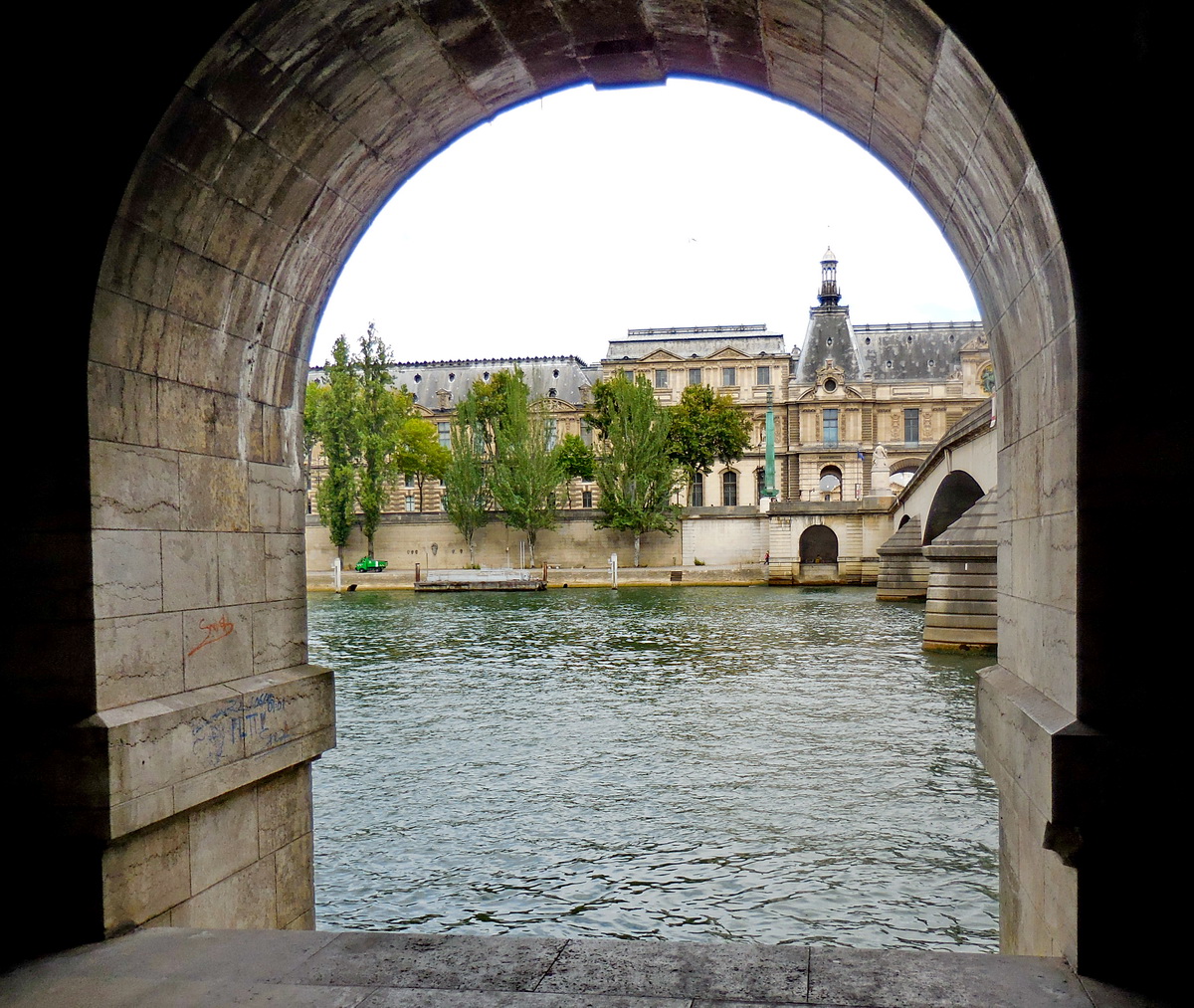
A view of the Louvre from the left bank of the Seine.


Once upon a time, years ago, we sat on this bench with our dear cat, General Burnside, and looked at the Louvre -- the same view as in the photo above this one -- in the rain.  The bench was unbroken then, and we were in the shelter of the Pont du Carrousel.  People on the tourist boats waved and smiled at the three of us.  The General passed away in September 2004 at the ripe old age of at least 21.  He was a rescue cat who adopted us; he was with us for fourteen years.  We think of him every time we pass this bench under the bridge.  That's why broken benches should be mended.  The memory is a happy one, not a broken one.

Thursday, September 17, 2015

There's always something to think about

September 17, 2015 -- Whenever I’m bored, which is almost never, all I need to do is look at Paris street signs.  They stimulte my curiosity.  Never ones to miss an opportunity to promote their culture, the French name their streets after artists, philosophers, politicians, poets, composers, musicians, novelists, historians, teachers, architects, engineers, and more.  Look around, and you’ll find one that will intrigue you.  Many of these signs tell you not only the name of the person for whom the thoroughfare is named, but also that person’s birth and death dates as well as occupation.

Swan near an archipelago of the Berges de la Seine.


Paris isn’t finished with naming thoroughfares.  The section of the Berge de Seine that we love the most is now named Promenade des Berges de la Seine André Gorz.  André was a philosopher, engineer, and journalist, born in the same year as my father (1923).  He passed away in 2007, a few years before my father died.

After seeing the sign, I wanted to know more about André.  Here’s what I learned.
Well, first of all, André Gorz isn’t his real name.  It is a nom de plume, as is Michel Bosquet, for a man who was really named Gerard Horst, who was actually born as Gerhart Hirsch.  Four names for one man!

For the sake of simplicity, I’ll call him André. 


He was an existentialist, but he was more the Sartre/Marxist type of existentialist, as compared to an existentialist like my husband Tom, who is more of Camus guy.

Philosophically, André was a part of the New Left movement which took on seriously leftist labor issues like a guaranteed income and distribution of work, even “liberation from work.”  I confess that I really don’t understand how an economy with “liberation from work” could possibly succeed.  But if we had dinner with André, maybe he could explain it.

André was born in Vienna, Austria.  His mother sent him to school in Switzerland to keep him out of Hitler’s army at the beginning of World War II.  He graduated with a degree in chemical engineering in 1945.

He must have been good with languages because he translated American short stories early in his career, around the same time that he became good friends with Jean Paul Sartre.  He began writing articles on philosophical topics and moved to Paris.  He got a real job working as a private secretary in the embassy for India.

I suppose it was to protect his real job that he started using pseudonyms like Michel Bosquet.  He began to write books, using his pseudonyms, and built his reputation as a theorist in the New Left movement which was inspired by Marx.  He thought of himself as a “revolutionary reformist.” 
In 1964, André and others founded Le Nouvel Observateur, a weekly that is now a prominent French news magazine.

Table where Tom and I sat on August 22 at Le Pario.  These chairs are comfortable!

He saw the riots of May 1968 as an affirmation of his leftist views.  He even wrote an article titled “Destroy the University,” which upset some of his colleagues.

But André continued publishing articles into the 2000s.  He and his wife Dorine did not die natural deaths; after learning that she had a terminal illness, they both committed suicide by injection in 2007.  How sad.

André’s second-to-last book, Lettre a D. Histoire d’un Amour (2006) was about his love for his wife.
I don’t see any obvious connection between André and the Berges de la Seine, but I like to imagine that he and Dorine loved to stroll along the quieter sections of the riverbank, hand-in-hand.  

[Source:  Wikipedia.com.]

Yesterday it rained, so the only stroll hand-in-hand that we were able to do was in the evening, when the rain stopped.  It was time to dine at Le Pario, Tom’s favorite Paris restaurant this year.  Le Pario is one of my top favorites, too.

Bread served at Le Pario is especially good.  And it comes
with a pat of butter!
After our stroll down the avenue Emile Zola, we were seated at a table by the window, and the server pointed out that it was next to the table where we dined last time we were at Le Pario.  That was August 22, too long ago for him to remember.  So these restaurants are keeping notes on loyal customers like us.  Hmmmmm.


We noticed that the British man at the table behind ours was the same man who sat near us at Axuria on Sunday.  He has good taste in restaurants.

The server brought us a lovely mis en bouche -- a little glass of warm, creamy-yet-frothy, garlicy soup – as we perused the menu. Tom selected a shrimp ravioli starter that came in a shrimp or lobster bisque, and I selected a pumpkin soup.  Both were gorgeous and delicious.

My main course was a ducking filet, which had been cut into chunks.  Le Pario’s Chef Eduardo seems to like cutting meat into chunks before serving.  The delicious duck was accompanied by a side dish of warm, rustic homemade applesauce.

Tom’s main course was a tourte of “viande de soleil,” which was really beef and pork, he said.  It was like a superb pot pie.  Tom loved the pastry crust of the tourte.

For dessert, we shared a brownie made with coconut.  The brownie was cut into three medallion-shaped chunks, and served with a few peach slices. 

It was an elegant and enjoyable dinner.  When the bill arrived, we noticed that the glass of white wine that I ordered, a Saint Véran, had been given for free.  Tom thanked the server.  The service and ambiance at Le Pario are top-notch.  And this particular dinner was good value.  Mostly, it was beautiful, and delicious.

A delightful beef and pork tourte at Le Pario.


The wind was picking up as we strolled home, and more rain fell during the night after we were safely tucked inside, listening to jazz piano music.

Wednesday, September 16, 2015

Meandering into the past for dinner

To walk from the 15th to the 6th is to take a walk back in time.  The 6th, while not the oldest part of Paris, is certainly very old – compared to the 15th.

When Paris was new, the 15th was just a patch of countryside, which eventually had a few villages named Vaugirard, Grenelle, and Javel.  The apartment we know so well in the 6th is 350 years older than the early twentieth century apartment that we now occupy in the 15th.

A tabac that serves dinners and lunches, in the 7th arrondissement.


Our dinner reservations were at Le Procope, one of the establishments that has a claim as the oldest restaurant in Paris.  It began in 1686 as a café operated by a Sicilian named Francesco Procopio Dei Coltelli.

Le Procope retains some of its old wallpaper, with a decorative motif representing La Republique Française and its core values of Liberté et EgalitéFraternité must have been added after the wallpaper’s 1830 date.
Our corner table in the dining room that looks like a library.


Antique furniture and charming décor abound in the various dining rooms of the sprawling Procope.  We’d dined in the elegant, high-ceilinged upstairs rooms in the past; this time, we were seated in an old room on the first level, just a few steps above the Cour du Commerce-Saint-André – an ancient cobblestoned shopping street, or should I say “alley.”  It is quaintly narrow, and its surface is extremely uneven.

The room where we dined was cozy and furnished as a library.  A “back door” onto the Cour allowed a few diners to slip in that way, and then make their way to the maître d’hotel stand on the other side, just off of the rue de l’Ancienne Comédie. 

We entered via that proper entrance on the rue de l’Ancienne Comedie and were warmly greeted and shown to our table – in the corner, with banquettes on two sides.  The server already knew that we prefer the menu in French, and that we’d dined at Le Procope in the past.  A gold tapered candle stood on our elegant table, and we were promptly given two complimentary kirs.  Tom noted that we were the only table in sight with a gold taper and kirs.

(Thanks to Lafourchette.com, we must be in Le Procope’s computer database.  We were using 2000 Yumms points from Lafourchette at Le Procope.  Yumms accumulate when you use Lafourchette.com regularly, as we do.  Using the Yumms subtracted 25 euros from our tab at the end of the dinner.)

We noticed that the menu at Le Procope has been shortened considerably since last year.  But this establishment’s signature dish, the coq au vin, is still offered, thank heavens; I’d been looking forward to it.  (Le Procope is now owned by Freres Blanc, a chain that has 13 restaurants/brasseries in Paris.)  Tom and I missed the older, longer menu with its plethora of traditional offerings.

The coq au vin arrives in a copper pot.


Tom ordered the three-course 38-euro prix fixe menu so we could share the starter and dessert.  It all began with six good escargots, and ended with a delicious, thin slice of Mirabelle (yellow plum) tart.

In the middle, I had a generous and flavorful coq qu vin, served in a copper casserole.  The coq au vin was everything it should be, with lots of thick, dark, rich sauce and mushrooms.  Fortunately, there was plenty of it;  I gave much to Tom because his steak, alas, was too chewy.

Our server was a young-to-middle-aged woman who seemed to be very familiar.  She must have served us before; she was professional and pleasant.
Coq so hot it steams up the camera lens.


After dinner, rain was predicted.  So instead of repeating our hour-long walk in reverse, we took the number 10 metro from the colorful and sprawling Odéon station back home to the Avenue Emile Zola station.  What a fast way to go!  We were home in minutes.  The rain came soon after, but by then we were listening to jazz piano music by Oscar Peterson.  

Tuesday, September 15, 2015

Paris: an international city

September 15, 2015 -- More and more, Paris is becoming an international city.  More and more, English is used to communicate with people from so many different lands who find themselves in the City of Light.

Signs with less-than-stellar translations into English are common; English is a difficult language.  However, well-funded public agencies in France should be able to come up with passable translations. 

The Pont de Bir Hakeim is named for a battle that took place in Libya in 1942.
Yesterday, Tom and I were stopped dead in our tracks by a sign posted in a construction zone around one of the entrances to the La Motte-Picquet metro station.  This is an important station because several metro lines come together here.  It is also the station that is near significant landmarks like UNESCO and the Eiffel Tower.

RATP, the agency that runs the metro, the trams, and the bus system in Paris, is state-owned.  It is a huge operation in the Île-de-France region, with 3 billion passengers per year.  But now it has grown even beyond the region; it operates transit systems elsewhere in Europe, Asia, Africa, and the Americas.

So RATP can afford to have top-notch translators.

Take a look at this sign:


The first sentence is translated into unintelligible gobbledygook.  The second sentence has a decent translation.  Did two different people translate the two different parts of one sign?   The first part of the sign is not particularly difficult to translate.  The translation should be, “Travelers who have a ticket should enter on the other side of the boulevard.” 

Munis de” isn’t too tough to translate.   Literally, it means “furnished with,” but it makes more sense to say “who have a.” 

Prendre l’acces de” literally means “to take the access from,” but it makes more sense to say “should enter on.”

The last part of this sentence’s translation was done properly; “l’autre côté du boulevard,” does mean “the other side of the boulevard.”  Oh, yes, the translation is also correct for “un titre de transport,” which simply means “ticket.”

I do not know if the Spanish translations are good.  Perhaps one of you dear readers could tell me.
For the English translations on this sign as a whole, we’d give RATP a C-.  Actually, Tom said he’d give RATP a textbook.
Tom's umbrella and scarf


I remember years ago when there was only a sign in French on the access at the other side of the boulevard.  Consequently, lots of foreigners (including us one time) would enter there, and then would have to exit and cross the boulevard to use the other entrance, where they could buy a ticket.  At least RATP is now making an attempt, however feeble, at communicating in other major languages.  

Still, on RATP’s report card, we’d comment, “Room for improvement.”

One of the places where RATP operates the rapid transit system in Africa is Algiers, Algeria.  We dined in Algeria last night – or as close as we can get to it in Paris.  That is to say that we dined at Le Tipaza, the restaurant on the rue Saint Charles which is named for a town on the coast of Algeria – a town known for its sandy beach.

We adore Le Tipaza.  The service is professional and friendly; the décor is beautiful, exotic, and uncrowded; and the food is high quality and excellent value. 

I wanted a lighter dinner because we’d had brunch at Eclectic earlier in the day, so I ordered the Grillade Royale (samplings of lean grilled lamb, beef, and merguez sausage) with homemade, healthy ratatouille, and then a light and refreshing homemade crème caramel for dessert.  Tom had a similar Grillade of grilled meats, including beef, and fries.  Then he had a magnificent order of profiteroles.  Oooh la la. (Photo below.)

The profiteroles at Le Tipaza.

Fortunately, we walked for a total of two and a half hours yesterday.
But I did also take the time to check out Heather Stimmler Hall’s most recent Secrets of Paris newsletter.  She included an article about what Parisians can do to help the Syrian and Iranian refugees.  A few of the refugees from the latest massive surge into Europe are starting to show up in Paris. 

We have not seen these refugees at all, but Heather has noticed a growth in the encampment of recent immigrants in the 13th arrondissement on the banks of the Seine.  That makes sense because the Grand Mosque of Paris is over that way; refugees would logically camp out where the support of the Mosque is nearby.

Heather points out that “In France, those without passports or visas are called ‘sans papiers’ (or Without Papers), not ‘illegal aliens.’  While they are waiting for their asylum requests to be processed, they are not allowed to work and must rely on the State and charitable organizations for everything including food, housing, and medical assistance.”  [I note that we use the term “undocumented” as well as “illegal aliens” in the U.S.; “undocumented” means the same as “sans papiers.”]

So it is important, initially, to support charitable organizations who help refugees who are not allowed to work, initially.   In her article, Heather lists charitable organizations who are helping in France.


Of course, soon there will be 10,000 more Syrian refugees in the U.S. (in addition to 1800 who are already in the U.S.), and they’ll need help, too.

One day in church on Sanibel a couple years ago, a man asked me about France’s role in the history of Syria.  I looked into the subject and wrote about it in my Paris Journal on September 11, 2013.  Upon re-reading it, I see why France should have a major role in providing refuge for Syrians.


Take a look, and see what you think.

Friday, September 11, 2015

In a different light

September 11, 2015 – Poetry is posted in the subway cars.  Not every car is so blessed, but the one we took home after dinner displayed this verse from the first act of Ciboulette, a 3-act operetta by Reynaldo Hahn:


Translation:

This sky too blue, these green trees,
These odors perfuming the breeze,
That puts my mind in a whirl . . .
Never have I laughed so well . . .
All that, it is due to Spring.

So what does Autumn bring to us?  More of the same, with a sky too blue, odors perfuming the breeze, leaves falling in a whirl, good times and lots of laughs with friends.

Six of us met at Jim and Maddy’s apartment in the 6th arrondissement for a drink before dinner.  We laughed, we talked nonstop, we even talked about politics with no arguments, even though we’re a politically diverse group.

We walked to dinner at La Bastide Odéon.  The restaurant is not nearly as good as it was a year ago, but still we enjoyed ourselves.  We must!  Life is short.

Left to right:  Jim Hanlon, Maddy Hanlon, Barbara Joy Cooley, Thomas
Cooley, Jim Burke, and Jackie Burke -- after the first course at La
Bastide Odéon.  We call this the annual "Sanibel East" dinner.

Before dinner, Tom and I walked around for an hour and a half.  We ducked into the indoor Marché Alimentaire at Saint Germain.  The familiar market was very quiet, perhaps because the adjacent boutiques/shopping center were completely closed up for renovations.  Or perhaps it is the economy; the Marché, while wonderful, is pricey.
The Saint Sulpice church.


We walked around to the front of the Saint Sulpice church, to the square.  I miss being near that church in September.  I would get up on Sundays and go to the end of mass, and the organ recital afterwards, when we were staying in the apartment where Maddy and Jim are now.  That great, hulking, somber church and its magnificent organ are unmatched.

But oddly, when we walked through the nearby Luxembourg Gardens, I didn’t have the feeling that I’d missed that park at all.  In fact, I was reminded of the feeling I often have in mid-September:  a feeling that it is just about time to go home to lovely Sanibel Island.  The Luxembourg Gardens are stunningly beautiful, but maybe a little too crowded at this time of year.

The same angle of sunlight that makes the shadows longer now in the Luxembourg Gardens is what makes our apartment in the 15th sunnier than ever.  The sun, resting a little lower in the sky, now shoots its rays directly through the French doors, with gusto, all afternoon.

View of the Senat building from the Luxembourg Gardens.
When we were in the gardens, we stepped into the Orangerie to check out the current exhibitions.  One was a black-and-white photo exhibition featuring images of people who returned to Paris in 1945 as World War II ended.  Most of these were soldiers who had been prisoners of war.  DeGaulle was also featured; and so were notable people like Leon Blum, who had a special type of confinement in a house on the edge of the camp at Buchenwald.

There were very few photos of Jewish concentration camp victims returning to Paris, although there were photos of their family members anxiously checking the postings on the bulletin board at the Hotel Lutece.

There were also photos of American soldiers who had been to the concentration camps, to free the people imprisoned there.   I was thinking that if my uncle George had not been shot by a sniper near Nancy, he might have been one of those young men who witnessed the end of that crime against humanity.

The other exhibition sharing the Orangerie space could not have been more different from the returnees photos.  It was a collection of color photographs of historic French country houses – farm houses, mostly – taken by kids.


We continued our walk through the gardens, and when we reached the gate at the south end of the park, we exited and walked through the two parks to the south, all the way to the fountain of the four corners of the earth.

These two little parks were loaded with squealing, running, energized, laughing children.  Fecundity was on display.  There were so many kids!

When we re-entered the Luxembourg Gardens, they seemed calm by comparison.  We walked to the elegant Medici fountain, found ourselves a couple of metal chairs, and meditated as we gazed into the water and watched ducks.  These birds were racing to and fro, in optimistic anticipation of bread crumbs tossed by humans.

We’ll probably go back to the Luxembourg Gardens on Sunday afternoon, weather permitting, for a free concert by the Jazzific jazz band.

Until then, we'll enjoy the good life in the 15th!
The four corners of the earth fountain.

Wednesday, September 09, 2015

Back in Little Teheran Again

September 9, 2015 – Last Friday evening, we invited our friends Ron and Elisabeth from the 6th arrondissement and Jim and Maddy from Sanibel (who are staying in the 6th arrondissement) over to our place for a glass of champagne, then the six of us walked around the corner to dine at Le Café Du Commerce.  The conversation was lively and we had a good time.  The four of them had arrived together in a taxi, and they left together in an Uber car.  Their Uber experience was a good one, and the cost was less than half the taxi fare.

The metro would have been even less, but for anyone with mobility issues, it is nearly impossible.  The metro involves taking lots of stairs and walking some distance.
The firehouse (caserne de pompiers) at 6 Place Violet, as seen through the Parc Violet on the rue de l'Eglise.
This building had been the home of the entrepreneur and developer of the Beaugrenelle quarter.  It was built in the
Neo-Palladian style in 1824, and is now on the national historic register.


Jim and Maddy had lived in Iran for a few years in the 1970s just before the revolution because Jim was employed by a big accounting firm that sent him there.  The experience of living there was good for them, but the experience of having to leave under the circumstances at the time was harrowing. 

They were interested in what I’d written about “Little Teheran” here in the 15th , so I let them know that after our positive experience of dining at Guylas on the rue des Entrepreneurs, I’d made a Lafourchette.com reservation for Perchiana, on the rue Mademoiselle, last night.  They decided that they’d like to join us, so they made a Lafourchette.com reservation, too.

Perchiana was very small, so much so that we said “bonsoir” to others who entered.  This included a couple of mature men who sat in a corner nearby, and a young man who sat at a table right next to Tom and me.

Inevitably, at the end of the dinner, we all were involved in a conversation.  The two mature men – one middle aged, one older – were originally from Teheran, and the young man’s parents were from there as well.  The young man mostly listened, interjecting comments only a couple times as he ate his dinner and charged his cell phone. 

The mature men, however, really wanted to talk – especially when they realized Jim and Maddy had lived in Iran.  We spoke in French and sometimes in English.  Most of the exchange was between Jim and the middle-aged man who, I believe, said he had a family in the U.S. and had received his Ph.D. in the U.S.  Both of the men had been professors; the older one had been at the university in Teheran.


At some point well into our conversation, the middle-aged Iranian man was very complimentary of the Obama administration’s negotiation of the nuclear deal with Iran.  Tom and I said, “Thank you!” quite emphatically to the man, and then we both turned immediately to Jim and said, “Sorry Jim.”  If we hadn’t done that, I think the Iranian men would have assumed we all supported President Obama on this issue, when in reality only half of us did (just like the U.S. voting population). 

The men repeatedly said that there is a lot of pro-American sentiment in Iran; several times they jokingly referred to Iran as the 53rd state of the U.S.  (I guess 51 and 52 must be Puerto Rico and the U.S. Virgin Islands?)

The food we were served was good, but the starter courses were awkwardly served with no rice;  both of them were sauces.  On the main plates, the grilled brochettes were very similar to what we’d had at Guylas.  We should have asked for all the dishes to be brought to the table all together.  Jim said the separate starter-main course arrangement just doesn’t make sense with Persian food.

At the end of that fascinating dinner, we all said goodbye to each other, and Tom and I walked with Jim and Maddy to the bus stop nearby.  They had arrived by bus, as well; they’d discovered that the number 70 bus goes right from the Place Saint Sulpice in the 6th  to the street in front of Perchiana in the 15th.  How convenient!


Now that was a bonne soirrée!

Monday, September 07, 2015

Diving for dinners

September 7, 2015 -- Dumpster diving for food –we’ve seen it on a number of occasions in recent years, but we hadn’t seen it this year in Paris, until we were on our way home from a few hours of walking in the afternoon yesterday.  Near the Cuban Embassy and the Place Dupleix, we saw a man sorting through the green poubelles in an orderly fashion, slowly filling his large fabric shopping bag.  He wanted the food others had rejected.
Yesterday was a beautiful day to walk in Paris.


In a way, this is a long-observed tradition in France.  The very origin of classic French foods like andouillette, tete de veau, kidneys, livers, pig’s feet, etc., is the fact that the poorer people got the unwanted parts of the animals, the parts that were left over after the richer people got the steaks, roasts and chops. 
French people are clever and talented when it comes to food.  Long ago, they learned to use the less desirable parts of the animals to make classic comfort foods.  They used the rejects to make wonderful dishes.
We discussed this over dinner, as Tom dined on fine lamb chops and I was very pleased to have an excellent tete et lange de veau (calf’s head and tongue) at Pere Claude.  It was a fine Sunday dinner over which we talked about dumpster diving and other matters.  Tom told me about the textbook chapter he just finished writing; I told Tom what I’d learned about a new French regulation dealing with food waste.
In May, the French national assembly passed a law to forbid supermarkets from deliberately ruining food that it puts out in dumpsters.  Some supermarkets were evidently pouring bleach on this food so that the dumpster divers could not use it.  Ostensibly, the supermarkets were preventing people from being poisoned by spoiled food; but one could also argue that the supermarkets were preventing poor people from getting free food, forcing them to buy food instead – or go hungry.
Bridal photo shoot on the rue de l'Universite.
Those supermarkets made hungry people feel like they were wrong to want this food.  Now, we thought, the tables have been turned; the national assembly made it clear that those supermarkets were in the wrong.
Now the supermarkets larger than 400 square meters could not legally destroy unsold food; instead, these businesses must have a contract with a charity to give the food away.  They must try to give the food away in an orderly fashion.  I believe this is commonly done by U.S. supermarkets.

Unfortunately, on August 15, the new law was scrapped due to a technicality since it was passed as an amendment to another law.  Still, some major supermarket chains vow that they will sign contracts with charities voluntarily.  And there is a new law that may be introduced in the French parliament.
Besides the charities, there is a “foraging movement” in France.  Activists wear gloves to retrieve food from dumpsters, then sort it and give it to people who need it.  Some of these activists are worried that people will think a new law is a “silver bullet” for solving the problem of supermarket food waste.  They see a bigger problem involving overproduction and distribution.
In a way, they’re right.  According to government estimates,  most of the food wasted in France (67%) is thrown out by consumers.  Only 15 percent of it comes from restaurants and 11 percent from stores.  The cost of all this wasted food?  20 billion euros.
The Champ de Mars.
After the passage of the French law in May, one of its champions proceeded to then pressure the European parliament to adopt a resolution that would be similar.  This champion’s name is Arash Derambarsh.
Derambarsh was born in Paris, but his parents were Iranians who fled from the revolution. For some reason, they went back to Iran a few months after his birth in 1979, so he lived in Iran until 1983.  He considers himself to be franco-persian, but he is of French nationality.  His dad, a filmmaker, and his uncle, a cartoonist, encouraged Derambarsh’s interest in politics and social justice.  So he became a lawyer, and he has been one of those people who put on gloves, dove the dumpsters or foraged in the poubelles, and gave the food to the poor.  The illegality of this act is what propelled Derambarsh to work towards changing the law.
I wish him well in his efforts to help feed the world.  But in addition to endeavors by champions like Derambarsh, we must work to reduce the amount of food wasted in our homes.  If the statistics in the U.S. are anything like the ones in France, an enormous amount of food is being wasted at home and abroad.
Think about it every time you go to the grocery.

Sources: