Showing posts with label O Fil Rouge. Show all posts

Thursday, September 12, 2019

Not a serious hunt

Exquisite doorway on Rue de la Convention, featuring a fine cat.
One day, as I passed through our building's porte cochere, I snapped up the last copy of the 15th arrondissement town hall's magazine.  From this periodical, I learn so much about daily life here.  Here are some snippets of news in the 15th:

The first "Workshop for the Future Papa" was a beautiful success so it is being offered again at the town hall.  Thirty some young men participated in the first workshop, which included modules on watchful communication, risk prevention, practical exercises (changing diapers, care, bathing, hygiene), advice, and counseling.  New sessions are scheduled for late September and mid-November.  [Imagine local government offering such workshops for young men in southwest Florida?]
Quail pastilla, potatoes and a couple bits of foie gras
at O Fil Rouge on the Rue Saint Charles.

The Family Festival is coming up on the 21st of September on the plaza in front of the town hall and in Square Adolphe Chérioux.  The numerous attractions and activities will include a mini-farm and the presence of the humanoid robots, Pepper and Nao.  There will also be a children's clothing and baby things market consisting of 600 booths or tables.

More than 300 nursery/daycare places are opening from the end of 2019 to the beginning of 2020 in various places throughout the arrondissement.

For the European Day of Languages, the 15th is offering a Kidilangues program for kids -- a program that goes beyond what's taught in language courses in the schools.

If you get the idea that much of the 15th arrondissement's concerns center around the family, you get it.  Now that summer vacations are over, all the Parisians and their baby strollers are back -- everywhere!

Maybe not so much in restaurants.  We do see a few baby strollers and tots in the cafés, but not that many.

Filet de bar (sea bass) at O Fil Rouge.
On Tuesday evening, we dined at O Fil Rouge and had a delightful time there.  I had Chef Fakhour's quail pastilla again, and Tom had the sea bass filet and veggies.  Desserts were a millefeuille and a chocolate lava cake; both delicious.  All portions were small, which is good.

Yesterday, we abandoned the computers to go in search of bookplates -- we need 17 of them for Tom to sign, so the publisher can affix them to new copies of Back to the Lake which are being sent to people who gave input for or helped to sell the new edition.

We have some bookplates that will do, but we thought that surely in Paris, we could find something special.  Tom had already gone in search of bookplates on Tuesday; I suggested he try a large stationery store (papeterie) that is near the École Militaire.  He went there, and to another papeterie as well as a bookshop near us, on the Avenue Emile Zola.  But bookplates were not to be found.  I decided to join him yesterday.

Please understand that this is not a serious hunt; it is just an excuse to go out on an adventure.  It is a game.
Decor at the Gloriette brasserie on Rue Saint Charles
and Rue de la Convention
Our first destination yesterday was Le Divan -- a big bookstore smack in the middle of the 15th arrondissement on the Rue de la Convention.  We'd visited it briefly several years ago.  Last year, I read that Le Divan had undergone a complete renovation.  So we were planning to revisit it sometime this summer anyway, just to check out the improvements.

I perused medieval history books while Tom asked the cashier about bookplates, or ex libris etiquettes, in French.  The young man had no idea what these were.  This was not a language or communication problem; he really had not seen bookplates before.  We admit, bookplates are old fashioned.
Gloriette brasserie, above and below.


Needless to say, Le Divan did not have bookplates.  But it does have lots of books, in a very inviting and well-lit shopping environment.

We continued westward on Rue de la Convention.  I spotted a papeterie that was crammed full of merchandise -- basically, office supplies.  It was difficult to move in that shop, so Tom asked the lady at the counter.  Even plain labels with a simple border -- like the kind we use for cheap nametags at gatherings back in th U.S. -- would do nicely, but these were not to be found.

The lady called her son up front to help.  He spoke a Pakistani version of English, but even in English, bookplates are not recognized as common stationery store merchandise.

Table is almost full and lunch hasn't begun, at Glorietta.

We continued on to Office Depot.  We've been customers of a few Office Depots in Paris over the years, and I think every time the experience is identical.  Customer service at Parisian Office Depots is nonexistent.  We searched, and of course all we could find were slightly oversized, plain white mailing labels.  These will do in a pinch, but we can also buy them at the stationery store near us, where the cashier is like a rooted turnip behind the counter, but at least she is there, is basically polite, and responds to questions.

Office Depot marked the end of the hunt.  Time to eat lunch!  The Gloriette brasserie, which I have been wanting to try, was just another block or two westward on Convention, at the corner of Rue Saint Charles.
Bakery on Rue du Theatre, where Lionel Naulleau displays
a poster featuring his well-deserved awards.  Lionel is 32, and he
works 17 hours a day, six days a week.  He takes one 3-week
vacation every year.  His mom helps by working in the front of the shop.
We were cheerfully greeted and seated at a nice little table in the dining room.  Tom had a chicken burger and fries, and I ordered the sea bass filet this time.  It came atop of delicious pile of veggies cut in the form of tagliatelle pasta -- but it was all veggies, no pasta or potatoes.  I loved it.  The dining room was whimsically decorated in twisting vines dotted with fluffy white flowers.  So French!
The other front window of Lionel's bakery.  The big
white things are large meringues!

On the way home, we bought the plain white oversized mailing labels at the papeterie near home.  Later, we ventured out for another short walk to the picturesque square at Rue du Theatre and Rue Saint Charles.  We stopped for bread at the bakery on Rue du Theatre, which recently re-opened after a long vacation.  The patron, Lionel Naulleau, has won another award for his baking, and he had a big poster board featuring this honor inside the front window.  We bought bread and a slice of Provençale quiche, and congratulated him on  the award, which is much deserved.

So dinner was just a bit of quiche and a very small side salad.  We opened the French doors and let last of the day's sun pour into the dining room.

Our evening entertainment is reading.  I just finished Cara Black's 9th book in the Aimee Leduc mystery series.  All of these books in the series take place in Paris and are crammed full of information about Paris.


Wednesday, July 10, 2019

The Red Thread -- making the disparate into one

O Fil Rouge is getting high ratings in Lafourchette.com.  I'm not surprised.  It is one of our favorite restaurants.

Last night we dined there on Chateaubriand and foie gras (Tom), a pastilla and foie gras (me), and pain perdu with a memorably rich caramel sauce (shared).  

I've lost track of how many years O Fil Rouge (the red thread) has been in business, but I remember when the place was newly opened on Rue Saint Charles, just a 20 minute stroll from our apartment.  I admired the restaurant's clever decorating that was clearly done on a tight budget.

Each year since then we noticed improvements in the decor.  Now the lighting and colors have softened to perfection, and the place has a look of clean elegance.  The decorating budget has expanded along with the restaurant's continuing success.

O Fil Rouge is looking good!

Pascal Perotto is the manager and maitre d' for this lovely and comfortable restaurant.  He is always welcoming, and he remembers his regular customers well.  The chef, Adil Fakhour, specializes in the cuisine of the south of France, with a hint of North Africa.  His recipe for his pastilla is a secret, according to the restaurant's web site.  

I think that pastilla is wonderful.  Because the menu changes with the season, the pastilla is not always on it.  But last night it was, and so I ordered it with enthusiasm.

Wikipedia says a pastilla is "is an elaborate meat pie traditionally made of squab (fledgling pigeons). As squabs are often hard to get, shredded chicken is more often used today; pastilla can also use fish or offal as a filling. Pastilla is generally served as a starter at the beginning of special meals."

The pastilla at O Fil Rouge, on the Rue Saint Charles.

In the case of last night's pastilla, it was the main course, and the pastry was two thin-as-can-be crispy
rounds with flavorful, marinated, shredded quail from Landes, a region in the southwest of France.  In Landes, quail are raised on farms and are marketed with a "red label" mark of quality.

Pastillas are considered to be a Moroccan dish, mainly, so here Philippe is combining the southern French with his North African cultural influences.

The pastilla was accompanied by small round potato halves, roasted to perfection, topped by a couple small pieces of melt-in-your-mouth foie gras entier.

There was a soothing, savory sweetness in the pastilla's filling; this is effective and soothing comfort food.

This restaurant is one of the few places in France that we trust for steak.  So Tom ordered the Chateaubriand, a big, tender chunk of flavorful beef, served with a big piece of that delicious foie gras entier, and the same kind of potatoes that arrived with my dish.  The steak was cooked perfectly to Tom's liking.

Chateaubriand Rossini at O Fil Rouge.

When we go to O Fil Rouge, we almost always order a pain perdu (lost bread; like French toast) to share; we love it for that caramel sauce.

Brioche façon pain perdu at O Fil Rouge.

The menu at O Fil Rougee is also
available in English (but we prefer French).
Why the name O Fil Rouge?  According to expressio.fr, in French this is an expression that means, "Thread of an enigma, a game; Guiding idea, something that gives coherence to a disparate whole. A repetitive element, a point of reference that comes up regularly in a discussion, a story, a presentation."

At this restaurant, I think the name applies in the way that the chef has a bit of a common theme, a taste of Morocco, woven through his thoroughly French cuisine.

The origin of the expression may have come from Goethe's early 19th-Century description of how a red thread was woven into ropes used in the royal fleets.  That red thread could not be pulled out without undoing the entire rope.  So, according to expressio.fr, this thread not only identified ownership of the rope, but also was "something whose absence made it unusable."

A similar expression that we would use is "a common thread,"  such as a common thread in a set of stories or chapters, one that holds the narrative together.

And so it goes . . . .

Saturday, July 14, 2018

Quatorze Juillet with the Cooleys

July 14, 2018 -- Quatorze Juillet, which Americans refer to as Bastille Day, begins quietly, at home.  Like many Parisians, we laze about the apartment and watch the military parade on TV.  In fact, this is our biggest TV day of the year, because we also watch the Tour de France in the afternoon, and in the evening we will watch the big concert and fireworks show -- all on French national television.  Then the rest of the year, we pretty much watch no television whatsoever (not counting Netflix on my tablet).
A modern twist on a traditional Moroccan dish called a Pastilla, at O Fil Rouge on the rue St. Charles.

Since I'm home all day today, I'm doing a couple loads of laundry.  French washing machines take a long time to wash a load.   Dryers take a long time, too.  This one has a reservoir that fills with water which must be emptied after each load.  The dryer doesn't vent.

That sounds dull, but the concert and fireworks show are not dull at all.  Tom and I don't do crowds anymore, and besides, we've discovered, the only way to see the entirety of the huge fireworks show is on TV -- with all the helicopter views all around.  Dan will go out and mix with the masses, however.

Last night we dined out at O Fil Rouge on the rue St. Charles.  With a 20 percent discount (on food, not drinks) thanks to lafourchette.com (thefork.com), we splurged on a Chateaubriand steak for Dan.  I had a Moroccan dish called a pastilla, stuffed with tender, savory braised lamb.  It was accompanied by heavenly puréed sweet potatoes.   Tom had a large veal chop.  The guys also got puréed potatoes with a generous sprinkling of chives.

For dessert, we shared one order of O Fil Rouge's famous pain perdu in a pool of rich caramel sauce.

Service was warm and friendly.  We were remembered as the Floridians that we are (well, at least Tom and I are).  The restaurant was full people and is showing signs of success.  Each year something about the decor is changed, making the place a bit more sumptuous and chic, looking a little less like someone clever decorated on a tight budget.
Chateaubriand topped with foie gras, with puréed potatoes and chives.

Three nights ago we also had a nice dinner, this one at l'Alchimie.  This is the first time Dan has treated us to dinner!  Dan and I each had a perfectly cooked fish filet that was rolled in a tube which was filled with a minced mushroom stuffing.  The concoction sat atop a small bed of tasty polenta.

Tom had a pluma de negra, which is a special, tender cut of pork.  We shared a couple servings of moelleaux au chocolat.  Lovely dinner!

In each of these restaurants, we were the only non-French people.  And that's the way we like it.

Thursday, August 17, 2017

Twenty miles of Paris

La Fontaine de l'Obsevatoire, also called the Fountain of the Four Corners of the Earth

August 17, 2017 – The vegetated wall on the riverfront side of the Musée du Quai Branly – Jacques Chirac is something to see in Paris, even now during its state of deconstruction.  Unfortunately, many of the double-glazed windows on that wall are blown, necessitating their replacement and some reconstruction of the wall.  So, the museum is taking the opportunity to do some renovation of the structure that supports the plants on the outside of that wall; as long as the space is blocked off for construction, might as well do everything at once. 

Vegetated wall on the Quai Branly under reconstruction.


Tom and I took a diversion from our normal path through the Branly garden to the Seine.  We walked along the Quai Branly to see the wall of plants.  Only a section of it still has plants; the rest has been unplanted, and the work on the wall is in process.  There were many panels on the construction fence that explained the ongoing work.  I photographed them so I could sit down and translate them later, in the peace and quiet of the apartment.

I just did that this morning, so I’ll share my translation with you (below).  It wasn’t easy.

A peaceful presence along the Seine, the wall of vegetation is becoming an emblem of the museum, a strong part of its identity as well as a remarkable element of Paris’ heritage.  Under the watchful look of the Eiffel Tower, its image circulates in the media or on the social networks.  Across it plays as well the dialogue of cultures that the museum strives to defend and perpetrate.

A new life for the vegetated wall

Conceived by the botanical researcher Patrick Blanc, the vegetated wall has been since 2004 a strong attribute of identity of the Musée du Quai Branly – Jacques Chirac.  In language of French symbolization, the establishment is represented by its vegetated wall.
An echo of the collections of the museum and its programs, the vegetated wall carries the universal message of the museum and contributes to sustainable urban development.
Significant works are today undertaken to technically reinforce the building and increase its longevity.  A newly planted creation is coming thanks to the work, replanting part of the plants of the previous wall.

An ode to the continents
The vegetated wall is a living organism.  It is our equal.  Each day, the 22,800 plants that compose it are in dialogue with man:  visitors to the museum, residents of the neighborhood, tourists, citizens of the Paris region passing by the building.  Thanks to the work undertaken, this dialogue that is conducive to inspiration and escape will continue for a long time.
Celebration of the African, Oceanic, American and Asiatique continents, the new wall will hold 376 species from the entire world.  Coming from many of the mountains (Moroccan Atlas, South African Drakensberg, Himalaya, mountains of Chili and Argentina . . .), the plants are notably chosen for their capacity to adapt to the climatic conditions of Western Europe.  Numerous plants from the former wall will be preserved and re-planted in the new wall:  Bromeliads, Corydalis . . . .

At the vertical


The technique of the vegetated wall consists of a superimposition of three elements:  A mineral wool insulation complex and a fixed steel mesh on a metal structure, a ten-millimeter expanded PVC foil, and a three-millimeter polyamide felt made of recycled old clothes.   This felt has a strong capacity for capillary action and retention of water, enabling the development of the roots of the plants. The watering, controlled by the electrovannes, is done via the drippers situated on the irrigation lines installed at different heights on the wall.

An eco-responsible project

Reservoir of biodiversity and of urban ecology, the vegetated wall contributes to the preservation and the reinforcement of nature in Paris.  Its contribution to the quality of the air is clear:  thanks to photosynthesis and to micro-organisms living in the roots, the plants exert a purification in the urban setting – absorption of gas, fine particles, and other elements tied to pollution.  The cushion of air separating the supporting structure from the building also makes excellent natural insulation, on a vast surface, reducing the need for air conditioning in the summer and the necessity for heating during the winter.  The work on the future wall will permit the perfection of the watering system as well to reduce the consumption of water.

The improvements made
Mother Nature's attempt at a vegetated wall on the
floodwall of the Seine.

The principal work consists of resizing the metal structure.  The fixation method for the PVC layers will be modified, to facilitate the maintenance and the work on the wall, augmenting the number of points of fixation.  A support grid for the plants (wire mesh of galvanized stainless steel) will be fixed partway up the wall, in a manner for reinforcing the ensemble of the structure against the effects of the wind.  The joints between the PVC layers will be filled to prevent any infiltration from the back of the complex.  The insulation will finally be thickened to improve thermal performance.

The Campaign “Build the Wall!”

Thanks to the generosity of the public, the campaign for participatory financing organized from May 15 to July 15, 2017, has permitted the museum to finance a third of the costs of the planting of the wall (introducing new species).  The Musée du Quai Branly – Jacques Chirac warmly thanks, once again, the donors and the patrons for their contributions to the project.  Thanks to their support, the wall will continue to live long years, with sweetness, beauty, luxuriance, and a positive impact on the environment.

A timeline on the fence  indicates that the work began in July (last month) and will be completed in May 2018.
The Berges de Seine, complete with beach chairs and palm trees (no, this is not Paris Plage).

We continued our normal walk along the Berges de Seine, spotting a plant here and there that Mother Nature was trying to install on the floodwall.  Tom loves the presence of a few palm trees along that stretch of the river.  They remind him of home, of course.

In the short span where we had to ascend to the street (at the eastern end of the Musée D’Orsay), we decided to cross the quay and dine at Le Fregate, a fine brasserie at the corner of the rue de Bac.  We’ve dined there several times in the past. 

I remembered a classic French blanquette de veau that I had there one Sunday afternoon.  Since it was Tuesday, August 15 – a big holiday – I thought the blanquette de veau just might be on the menu again.  It was!  I ordered it, and found it to be a lighter, healthier version of the dish I remember from that Sunday years ago.  Tom just had dessert – a café gourmand and apple pie.

The brasserie is as beautiful as ever, and the service was warm and professional.  

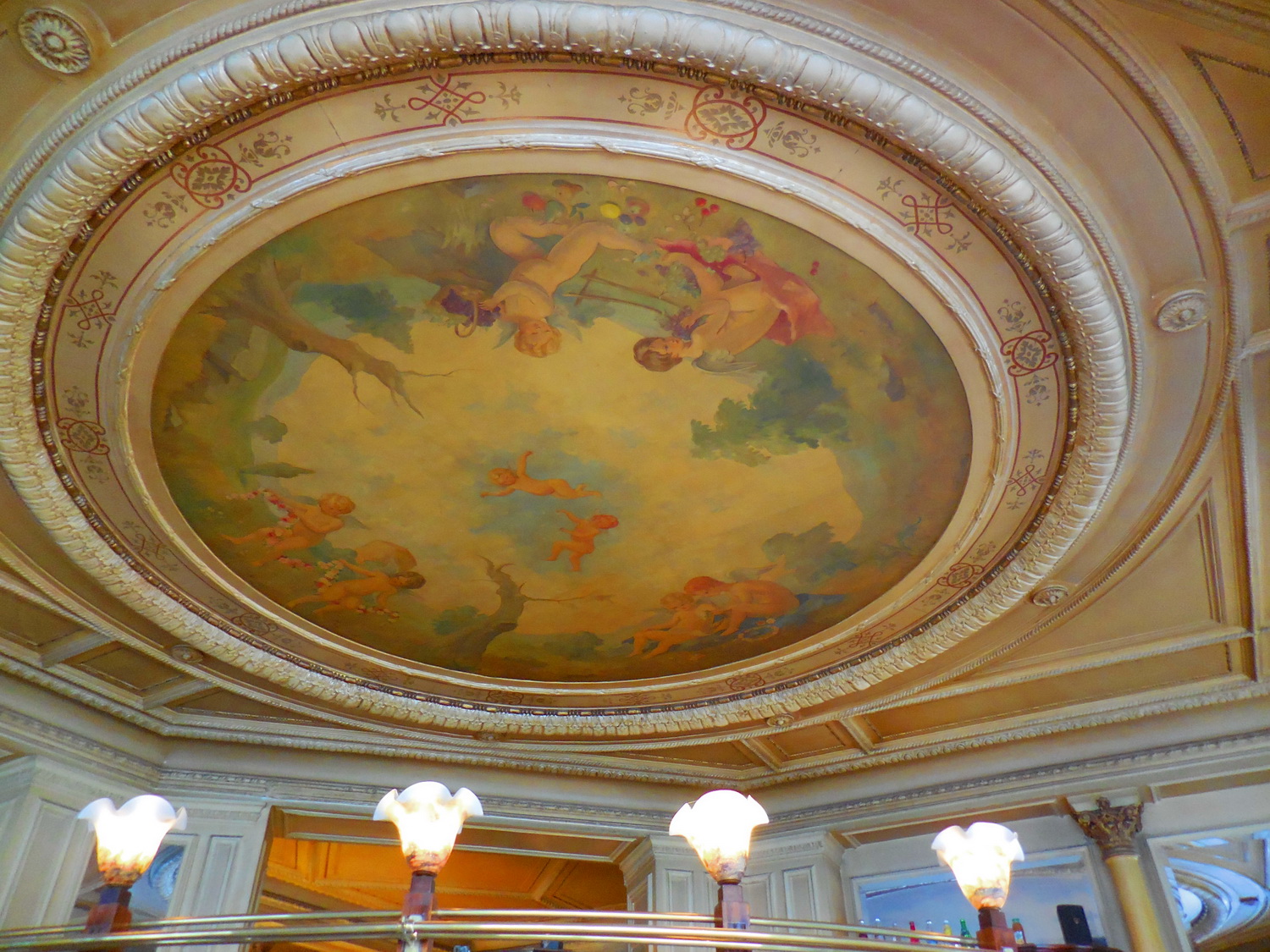
Ceiling at Le Fregate, on the rue de Bac.

After that lunch, we walked on to the Saint-Germain-des-Pres neighborhood.  Right there, on the corner by the church of Saint-Germain-des-Pres, we saw the musicians of the group La Planche a Dixie performing, just as we’ve seen them there on many Sundays in the past.  The leader of the group, Christian Giovanardi, is a drummer and washboard player, like Tom.  Out on the street, Christian is playing the washboard, of course, not the drums.

We stopped and listened for a while.  I noticed that Christian is a very good washboard player, but my husband Tom is better.  Tom thinks it is terribly funny that the playing the washboard is something he does so very well.  Why couldn’t it have been the violin, he thinks.

La Planche a Dixie plays on boulevard Saint Germain, and sells CDs.
We already own all four of the group's CDs.

Percussionist Christian Giovanardi plays the washboard.

After a stroll through part of the Luxembourg Gardens, we left that green expanse via the rue de Fleurus, where Gertrude Stein once lived.  Making our way back up the boulevard Raspail, we were able to catch the number 10 metro at Sevres-Babylone to go home in time to rest up for our traditional holiday dinner at Le Tipaza.

We found ourselves on rue de Sevres once again yesterday.  We stopped in Bon Marché to look around the place and to see if the store might have a scarf that I’d like.  We didn’t find the right scarf, but we picked up a couple decorating ideas and admired some of the two buildings’ finely restored features.  Work is still going on in parts of the two structures.
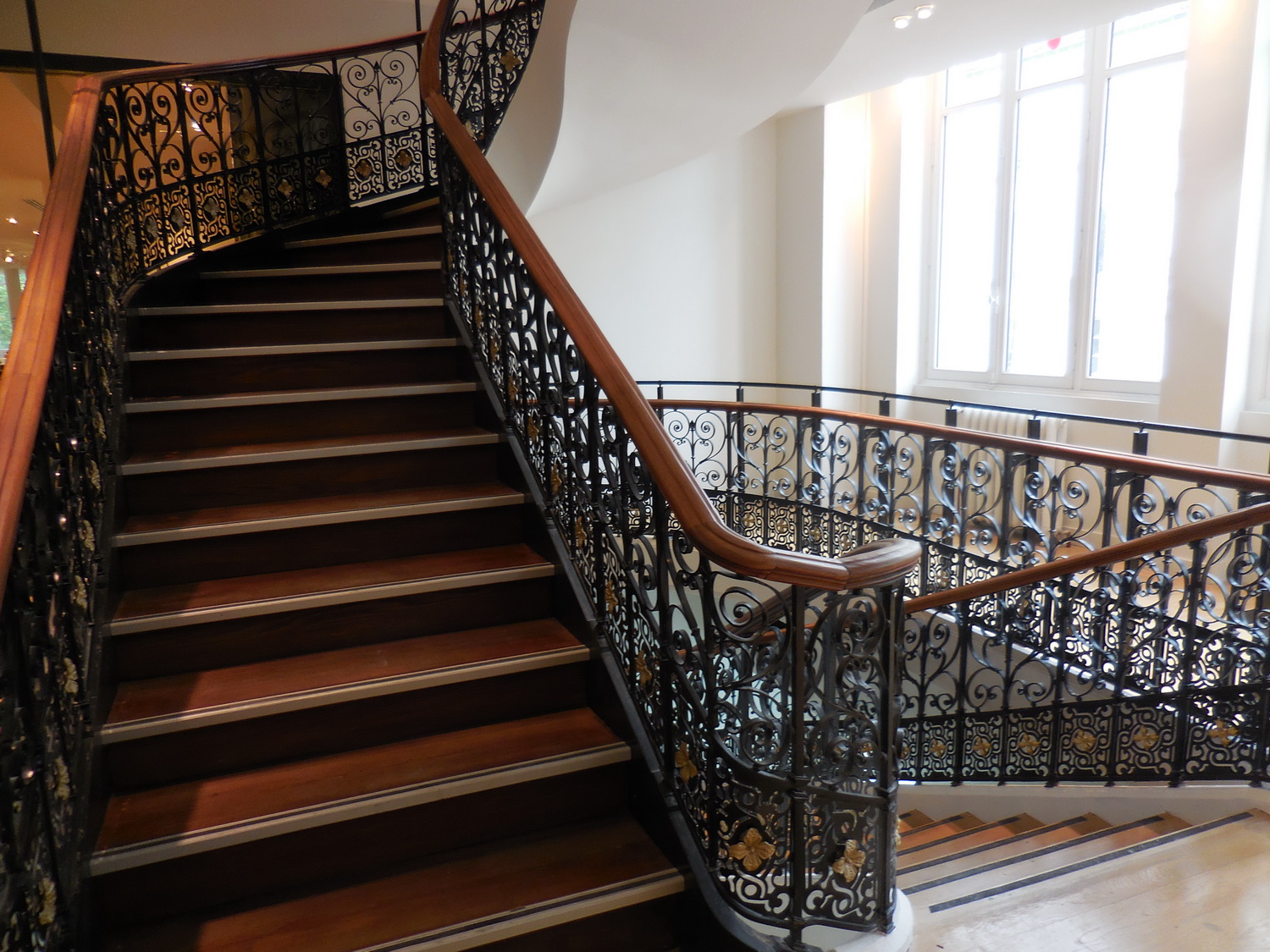
Stairways and escalators in Bon Marche.


A long lunch at Les Mouettes, on the rue de Bac near Bon Marché, restored our energy.  It was the quiche of the day for me, and café gourmand again for Tom (coffee and an assortment of three small desserts – fruit, chocolate mousse, and crème brulée) – a very nice lunch indeed!

Quiche of the day at Les Mouettes -- a savory ham and mushroom.

We strolled over to the Place Saint Sulpice, whose fountain was looking lovely on such a beautiful day.  We toured the inside of the church for what seemed like the thousandth time.  Then it was time to stroll through the Luxembourg Gardens again. 

Included in that stroll were the two gardens south of the Luxembourg.  At the end of that stretch is the magnificent fountain of the four corners of the earth.  Two great fountains in one day! 
The church and the fountain on Place Saint Sulpice.


We ambled along the boulevard Montparnasse, admiring beautiful and famous brasseries like Le Dome and Le Coupole, as well as funky shops like a costume store that posted masks of political figures on its window.  Can you name them all?  (Double-click on the photo to enlarge it.)
Masks

Each of these walks – Tuesday’s and Wednesday’s – were about 10 miles long.

Last night, we dined at one of our favorite restaurants, O Fil Rouge, on the rue St. Charles.  The owners and chef have re-opened after an invigorating vacation.  New items are on the menu.  We ordered one of them, duck breast ravioli, as a shared starter.  Then Tom had a delicious steak and fries, and I was back to my usual fish-and-vegetables habit.  But oh, what a special dish this was:  perfectly cooked red tuna on tasty veggies with just a bit of buttery sauce – all topped by a slice of foie gras entier.  The dish practically exploded with flavor.

We shared O Fil Rouge’s unforgettable pain perdu for dessert -- rich, warm, and seductive – just like the summer evening in Paris.

O Fil Rouge's red tuna, "Rossini" fashion.


Monday, July 17, 2017

A weekend of walking through Paris

Parc Monceau
July 17, 2017 – The lines 6 and 2 of the Paris metro when put together, form a perfect oval around the heart of the city.  Line 6 offers a great view in its southwestern stretch, where it is an elevated train over a part of Paris that was a swamp, a long time ago. 

On Saturday, we took the 6 to Etoile, where we switched to the 2 and disembarked at Monceau, the beautiful park created in 1861 in the northern part of the 8th arrondissement – one of the chic residential areas of Paris.

After a long, leisurely stroll through the park, which was being heavily appreciated by many families on that gorgeous weekend, we paused to stare at the magnificent mansion just on the edge of the park, at 5 rue Van Dyck.  Where does the money come from to build a house like this?

Peering through the gate at the side of the mansion at 5 rue Van Dyk

In this case, it came from chocolate.  Jean-Antoine Menier, a chocolate maker from the Seine et Marne area, made medications based on chocolate in the 1800s.  In 1836, he created the first chocolate bar (tablette de chocolat).  It was wrapped in yellow paper.

His son, Emile-Justin Menier, took the helm and received a gold medal for “pharmaceutical products” at the Universal Exposition.  Emile successfully expanded the business, buying 1500 hectares in Nicaragua so he could mitigate the fluctuations of the cacao market.  He had a new mill built to modernize his factory in the Seine et Marne area.  The mill was unusual and beautiful:  a metal structure with a multi-color brick exterior, completed in 1872.  By 1876, the factory was producing 7,600 tons of chocolate annually.

The straw gorilla in this flower bed at Parc Monceau is wearing a tank top
that promotes Paris as a site for the 2024 Olympics

From 1872 to 1874, he had his own house built facing the Parc Monceau.  The luxurious carvings on the exterior walls give the home an opulence unmatched by other houses in the neighborhood.  This architectural gem is not open to the public; it is now divided into a few large apartments.

We walked on through the park, exiting at the rue Rembrandt, then descending the hill on rue Courcelles.  We saw that the grand, formerly crumbling church of St. Philippe de Roule is undergoing a massive renovation, including a rebuilding of its roof.  What looks like a Butler building has been constructed over the entire top of the church.  This is quite a production!

We continued our descent to the Champs Elysees along the rue La Boetie.  The crowd along that celebrated avenue was thick.  We somehow made our way across it, and then followed the rue Pierre Charron and avenue George V to the Seine.  We noticed that people have been putting those awful love locks on the chain surrounding the flame sculpture by the Pont de l’Alma – what has become the memorial to Princess Diana.  I do so wish that love lock fad would go away!
Shinto gothic house in the 8th arrondissement.

When we crossed the Seine and were passing by the Russian Orthodox church and cultural center, its bells began to ring.  I didn’t know it had bells!  They aren’t visible.  Perhaps they are in the golden domes?

After a stroll down the avenue Bosquet, we stopped in at the comfortable brasserie La Terrasse for refreshments.  Then it was just a short stroll home.

In the evening, I used lafourchette.com to reserve a table at O Fil Rouge.  There we had a terrific dinner.  The owner recognized us, even though I don’t think we made it there last summer.  I highly recommend this restaurant, located a bit out of the way on the rue St. Charles near the rue Ginoux.

Yesterday we took the line 6 to Denfert Rochereau, the place where you can begin a tour of the Paris catacombs.  Instead, we remained above ground to walk along the beautiful avenue René Coty.  This boulevard is blessed with a shady pedestrian central walkway – a great place to walk on a warm afternoon.

Walking on the avenue Rene Coty
We walked all the way to the Parc Montsouris (“Mouse Mountain”) in the southeastern corner of the 14th arrondissement.  After we’d toured the park, we walked back up the avenue René Coty, pausing to use one of the brand new Wallace Fountains.  Unlike the old Wallace Fountains which run continuously, the new ones have a button that you push to make the water flow.  Tom discovered that the secret is that you have to push the button really hard to make it work.

A new Wallace Fountain, on the avenue Rene Coty.

We turned toward home on the rue d’Alesia, stopping to visit the church of Saint-Pierre de Montrouge.  The church's architect, Emile Vaudremer, created a simple yet grand church -- one of the first in a style known as Roman Primitive.  Displays in the back of the church indicate that it has a sizeable staff and lots of programs.  This is an active parish.

Church of Saint-Pierre de Montrouge
The rue d'Alesia becomes the rue Vouille and then the rue de la Convention in the 15th arrondissement.  Right where it becomes rue de la Convention, we stopped at the Tasco brasserie for refreshments.  This included sharing a piece of homemade tiramisu which was very delicious.

From there, we walked up the rue de l’Abbé Groult to our neighborhood where we stopped to buy groceries at the Carrefour City on our street.  I miss the Dia discount grocery that Carrefour City replaced, but I do appreciate Carrefour for being open on Sunday.


Scenes in the Parc Montsouris


In the evening, we dressed up and walked to La Gauloise for a fine steak dinner.  Mostly I eat fish and vegetables for dinner these days; last night was a notable exception.  The beef filet at La Gauloise is reliably tender and perfectly cooked.  It comes with an impossibly large serving of great fries.  I can only eat a small part of that mountain of fries, but Tom really attacked his.  We skipped the starter course and dessert.

What we love about La Gauloise is not just the food; it is the plush ambiance.  We were able to sit at our favorite table, just inside the front window which was open to the terrace.  La Gauloise is convenient, too -- only a ten- minute walk from our apartment.

So ended a weekend of walking – about 20,000 steps each day.


Sunday, August 14, 2016

We did ask for a doggy bag in a French restaurant!

August 14, 2016 – Like an old house, Paris always needs some TLC and renovation – in many places at once.  The fountain near the intersection of the rues Balard, Saint Charles, and Modigliani has always appealed to me, but it has always needed maintenance and restoration ever since I’ve known it.  Through the years, we’ve passed by it many times because it is near one of the entrances to the Parc André Citroën.  Once we even saw a fashion shoot taking place there – an unexpected sight, deep in the bowels of the 15th arrondissement, far away from the fashion districts.

La Fontaine des Polypores, by Jean-Yves Lechevallier, 1983.


Last year, the fountain was covered by scaffolding and equipment.  Serious renovation had finally been undertaken.

Yesterday, toward the end of our long hike, we passed by the fountain, and voila!  The work has been completed, and the fountain is now clean and whole, glistening with water, looking as it should.

La Fontaine des Polypores was created by Jean-Yves Lechevallier, a sculptor from Rouen.  After its installation, it was inaugurated by President Chirac in 1983.  That was nine years before the Parc André Citroën opened.

Our long walk before we found the renewed fountain was along La Petite Ceinture – the section of former ring railroad that has been turned into a rustic promenade paralleling the southern border of the 15th arrondissement.

The sky was blue, the temperatures were in the low 80s with humidity around 40 percent – perfect for ambling along a dirt path through strips of native vegetation.
La Petite Ceinture, a promenade in the 15th arrondissement.


With a half hour of walking to reach La Petite Ceinture, and hour of walking on the promenade, and another half an hour of walking toward our restaurant for the evening, we were dehydrated and exhausted by the time we reached Place Charles Michels.

Two cafés were on the shady side of the Place, so we crossed over to inspect their beverage menus.  The more crowded, trendy one (Le Lutétia) was costlier than the smaller, less-occupied one (Il Teatro), so we chose the latter.  I could not understand why so many preferred the more crowded, costlier café.  This was just for drinks, after all.  (The time was 6:45PM – much too early for the dinner hour, which begins at 7:30PM.)  Could it be that people preferred the café that was not run by immigrants?

A pleasant server of perhaps Pakistani origin took our drink order at Il Teatro café.  After she brought us the cold drinks (generous pours), she brought olives and peanuts for us to nibble.
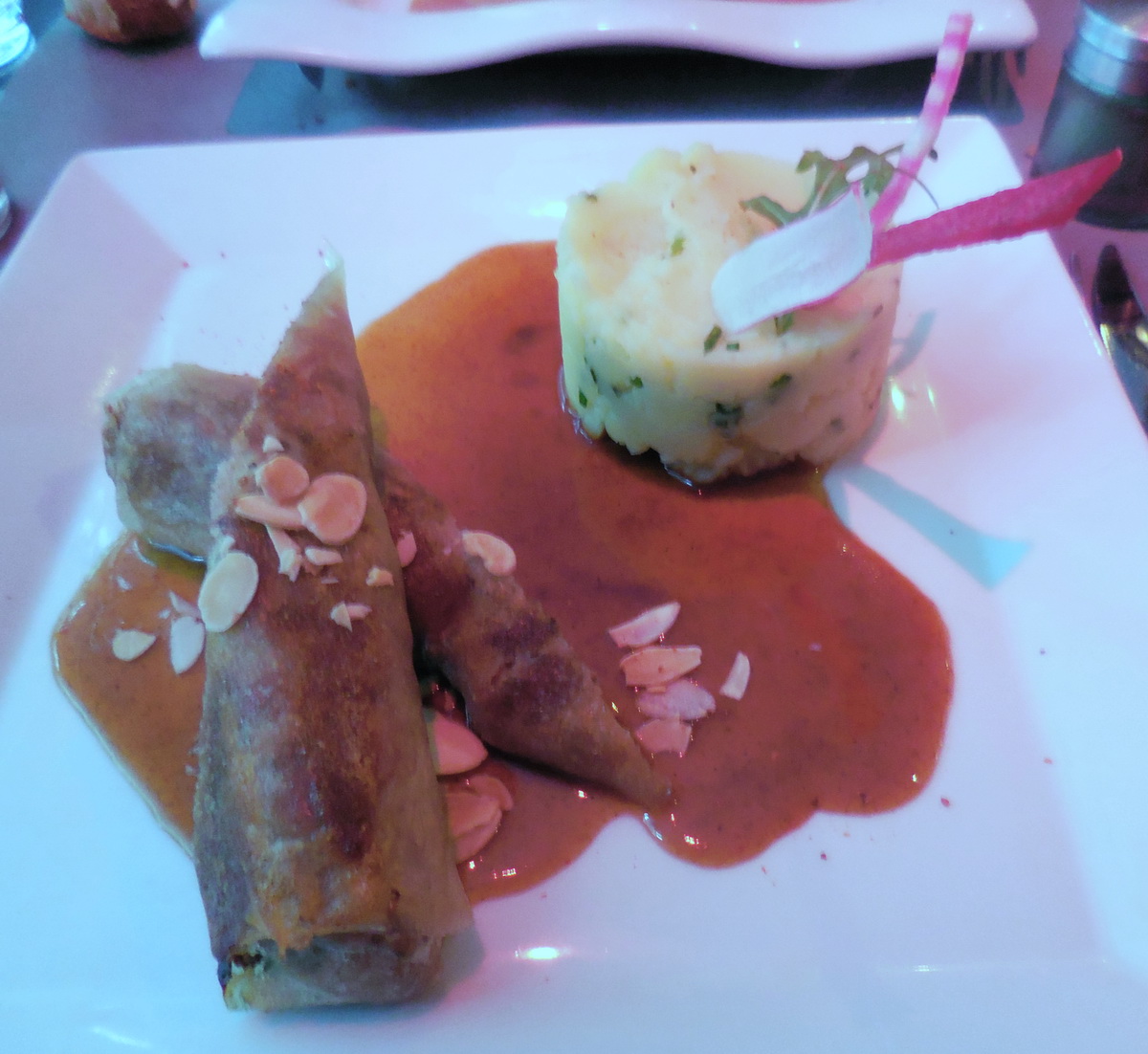
Pastilla created by Chef Adil Fakhour at O Fil Rouge


That was 9 euros well spent ($10, tax and tip included).  After a half an hour, we were refreshed and restored enough to walk the final ten minutes to our restaurant, O Fil Rouge, on the rue Saint Charles.

O Fil Rouge is only a couple years old.  In February 2013, the restaurateur Pascal Perotto placed this employment ad on employ-restaurant.fr:  Restaurateur Parisien désire partager sa passion avec un jeune Chef (associé),celui ci aura des parts dans la société ,sera passionnée ,créatif et gestionnaire pour de nouvelles aventures culinaires en ile de France, petite structure d'une trentaine de couverts ,une Cuisine moderne qui laisse la part belle aux produits frais et la Passion pour moteur.

A basic translation:  Parisian restaurateur wants to share his passion with a young chef (partner) who will have shares in the company, will be passionate, creative, and will manage new culinary adventures in the Paris region.  This is a small restaurant with thirty place-settings, a modern kitchen that makes great fresh food.

And so Pascal attracted Chef Adil Fakhour to the job.

Tom's veal chop at O Fil Rouge.
The cuisine is French, with modern twists and with the occasional North African dish.  I was thrilled to see that a pastilla was offered on the menu this time.  

Traditionally, a pastilla is a Moroccan dish made with squab.  Squab is kind of hard to get, so this one was made with lamb, and figs!  Pastillas require lots of spices, and lots of chopping.  The meat and other ingredients are mixed together and cooked in a thin or flaky pastry.  The ones I’ve seen before have been rectangular or triangular.  This one, at O Fil Rouge, was rolled into a cylinder and then sliced diagonally, once, just before serving.  

The sauce was amazingly intricate in its seasonings.  Curiously, the pastilla was served with traditional mashed potatoes.  Very good, but I would have expected a garniture that was more North African.

Tom had the same kind of mashed potatoes with his main dish, a veal chop that was the size of a small roast.  It was tasty, but too much.  So I dared to ask Pascal’s wife if we could possibly have a doggy bag.  She said no problem, she’d prepare it.  It is amazing what you can get away with when you are older.  (Traditionally, one does not EVER ask for a doggy bag in France.  But times are changing.)

I forgot to mention that the appetizer which we shared – a seafood ravioli in a spicy crustacean sauce – was stunningly good.
Pain perdu at O Fil Rouge.


At O Fil Rouge, we always order one pain perdu to share for dessert.  This is perhaps the best pain perdu in all of Paris.  This one is made with a brioche, soaked in cream and egg and cooked to a point (yes, like French toast), and served with a rich, homemade caramel sauce that will make you purr.
I asked for a glass of port as Tom was having coffee after dinner.  Pascal’s wife gave me a generous pour in an ordinary water glass.  It was good.

Then she brought the “doggy bag”: a sturdy tupperware-like container with both the veal and potatoes.

At home, we took in the last light of the day, sitting on the balcony, musing over the many pleasant little surprises that the day brought to us.  Life is good.