Showing posts with label Place Saint Sulpice. Show all posts

Friday, August 09, 2019

It is summertime in the 6th

A strikingly handsome bust of the Swedish playwright August Strindberg appeared before us as we walked down Rue Mabillon toward the back of the Saint Sulpice church.  We'd not seen it before, even though it was installed in November 2017.  Strindberg is quoted on a plaque below the bust.  Tom was curious about that quote from Strindberg, referring to one of the murals by Eugene Delacroix inside the church.  Here's a translation:

"I often enter the church to strengthen myself in the contemplation of Jacob's struggle with the angel of Delacroix. And on leaving I remember the wrestler who stands despite his dislocated hip."


Mural by Eugene Delacroix, depicting Jacob's struggle with the angel.

I don't enter the church of Saint Sulpice to strengthen myself, but I treasure the opportunity to visit that place because I always have a sense of complete calm by the time I leave it.  I don't think I get quite the same feeling anyplace else that I've been.  I don't have to be there for very long; the feeling just washes over and through me.

My sister likes that church, too.  Perhaps it is in our DNA.

We'd entered the side door on the southern façade and made our way past the sacristy and back to the chapel of the virgin where I sat quietly for a while.

Moving on along the north side of the nave, we quickly passed by a tour guide who was whispering to his group about the pieces of the church that played roles in The DaVinci Code.  We don't care about that.

We paused to admire a large number of wooden chairs that were efficiently and elaborately stacked in the north aisle.  We speculate that these are here because the Notre Dame de Paris cathedral is out of commission, and the church of Saint Sulpice -- which is almost as large as Notre Dame, and not far away -- is now accommodating the worshipers who would otherwise be at Notre Dame.

Heliodorus driven from the temple, by Eugene Delacroix -- a mural in the church of Saint Sulpice.
At last we made our way over to the Delacroix murals.  Tom particularly likes to examine these when we go to Saint Sulpice.

We exited the main doors and looked over the Place Saint Sulpice.  The square was amazingly quiet and uncrowded.  The fountain was flowing with water again, and it is in top form now -- as clean as can be.
An uncrowded Place Saint Sulpice.

The magnificent fountain in the Place Saint Sulpice.
At the southeast corner of the Square, we walked down to the Rue de Ferou, past a newly expanded ice cream parlor and tea room at the corner of Rue Canivet (photo below).  If we still stayed on the Rue Canivet in September, this would be a hazard for Tom, who loves ice cream.


We entered the Luxembourg Gardens through the gate on Rue de Vaugirard, by the Angelina tea room.  Almost immediately, I was horrified to see an ugly building that has been erected in that part of the park.  I read the signs, which assured me that the building is only temporary.  It houses a daycare center while the center's real home is being renovated.  There is almost no vacant land in the 6th arrondissement, so this is where the temporary building has to be, I suppose.

But the rest of the garden was as lovely as ever.  We wandered slowly, pausing to rest on a couple of the ubiquitous green metal chairs, and pausing again to look at a sculpture by Zadkine that we'd forgotten (photo below).

We walked past some of the "old queens," statues representing Queens of France (as well as Saint Genevieve and other influential women) that were created and installed in the gardens in the 19th century.

Bathilde, my 40th great grandmother.  She was sold into slavery when she was
a child.  Later, Clovis II asked to marry her.  Even later, when acting as queen regent,
she abolished the trading of Christians as slaves, and she tried to buy and free children from slavery.

My 36th great grandmother, Bertrade, who died on July 12, 783,
in Choisy, Haute-Savoie, Rhone-Alpes, France, at about age 63 -- my age now.


After walking alongside the Medici Fountain, which was lined with dozens of people in green metal chairs, we exited the park and walked down the Boulevard St. Michel, past the Place de la Sorbonne, and turned left on the Boulevard Saint Germain.

The side of the lovely Medici fountain.
Tom was ready for coffee and ice cream, so I suggested that we go to Les Editeurs -- a place where I once met a friend for a drink, but Tom had not yet seen.

Les Editeurs is a classic brasserie with one dining room that is lined with books, and the other area is decorated with colorful prints.  We sat out on the sidewalk, which was decidedly quieter and roomier than the crowded Danton brasserie across the street, facing the Carrefour de l'Odéon.
Bee hives in wooden boxes in the pavilion on the left
in the Luxembourg Gardens.

When we walked past it, Danton was full of tourists.  Tourists also crowded the sidewalks on the boulevards of the 6th.  I can see why Parisians feel overwhelmed by tourists in that part of town, just as we feel overwhelmed by tourists in south Florida in the winter and early spring.

In Paris, we don't see ourselves as tourists.  Paris is just where we live (and write) in the summer.  We agree with many Parisians, that it is easier to live in the 15th and 16th arrondissements because those places don't feel like Disneyland because they aren't loaded with tourists.

Tom had his Berthillon ice cream and espresso, we shared a bottle of sparkling water, and I had a glass of wine, as we admired the Carrefour de l'Odéon.  Here's a video of our view from our table:


As we paid the tab, I checked the fitness app; we'd met our 5-mile walking goal for the day.  So we took a taxi from the taxi stand around the corner and we were home in no time.

We'd taken the metro to go over to the 6th earlier in the afternoon, when my knees and Tom's hip were still in fine form.  But after 5 miles of walking, we don't wish to suffer from going down all the steps to the metro platform underground.  We've learned that taking taxis to go home after walking is just a great way to extend our sightseeing time on street level.

Inside the brasserie called A La Tour Eiffel, 96 Rue du Commerce.
After resting in the apartment for a while, we dressed casually for dinner down the street at the brasserie called A La Tour Eiffel, across from the Saint John the Baptist church that was once the centerpiece of the town of Grenelle.  We had our first dinner in Paris at A La Tour Eiffel in August 1998.

This brasserie is handsome, has a reasonably priced menu, and serves a delicious beef carpaccio and fries (for Tom) and duck breast with mushroom sauce and asparagus (for me).

Here are more scenes from the day:

Display at A La Tour Eiffel.

Beef carpaccio (above) an duck breast with mushroom sauce (below)
at the brasserie called A La Tour Eiffel.


Old façade on Rue de Ferou.

Looking at Saint Sulpice from the Rue de Ferou.

The fountain in Place Saint Sulpice (above and below).


THANK FOR FOR RESPECTING  THE SILENCE in the church.  I can't emphasize this enough.

Detail in one of the Delacroix murals in Saint Sulpice.


Extra chairs stacked in the north aisle.

The chapel of the Virgin in Saint Sulpice.


Thursday, July 04, 2019

Sitting by Saint Sulpice, soaking it in

At last we made it over to the 6th arrondissement on our walk yesterday evening.   We were headed over there the day before, when we were diverted by the demonstrating labor union group.

A van, whimisically painted with watery scenes, near the rue d'Estrées in the 7th.

We found the beginning of the rue de Babylone in the middle of the 7th arrondissment, and off we went, headed directly toward the St. Sulpice church. 

The first interesting sight along the way on the rue de Babylone was La Pagode, a picturesque old movie theatre that, in recent decades, had been allowed to fall into ruin.  We were delighted to see a construction fence and sign announcing that La Pagode is undergoing a complete renovation, inside and out.  Hooray!
Sign announcing the restoration of La Pagode cinema.

We stopped to rest for several minutes in the walled garden named for Catherine Labouré, a Catholic nun who saw visions of the Virgin Mary in the 1830s.  This garden is a public park, much used by the children of the 7th.  We avoided the middle of the park where the children played, and instead rested on a bench in the quiet, deep shade of the grape arbor along the western edge of the park.

Then we were ready to head on into the busy 6th, with all of its tourists and frenzied Parisians.

So there we sat on a bench in the Place Saint Sulpice, gazing up at the church and the clear blue sky.  Tom wanted to eat at the Café de la Mairie, facing the square, so we squeezed into two chairs on the crowded terrace and ordered a light dinner.  We dined as we watched the world go by.

The church of Saint Sulpice, and its fountain (with no water at the moment).

Paris is so much more touristy over there in the 6th.  I love all the ancient buildings there, but I also love the old-but-not-so-ancient architecture of the 15th, where we live in the summer.

After dinner, we made it about half way home by foot, and then we gave up the walking and hailed a taxi at a bus stop.  (In Paris, you may only hail taxis in places where they can safely pull to the curb and stop.  Bus stops are ideal for this.)

Again, the evening was cool and delightful.  No more heat waves for now!

Thursday, August 17, 2017

Twenty miles of Paris

La Fontaine de l'Obsevatoire, also called the Fountain of the Four Corners of the Earth

August 17, 2017 – The vegetated wall on the riverfront side of the Musée du Quai Branly – Jacques Chirac is something to see in Paris, even now during its state of deconstruction.  Unfortunately, many of the double-glazed windows on that wall are blown, necessitating their replacement and some reconstruction of the wall.  So, the museum is taking the opportunity to do some renovation of the structure that supports the plants on the outside of that wall; as long as the space is blocked off for construction, might as well do everything at once. 

Vegetated wall on the Quai Branly under reconstruction.


Tom and I took a diversion from our normal path through the Branly garden to the Seine.  We walked along the Quai Branly to see the wall of plants.  Only a section of it still has plants; the rest has been unplanted, and the work on the wall is in process.  There were many panels on the construction fence that explained the ongoing work.  I photographed them so I could sit down and translate them later, in the peace and quiet of the apartment.

I just did that this morning, so I’ll share my translation with you (below).  It wasn’t easy.

A peaceful presence along the Seine, the wall of vegetation is becoming an emblem of the museum, a strong part of its identity as well as a remarkable element of Paris’ heritage.  Under the watchful look of the Eiffel Tower, its image circulates in the media or on the social networks.  Across it plays as well the dialogue of cultures that the museum strives to defend and perpetrate.

A new life for the vegetated wall

Conceived by the botanical researcher Patrick Blanc, the vegetated wall has been since 2004 a strong attribute of identity of the Musée du Quai Branly – Jacques Chirac.  In language of French symbolization, the establishment is represented by its vegetated wall.
An echo of the collections of the museum and its programs, the vegetated wall carries the universal message of the museum and contributes to sustainable urban development.
Significant works are today undertaken to technically reinforce the building and increase its longevity.  A newly planted creation is coming thanks to the work, replanting part of the plants of the previous wall.

An ode to the continents
The vegetated wall is a living organism.  It is our equal.  Each day, the 22,800 plants that compose it are in dialogue with man:  visitors to the museum, residents of the neighborhood, tourists, citizens of the Paris region passing by the building.  Thanks to the work undertaken, this dialogue that is conducive to inspiration and escape will continue for a long time.
Celebration of the African, Oceanic, American and Asiatique continents, the new wall will hold 376 species from the entire world.  Coming from many of the mountains (Moroccan Atlas, South African Drakensberg, Himalaya, mountains of Chili and Argentina . . .), the plants are notably chosen for their capacity to adapt to the climatic conditions of Western Europe.  Numerous plants from the former wall will be preserved and re-planted in the new wall:  Bromeliads, Corydalis . . . .

At the vertical


The technique of the vegetated wall consists of a superimposition of three elements:  A mineral wool insulation complex and a fixed steel mesh on a metal structure, a ten-millimeter expanded PVC foil, and a three-millimeter polyamide felt made of recycled old clothes.   This felt has a strong capacity for capillary action and retention of water, enabling the development of the roots of the plants. The watering, controlled by the electrovannes, is done via the drippers situated on the irrigation lines installed at different heights on the wall.

An eco-responsible project

Reservoir of biodiversity and of urban ecology, the vegetated wall contributes to the preservation and the reinforcement of nature in Paris.  Its contribution to the quality of the air is clear:  thanks to photosynthesis and to micro-organisms living in the roots, the plants exert a purification in the urban setting – absorption of gas, fine particles, and other elements tied to pollution.  The cushion of air separating the supporting structure from the building also makes excellent natural insulation, on a vast surface, reducing the need for air conditioning in the summer and the necessity for heating during the winter.  The work on the future wall will permit the perfection of the watering system as well to reduce the consumption of water.

The improvements made
Mother Nature's attempt at a vegetated wall on the
floodwall of the Seine.

The principal work consists of resizing the metal structure.  The fixation method for the PVC layers will be modified, to facilitate the maintenance and the work on the wall, augmenting the number of points of fixation.  A support grid for the plants (wire mesh of galvanized stainless steel) will be fixed partway up the wall, in a manner for reinforcing the ensemble of the structure against the effects of the wind.  The joints between the PVC layers will be filled to prevent any infiltration from the back of the complex.  The insulation will finally be thickened to improve thermal performance.

The Campaign “Build the Wall!”

Thanks to the generosity of the public, the campaign for participatory financing organized from May 15 to July 15, 2017, has permitted the museum to finance a third of the costs of the planting of the wall (introducing new species).  The Musée du Quai Branly – Jacques Chirac warmly thanks, once again, the donors and the patrons for their contributions to the project.  Thanks to their support, the wall will continue to live long years, with sweetness, beauty, luxuriance, and a positive impact on the environment.

A timeline on the fence  indicates that the work began in July (last month) and will be completed in May 2018.
The Berges de Seine, complete with beach chairs and palm trees (no, this is not Paris Plage).

We continued our normal walk along the Berges de Seine, spotting a plant here and there that Mother Nature was trying to install on the floodwall.  Tom loves the presence of a few palm trees along that stretch of the river.  They remind him of home, of course.

In the short span where we had to ascend to the street (at the eastern end of the Musée D’Orsay), we decided to cross the quay and dine at Le Fregate, a fine brasserie at the corner of the rue de Bac.  We’ve dined there several times in the past. 

I remembered a classic French blanquette de veau that I had there one Sunday afternoon.  Since it was Tuesday, August 15 – a big holiday – I thought the blanquette de veau just might be on the menu again.  It was!  I ordered it, and found it to be a lighter, healthier version of the dish I remember from that Sunday years ago.  Tom just had dessert – a café gourmand and apple pie.

The brasserie is as beautiful as ever, and the service was warm and professional.  

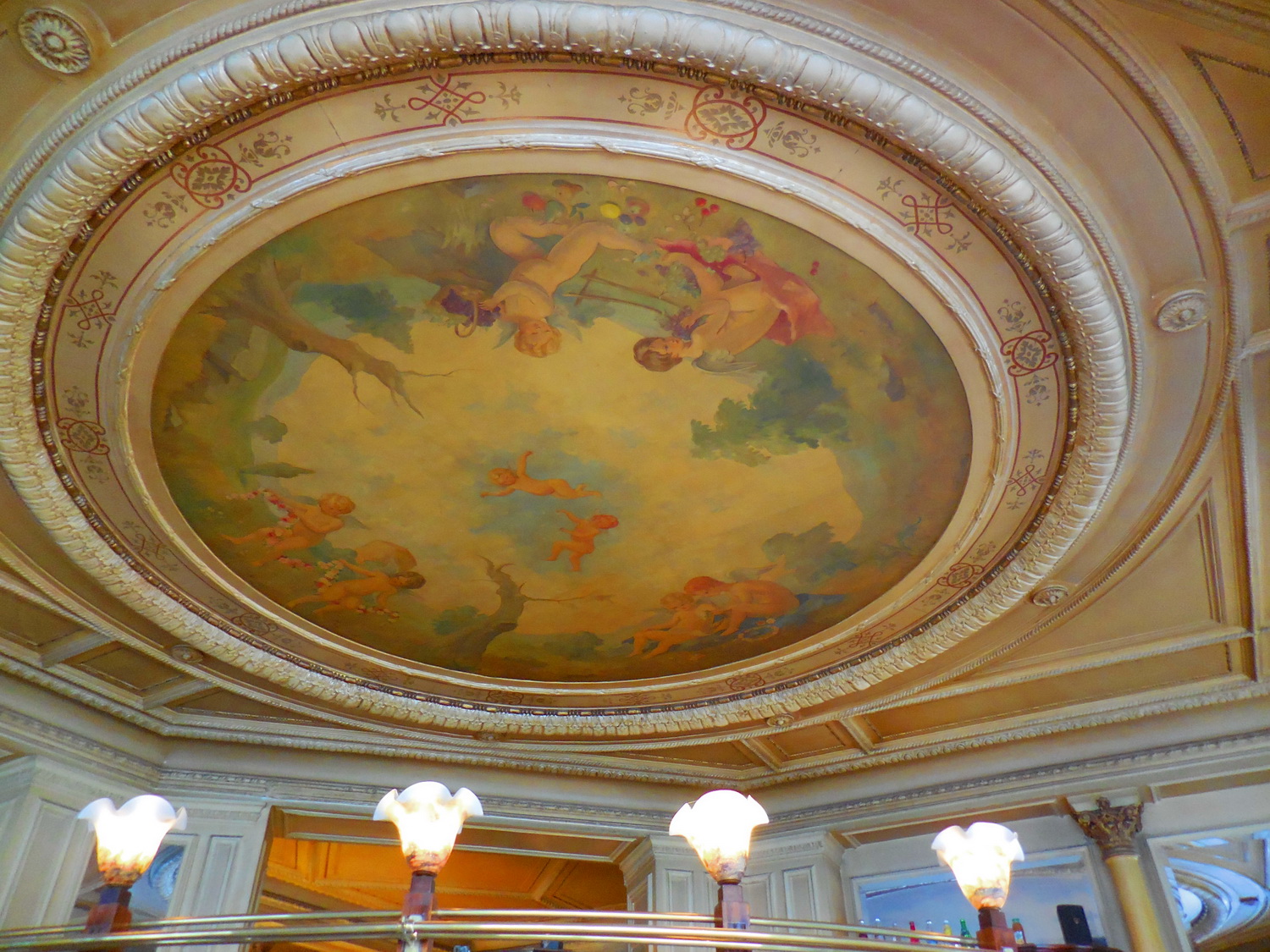
Ceiling at Le Fregate, on the rue de Bac.

After that lunch, we walked on to the Saint-Germain-des-Pres neighborhood.  Right there, on the corner by the church of Saint-Germain-des-Pres, we saw the musicians of the group La Planche a Dixie performing, just as we’ve seen them there on many Sundays in the past.  The leader of the group, Christian Giovanardi, is a drummer and washboard player, like Tom.  Out on the street, Christian is playing the washboard, of course, not the drums.

We stopped and listened for a while.  I noticed that Christian is a very good washboard player, but my husband Tom is better.  Tom thinks it is terribly funny that the playing the washboard is something he does so very well.  Why couldn’t it have been the violin, he thinks.

La Planche a Dixie plays on boulevard Saint Germain, and sells CDs.
We already own all four of the group's CDs.

Percussionist Christian Giovanardi plays the washboard.

After a stroll through part of the Luxembourg Gardens, we left that green expanse via the rue de Fleurus, where Gertrude Stein once lived.  Making our way back up the boulevard Raspail, we were able to catch the number 10 metro at Sevres-Babylone to go home in time to rest up for our traditional holiday dinner at Le Tipaza.

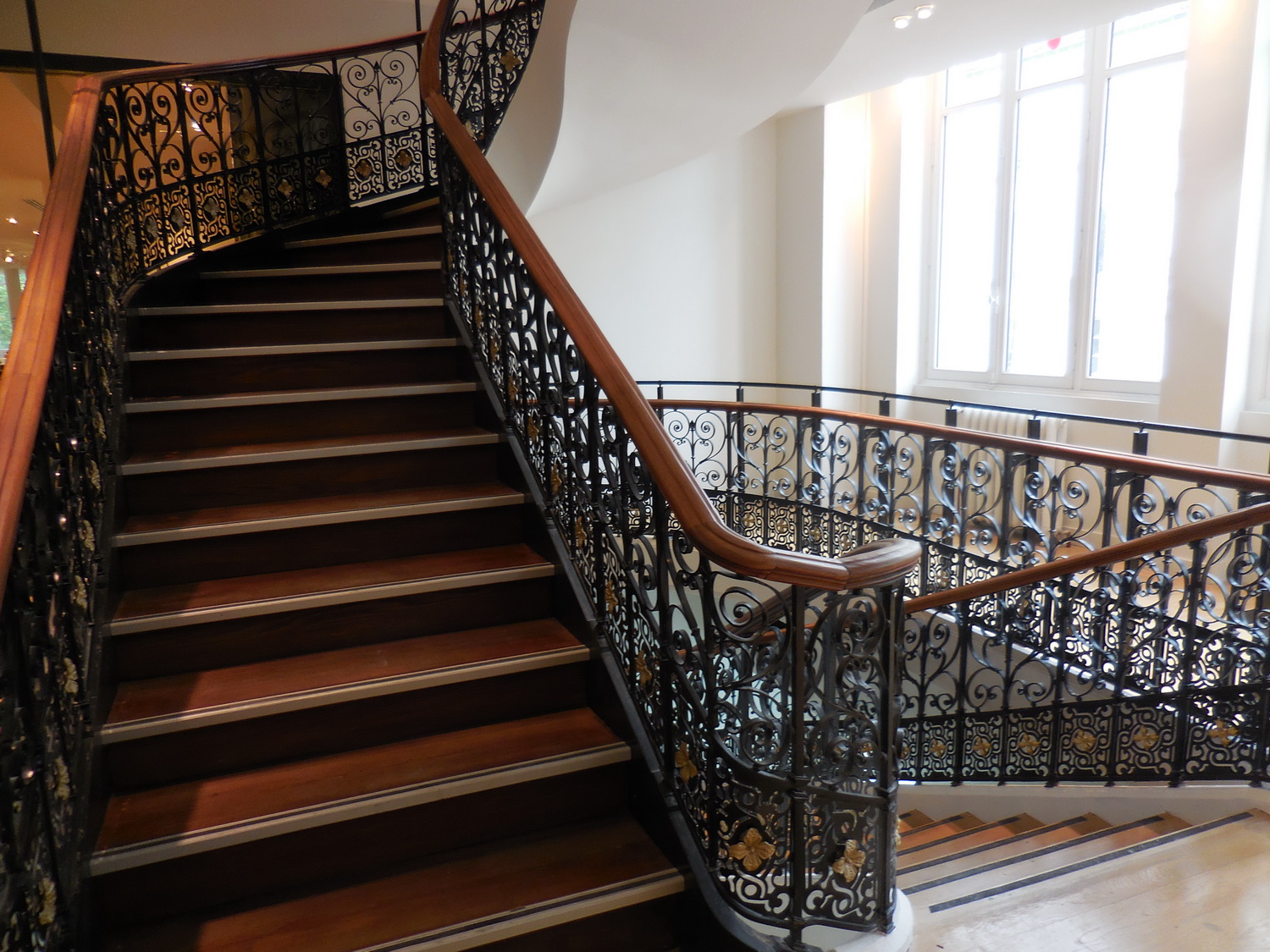
We found ourselves on rue de Sevres once again yesterday.  We stopped in Bon Marché to look around the place and to see if the store might have a scarf that I’d like.  We didn’t find the right scarf, but we picked up a couple decorating ideas and admired some of the two buildings’ finely restored features.  Work is still going on in parts of the two structures.
Stairways and escalators in Bon Marche.


A long lunch at Les Mouettes, on the rue de Bac near Bon Marché, restored our energy.  It was the quiche of the day for me, and café gourmand again for Tom (coffee and an assortment of three small desserts – fruit, chocolate mousse, and crème brulée) – a very nice lunch indeed!

Quiche of the day at Les Mouettes -- a savory ham and mushroom.

We strolled over to the Place Saint Sulpice, whose fountain was looking lovely on such a beautiful day.  We toured the inside of the church for what seemed like the thousandth time.  Then it was time to stroll through the Luxembourg Gardens again. 

Included in that stroll were the two gardens south of the Luxembourg.  At the end of that stretch is the magnificent fountain of the four corners of the earth.  Two great fountains in one day! 
The church and the fountain on Place Saint Sulpice.


We ambled along the boulevard Montparnasse, admiring beautiful and famous brasseries like Le Dome and Le Coupole, as well as funky shops like a costume store that posted masks of political figures on its window.  Can you name them all?  (Double-click on the photo to enlarge it.)
Masks

Each of these walks – Tuesday’s and Wednesday’s – were about 10 miles long.

Last night, we dined at one of our favorite restaurants, O Fil Rouge, on the rue St. Charles.  The owners and chef have re-opened after an invigorating vacation.  New items are on the menu.  We ordered one of them, duck breast ravioli, as a shared starter.  Then Tom had a delicious steak and fries, and I was back to my usual fish-and-vegetables habit.  But oh, what a special dish this was:  perfectly cooked red tuna on tasty veggies with just a bit of buttery sauce – all topped by a slice of foie gras entier.  The dish practically exploded with flavor.

We shared O Fil Rouge’s unforgettable pain perdu for dessert -- rich, warm, and seductive – just like the summer evening in Paris.

O Fil Rouge's red tuna, "Rossini" fashion.


Monday, July 24, 2017

Paris, from the sky

July 24, 2017 -- Pictures bring words to life.  Writer’s block doesn’t happen to me.  When it threatens, I simply turn to look at the photographs that I took yesterday – or even earlier.  Then the story pops into my head.

The photograph of the façade of the Saint Sulpice church, which I took with my sister in mind (she likes that façade), reminds me that the weather was a little cool and windy.  Tom and I noticed posters promoting a sale of men’s clothes.  The posters were sandwiched around posts and small trees all around the Place Saint Sulpice.   We recognized the address as that of the former workshop for Emile Lafaurie.

The Saint Sulpice church


The cooler weather inspired clothes shopping.  Who wants to try on clothes when the weather is hot and humid?

From our September stays in an apartment on the rue du Canivet, we knew about Emile Lafaurie.  His men’s apparel business has grown, but back in those days he toiled away, designing clothes, right there in the little space on the rue du Canivet.  The back of the space has a metal verriere ceiling, with frosted glass, providing just the right light for sewing by hand.

Now the space is empty, cleverly renovated with interior walls of varnished chipboard, and opened occasionally for a sale of odd lots of Emile’s clothes and shoes for men.  Tom likes the shirts, especially.
Poster advertising the sale of Emile Lafaure clothing.


We entered the workshop, and Tom tried on clothes for a while until he decided upon a handsome, long-sleeved blue shirt with tiny little red and white anchors all over it – perfect for a former Navy officer who lives on Sanibel Island.  The shirt also looks great with Tom’s casual, dark blue jacket that he wears in cool, damp weather. 

When he paid for the shirt, he decided to wear it so he wouldn’t have to carry a bag.  He hates to carry anything when we walk in Paris.  He needed that extra layer between his t-shirt and jacket because the temperatures dropped to the 60s – which is cold for South Floridians.

We ambled around the Luxembourg Gardens for a while.  We admired the new message on the old pavers on the narrow rue Férou, a message that clearly tells drivers that pedestrians rule that little rue.  We noticed on that same street that the upper floors of the building that contains the best apartment that Hemingway ever lived in in Paris is in need of serious repairs.  The wooden shutters are falling apart, and that isn’t quaint or cute.

The rue Ferou, where pedestrians have priority.


While we were walking, Dan and the granddaughters were at the Cluny museum, taking a look at the magnificent Unicorn tapestries.  We’ve seen these tapestries multiple times, so we just rode the metro to the 6th arrondissement with them, then went our separate ways for a couple hours.

After our walk, we stopped in the Café de la Mairie for a drink, and we called Dan, who has Tom’s phone.  Tom and Dan and the girls met a little later, and went to the Café Bergamote for refreshments.  I took the metro home so that I could watch the end stage of the Tour de France. 

That final stage is when the Tour comes into Paris.  I simply LOVE the aerial views of Paris that this last day of the Tour provides on TV.  Why do I love looking at Paris from the sky?  I do not know. 

The apartment one level up from the street at 6 rue Ferou was the best place Hemingway ever lived in Paris.

This time, the videographers were focusing on more left bank sights than usual because of the slightly different entry point the Tour took into the city – the Porte d’Orleans instead of the Porte de Versaille.

A huge new Defense Ministry complex south of here has recently been completed.  Observing it from the air made it possible to see what a complicated and lovely architectural achievement it is.  We’ve noticed the construction going on for the past couple years.  Now it is done, evidently.  Some are calling it France’s version of the Pentagon, but I think it is even more architecturally interesting than that.  Plus, it has the largest solar-panelled roof in the city.   The cost of the complex?  4.2 billion euros.

The Musée du Quai Branly and its beautiful tropical garden were featured.  The new domes of the Russian Orthodox Church shone brightly.  The magnificent Grand Palais was a centerpiece of the show;  the Tour rode right through it!  The Grand Palais has great possibilities for the 2024 Olympics, so the City was cleverly showing it off.

The magnificent fountain in the Place Saint Sulpice.


When Tom, Dan and the girls came home, the end of the Tour was still happening, so we all watched together for a while.  Then they asked me to make a reservation for dinner via lafourchette.com.  They wanted to go to the new Italian place, Pietro Commerce.

So we did.  It was impossible to entirely consume the copious servings of pasta, etc. But the food was very good.

I saw visions of plenty early in the day, too, when I took my market walk.  This is a Sunday or Wednesday morning walk when I take in the full length of the market under the tracks at the Boulevard de Grenelle, then retrace my steps, walk up the avenue de le Motte Picquet to the end of the Champ de Mars, pause to look at the Eiffel Tower looming over the Champ, walk on to the colorful pedestrian market street of rue Cler, walk its full length and turn left to go back to the Champ de Mars, cross it, and walk home. This is about 8,000 steps.

Add to that an afternoon walk and an evening walk and soon I’m at 15,000 to 20,000 steps for the day.  You’ll notice that by combining an afternoon walk with a metro ride, we are covering much territory in Paris this summer.


And the beat goes on.