Showing posts with label La Petite Ceinture. Show all posts

Sunday, August 04, 2019

Seizing the forgotten places

"We seize forgotten places, places in transformation, places waiting for change or simply places that need to connect their audiences to create places of life, places of meeting and sharing for 6 months, 1 year, 3 years ... "  That's how Frédéric Lambert and Vincent Quenor describe their business, Paris Enchanté.

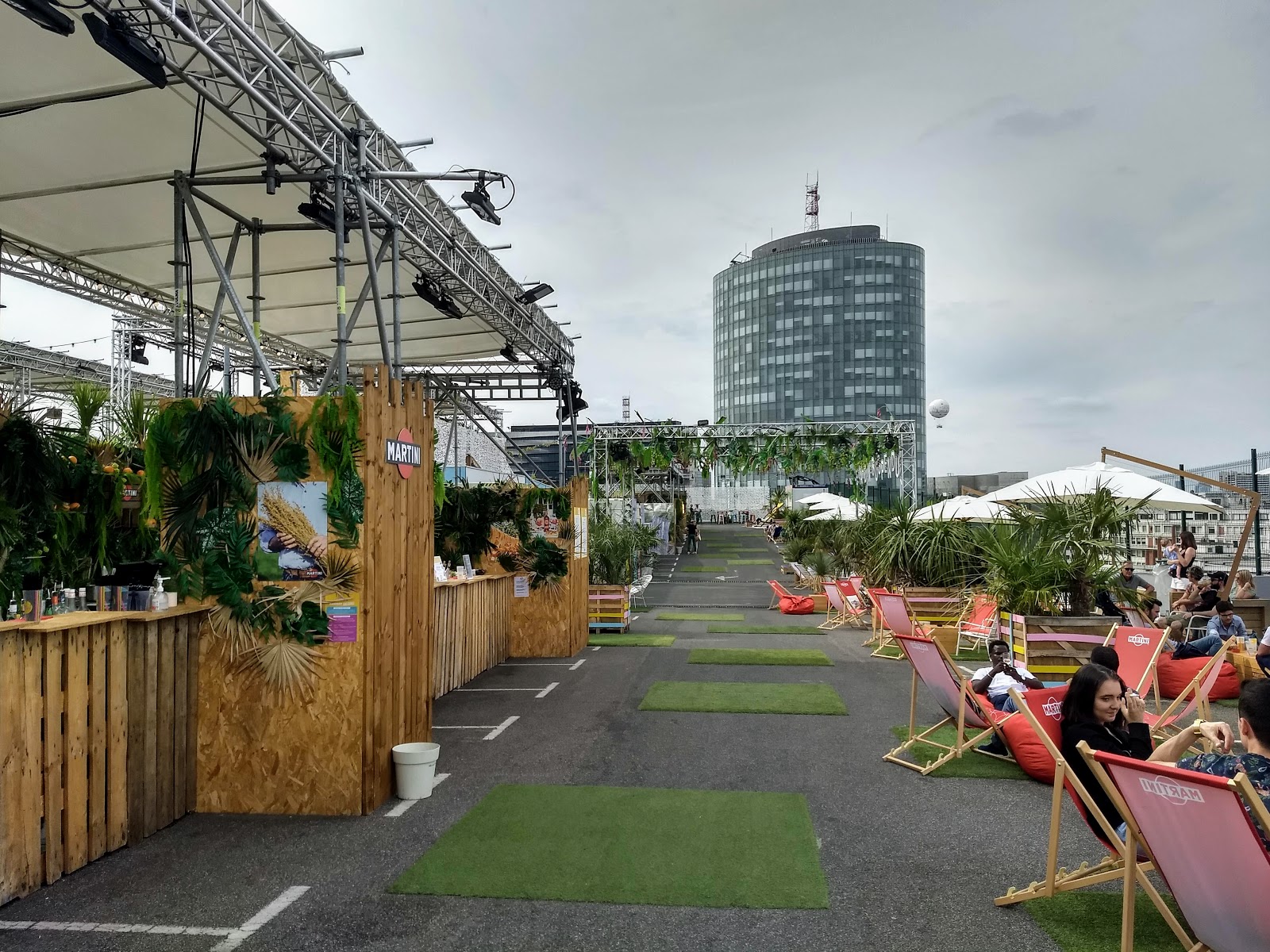
The "forgotten places" that they "seize" and transform tend to be large.  Last summer, Paris Enchanté opened Le Jardin Suspendu, a vast bar on top of a large parking garage by the Paris Expo grounds -- where many agricultural and other fairs and trade shows are held.

Grocery on the Rue Hameau that we passed when walking
to the Jardin Suspendu.
This edgy place is on the edge of the city, literally.  To find it, we walked through the old Vaugirard part of the 15th and kept going, beyond the Boulevard Lefebvre.  As we approached the Peripherique (highway that encircles Paris proper), I did not know what to expect.  Were we going to cross beneath or over the highway?

Then I saw that in that particular place in the Porte de Versailles area, where the Avenue Ernest Renan crosses the Peripherique, the highway is elevated and enclosed in glass!  We could barely hear the cars and trucks zooming by as we walked up to and crossed beneath that busy roadway.

Views from the top of the parking garage.


Then we turned right on the Rue d'Oradour sur Glane, where the north side of the street is in Paris and the south side is in the suburb of Issy-les-Moulineaux.  The stone retaining wall of the Peripherique, to our right, was a beautifully vegetated wall.  That wall was not only beautiful, it also seemed to absorb traffic noise.

Vegetated wall along the Rue d'Oradour sur Glane, beneath the Peripherique highway.
A wide opening in the wall marked the entrance to a parking garage on the other side of the Peripherique.  We followed it beneath the highway, and in the entryway to the garage were two security guards (unarmed).  There was no pedestrian walkway, only the ramp for cars to go in and out of the garage.

We politely greeted one of the guards and asked if this was the entrance to Le Jardin Suspendu -- the Suspended Garden.  He said yes, and he explained that we'd walk up the ramp and through the garage to the elevator, but first he had to check my handbag.

Sling chairs (above), and food/beverage booths (below) in the Jardin Suspendu.


This happens almost everywhere that large numbers of people gather these days in Paris.  Always be ready to show guards the inside of your bags or knapsacks.

As we approached the elevator, we noticed rows of metal barriers indicating that sometimes there were long lines of people waiting here.  Another guard was stationed by the elevator, probably to control the number of people who used the elevator at a time.  But now, there were so few people around, he seemed to be bored.  The Garden opened at 4PM and it was only 5PM.  It would stay open until midnight or 1AM.  I'm guessing that the crowds come after dark.


The elevator guard nicely told us that we wanted to go to the 7th floor.  In the elevator, I noticed a sign explaining that to buy drinks or food in the Garden, we would need to first purchase a card at the cashier's desk.  A similar system is used for many popular bars in Paris now.  This way, you don't have cash being handled in a crowded, chaotic party situation.

Out on the roof, sling chairs and other casual seating was arranged around the periphery, and a food court of sorts was set up in the middle, with booths selling a variety of tapas and beverages. 

At each end of the vast rectangular space was a stage.  On one, three DJs were playing funky music, and the other was set up for showing movies or videos.

Wildflowers growing along the Petit Ceinture.
The decorations were ephemeral and fun.  Nothing looks permanent, because the Garden is only seasonal.  It also may exist for only a few years, only to be replaced by some other vast forgotten space that is to be discovered and transformed by Frédéric and Vincent.

If we were drinkers, we would have grabbed a couple of beers and lounged in sling chairs in the sun.  But we aren't; we are flaneurs.  So we walked around, took some photos, got the feel of the place, and then moved on after deciding that it was a good idea, this Suspended Garden.

Paris Enchanté opened Le Jardin Suspendu last summer.  This summer, their newest operation is Le Jardin Defendu, at La Defense, a business district just northwest of Paris.  Both of these places are basically summertime operations.  Paris Enchanté also operates La Grand Surface which is not open in the summer; it will reopen at the rentrée, this Fall.  La Grand Surface is in the 9th arrondissement, at 4 rue des Italiens.
A B&B for bugs on the Petite Ceinture.

Looking down on a street in the 15th arrondissement, from the Petite Ceinture.
We decided to walk along the Petite Ceinture (former railway, now a walkway) part of the way home.  This is another forgotten place that was seized, this one by the City of Paris, and transformed into an enchanting promenade. 

At Balard, we descended many steps from the elevated track to the street level and walked into the Parc André Citroen, where we enjoyed a snack and rested our weary feet in the pleasant Buvette du Parc.

Pesky sparrows in the éBuvette du Parc.
In the park, I consulted the fitness app on my phone and discovered that we'd walked way over our limit.  So we found a taxi stand near the Buvette, and we rode home where we flung open the French doors and had a picnic supper in the dining room:  succulent fresh cherries, terrine, cheese, whole wheat bread, strawberries, ham, gherkins, salad, etc.

More scenes from yesterday:

Looking from the Petite Ceinture toward Parc André Citroen, we could see the park's balloon rising.

This building just south of the city seems to have an extensive surface of movable solar panels.
We could see this from the Petite Ceinture.

Square Desnouettes Clos Feuquières (above and below) is a park that was once
a walled estate owned by the Marquis de Feuquières, in the old village of Vaugirard.  


Maison Park, an attractive restaurant at 10 rue Desnouettes, is highly rated.

Thursday, July 13, 2017

Take a hike

Wildflowers on the Petite Ceinture

July 13, 2017 – In spite of the slightly rainy weather, we decided to take a hike through nature, along the Petite Ceinture: a long section of what was once a beltway train around Paris.  The train was abandoned years ago, but the tracks and the banks of thick vegetation remained.  Under the green guidance of the Bertrand Delanoe administration, the City of Paris turned this neglected resource into a walker’s wonderland.

A couple beetles doing their thing
The gritty sandy mix used to fill and level the space between and beside the rails blends beautifully with the chunky gravel and stone mix that remains along the tracks.  That sandy mix is easy on feet that grow weary of walking on urban pavement.

To help the environment and to keep maintenance costs down, the gardeners have turned most of the work over to Mother Nature.  The native wildflowers that she fosters there are becoming more beautiful every year that we walk along the Petite Ceinture.  Surely the gardeners must pass through occasionally to remove noxious plants (does poison ivy grow in Paris?), but we’ve never seen them there. 

Like on the Ile aux Cygnes, there is no water supply along the Petite Ceinture, so the wildflowers and other vegetation must be tough; they have to make it on their own.

This year, Queen Ann’s Lace rules the Petite Ceinture, but there are plenty of other wildflowers adding spots of color everywhere.  I particularly love the orange-red poppies.  Can you identify some of the other flowers?


When we reached the end of the trail at the rue Olivier de Serres, we climbed steps to reach the street level.  Where we’d started our walk along the railway, at the foot of the Avenue Felix Faure, we were in former swamp land, so we had to climb a few flights of steps to get up to the trail.  Here, at the end, we were on the land that rises up to become Montparnasse, so we had to climb many steps again to reach the street.  The left bank of Paris seems fairly flat until you experience these steps (as well as those around the Pantheon area in the 5th arrondissement).

On the rue Olivier de Serres, we located a doorway leading to one of the Russian Orthodox churches that Dimitry Vicheney mentioned in his interview (see yesterday’s journal entry).  Beyond the mysterious doorway were steps leading up to a courtyard, but because all the lettering on the bulletin posted at the door was Russian, we did not feel welcome to visit as we do the other churches in Paris.  Also, a school is associated with the church there, and we did not wish to be a distraction to the kids.  I wonder if the kids speak Russian in that school?  I suppose they do.

Bulletin, all in Russian.


Stairs leading to Russian Orthodox church and school


Continuing our trek down the rue Olivier de Serres, Tom was becoming footsore, so I suggested that we have refreshments at La Source again, at the intersection of the rues Alain Chartier and Vaugirard.  After a café gourmand which included a little ice cream, Tom was renewed and we walked home in the most direct way possible (rue Alain Chartier and rue de Javel to the Place Etienne Pernet and rue du Commerce) because of the rain. 
Axuria's incomparable souffle au Grand Marnier

At home we did the usual: relax while watching the end of the day’s stage of the Tour de France.  Earlier, as we’d started our walk, I’d ducked into Axuria to make a dinner reservation.  So in the evening, we dressed up a little and walked back down the Avenue Felix Faure for a fine dinner at 8.  It was a thick, juicy veal chop for Tom, sea bass with peas and risotto for me, and then soufflé au Grand Marnier for each of us.  That soufflé is heavenly, and it is cooked perfectly every time. 

By the time we walked home, we’d logged almost 25,000 steps for the day. 
The back of the dining room at Axuria.

Sunday dinner at Axuria is tempting.


Tom's veal chop was more like a slice of a roast.


Sunday, August 14, 2016

We did ask for a doggy bag in a French restaurant!

August 14, 2016 – Like an old house, Paris always needs some TLC and renovation – in many places at once.  The fountain near the intersection of the rues Balard, Saint Charles, and Modigliani has always appealed to me, but it has always needed maintenance and restoration ever since I’ve known it.  Through the years, we’ve passed by it many times because it is near one of the entrances to the Parc André Citroën.  Once we even saw a fashion shoot taking place there – an unexpected sight, deep in the bowels of the 15th arrondissement, far away from the fashion districts.

La Fontaine des Polypores, by Jean-Yves Lechevallier, 1983.


Last year, the fountain was covered by scaffolding and equipment.  Serious renovation had finally been undertaken.

Yesterday, toward the end of our long hike, we passed by the fountain, and voila!  The work has been completed, and the fountain is now clean and whole, glistening with water, looking as it should.

La Fontaine des Polypores was created by Jean-Yves Lechevallier, a sculptor from Rouen.  After its installation, it was inaugurated by President Chirac in 1983.  That was nine years before the Parc André Citroën opened.

Our long walk before we found the renewed fountain was along La Petite Ceinture – the section of former ring railroad that has been turned into a rustic promenade paralleling the southern border of the 15th arrondissement.

The sky was blue, the temperatures were in the low 80s with humidity around 40 percent – perfect for ambling along a dirt path through strips of native vegetation.
La Petite Ceinture, a promenade in the 15th arrondissement.


With a half hour of walking to reach La Petite Ceinture, and hour of walking on the promenade, and another half an hour of walking toward our restaurant for the evening, we were dehydrated and exhausted by the time we reached Place Charles Michels.

Two cafés were on the shady side of the Place, so we crossed over to inspect their beverage menus.  The more crowded, trendy one (Le Lutétia) was costlier than the smaller, less-occupied one (Il Teatro), so we chose the latter.  I could not understand why so many preferred the more crowded, costlier café.  This was just for drinks, after all.  (The time was 6:45PM – much too early for the dinner hour, which begins at 7:30PM.)  Could it be that people preferred the café that was not run by immigrants?

A pleasant server of perhaps Pakistani origin took our drink order at Il Teatro café.  After she brought us the cold drinks (generous pours), she brought olives and peanuts for us to nibble.
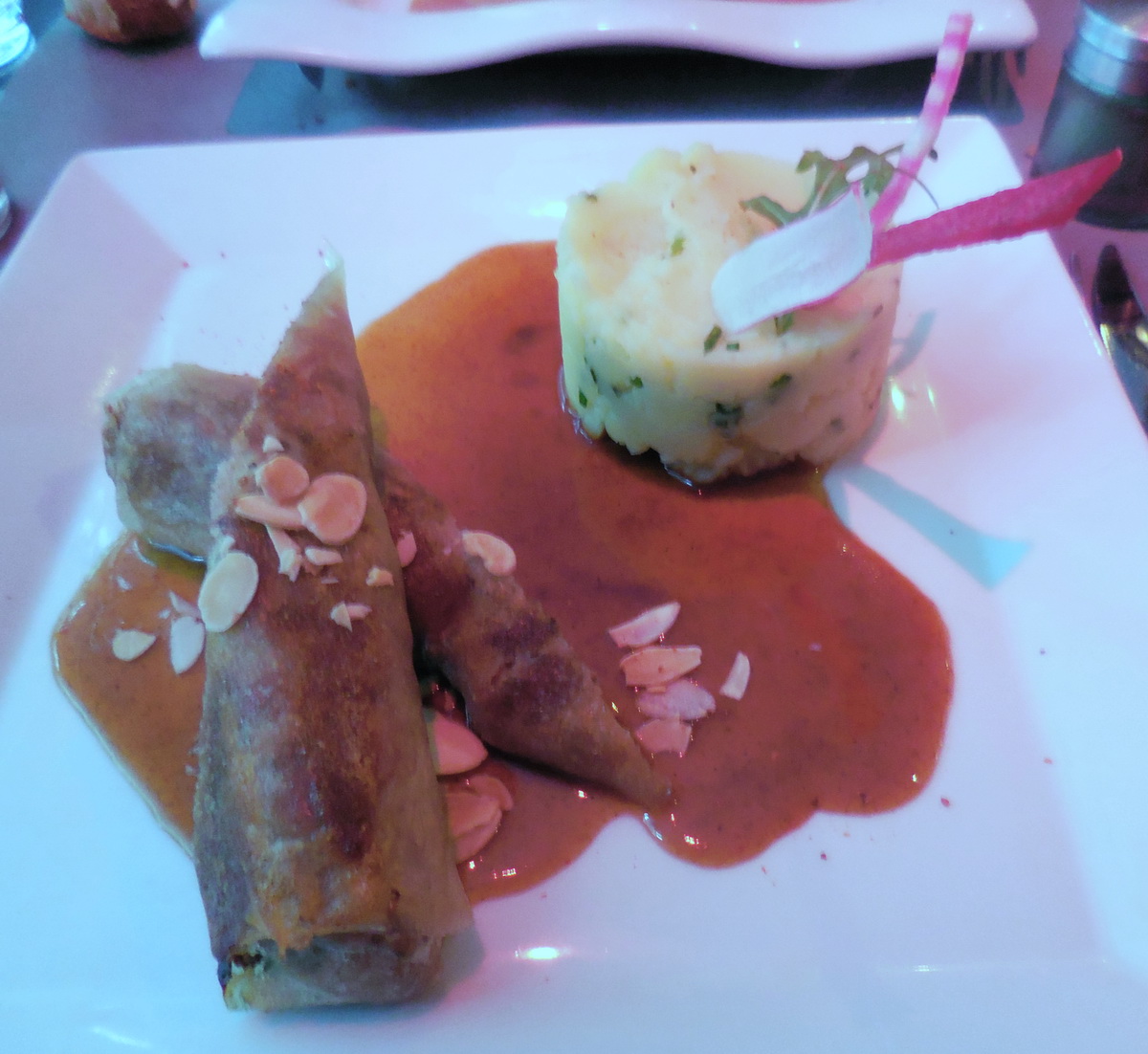
Pastilla created by Chef Adil Fakhour at O Fil Rouge


That was 9 euros well spent ($10, tax and tip included).  After a half an hour, we were refreshed and restored enough to walk the final ten minutes to our restaurant, O Fil Rouge, on the rue Saint Charles.

O Fil Rouge is only a couple years old.  In February 2013, the restaurateur Pascal Perotto placed this employment ad on employ-restaurant.fr:  Restaurateur Parisien désire partager sa passion avec un jeune Chef (associé),celui ci aura des parts dans la société ,sera passionnée ,créatif et gestionnaire pour de nouvelles aventures culinaires en ile de France, petite structure d'une trentaine de couverts ,une Cuisine moderne qui laisse la part belle aux produits frais et la Passion pour moteur.

A basic translation:  Parisian restaurateur wants to share his passion with a young chef (partner) who will have shares in the company, will be passionate, creative, and will manage new culinary adventures in the Paris region.  This is a small restaurant with thirty place-settings, a modern kitchen that makes great fresh food.

And so Pascal attracted Chef Adil Fakhour to the job.

Tom's veal chop at O Fil Rouge.
The cuisine is French, with modern twists and with the occasional North African dish.  I was thrilled to see that a pastilla was offered on the menu this time.  

Traditionally, a pastilla is a Moroccan dish made with squab.  Squab is kind of hard to get, so this one was made with lamb, and figs!  Pastillas require lots of spices, and lots of chopping.  The meat and other ingredients are mixed together and cooked in a thin or flaky pastry.  The ones I’ve seen before have been rectangular or triangular.  This one, at O Fil Rouge, was rolled into a cylinder and then sliced diagonally, once, just before serving.  

The sauce was amazingly intricate in its seasonings.  Curiously, the pastilla was served with traditional mashed potatoes.  Very good, but I would have expected a garniture that was more North African.

Tom had the same kind of mashed potatoes with his main dish, a veal chop that was the size of a small roast.  It was tasty, but too much.  So I dared to ask Pascal’s wife if we could possibly have a doggy bag.  She said no problem, she’d prepare it.  It is amazing what you can get away with when you are older.  (Traditionally, one does not EVER ask for a doggy bag in France.  But times are changing.)

I forgot to mention that the appetizer which we shared – a seafood ravioli in a spicy crustacean sauce – was stunningly good.
Pain perdu at O Fil Rouge.


At O Fil Rouge, we always order one pain perdu to share for dessert.  This is perhaps the best pain perdu in all of Paris.  This one is made with a brioche, soaked in cream and egg and cooked to a point (yes, like French toast), and served with a rich, homemade caramel sauce that will make you purr.

I asked for a glass of port as Tom was having coffee after dinner.  Pascal’s wife gave me a generous pour in an ordinary water glass.  It was good.

Then she brought the “doggy bag”: a sturdy tupperware-like container with both the veal and potatoes.

At home, we took in the last light of the day, sitting on the balcony, musing over the many pleasant little surprises that the day brought to us.  Life is good.