Thursday, July 25, 2019

The heat and the homeless

I lost my privilege of positivity in this heat wave.  Today, the temperatures will rise to 106 in Paris, a city where most places, by far, are not air conditioned.  Those that are air conditioned may not be air conditioned very well, and some places that are air conditioned -- like the American Library -- have closed their doors -- even to their dues paying members -- for this hottest day.  The library has no sympathy for us, even if we want to use the space so that we can work on producing books that the library puts on its shelves.
The Eiffel Tower as seen from the entrance to the
École Militaire.

But in some ways, I agree that we don't need the help or sympathy.  We don't need it nearly as much as the homeless do.  The social services experts here say that summertime can be even harder for the homeless in cities like Paris than the wintertime is.

Summer heat means that keeping food fresh is more difficult for the homeless.  Even getting enough water to drink can be a challenge -- although that is far easier to do in Paris than in Marseilles, evidently.  Many of the homeless -- especially immigrants -- are carrying heavy backpacks and wearing multiple layers of clothing.  In an interview, one of them acknowledged, "I am going to stink."

So I cannot be positive when there is so much suffering out there on the streets.  Bear with me.  Here's the situation.

Paris has many services available to the homeless.  Some are offered by the government, some by non-profit organizations.  La Protection Civale, L'Armée du Salut (The Salvation Army), La Maison dans le Jardin, LÉspace Solidarité du SamuSocial, Emmaus Solidarité, Street Housing - Secours Catholique --  these are just some of the groups working to help the homeless survive the heat wave.

Some of these organizations send out groups on maraudes.  These are not marauders in the English-language sense of the word; they are not out roaming in order to plunder and steal.  Instead, they are out to give what is needed to the homeless:  bottles of water, maps that show neighborhood water fountains and spigots, information about places where food is available, etc.
Garden behind the Grand Palais.

These good marauders are volunteers.  In the summer, like so many Parisians, many of them leave the city for extended vacations.  That leaves the organizations in great need of volunteers to fill the summertime gap.

This is not a volunteer job for older people like us -- or even for many middle-aged people.  To be out in the heat of the day, breathing air with elevated levels of bad ozone is very bad for those with high blood pressure and immune system problems. (We learned that the hard way, in the heat wave of 2003.)  A better solution might be to raise money to hire and pay young people to do this important work in the summer.

While the marauders go to the people, the people come to certain centers like the one operated by SamuSocial in the 12th arrondissement.  Here, the homeless can take a shower, cool off, even see a doctor.  (The SAMU are emergency doctors and responders.) 

The President of SamuSocial, Eric Pliez, appeared on TV on Monday to denounce the poor care for the homeless in Paris.  He estimates that there are 5,000 homeless people in this city.  He points out that people are weakened by life on the streets, and so are more vulnerable during heat waves and cold spells.  (Of course, the biggest danger is during the day in a heat wave, and in the night during wintery weather.)

Homeless people in dire need of help can call 115 to request emergency shelter.  SamuSocial responds.  This week, 115 has been overwhelmed by calls.

During the hottest part of the summer, the City of Paris is leaving many parks open all through the night.  This isn't just for the benefit of the homeless; many Parisians live in small, hot, studio apartments, and they need a place to walk, sit, and cool off after dark, too.

Homeless shelters have increased the number of places available, included an additional 80 spaces in Paris, with another 110 available if needed.

As for the two of us, we're okay.  We stay cool by staying damp, with fans turned upon us, all day long.  We work, and for these two hottest days, we are not venturing out of the apartment.  We are finishing so much work that we will have more time to explore and wander in Paris when the weather cools off, beginning this weekend.

More soon . . . .

Tuesday, July 23, 2019

In the cool of the morn


The early morning hours, just after sunrise, give a feeling of space and air on the avenues.  The streets are uncrowded, and although some of the few people who are out are in a hurry, some of them are decidedly unrushed.  The relaxed months of summer are almost here.

Early morning view of the Seine from the Pont des Invalides.
This early morning air is as cool as it will be today.  Afternoon temperatures will be in the high 90s.  Tomorrow and the next day will be even hotter -- much hotter.  I don't think we ever experienced 107 degrees F before -- not even in the deadly heat wave of 2003, when 15,000 people died in France from heat and, I would say, air pollution. 
Statues in the garden of the Chinese Cultural
Center on the Avenue de la Tour Maubourg.

The temperature reached 104 in 2003 -- and it stayed there for many days.  On Thursday afternoon, we will experience 107 degrees, according to the forecasters, but thankfully, we will not simultaneously breathe heavily polluted air as we did in 2003.  And thankfully, we do not have Florida-type humidity with this heat.  Yesterday's humidity was a desert-like 33%.  We are most thankful that the weather will return to almost normal on Friday.

So I walked early this morning, all the way to the Petit Palais, the City of Paris Beaux-Arts museum.  The museum was not open that early, of course, but early was the time to walk today.  While I rested on a park bench for a few minutes, I admired the handsome façades of both the Grand and Petit Palais. 

Beautiful banners on the Petit Palais promote the special exhibitions of paintings of the Romantic movement.  Tom and I plan to see those exhibitions this summer.  Each year, we visit the Petit Palais a couple times, because it is our favorite museum.  What's not to love about it?  Even the cafeteria is beautiful.  Admission is free for the museum's permanent collection, and for the cafeteria which is situated on the gorgeous garden that the museum encircles.
Garden behind the Grand Palais.
The little parks at the back corners of the Grand Palais were pleasantly cool, lush green oases, tucked away like small secrets known only to flaneurs.

A Gothic building that I've admired for decades, as seen
from the Cour de la Reine.

I'd walked up the Avenues de la Motte Picquet and de la Tour Maubourg to reach the right bank via the Pont des Invalides, so I selected the Cour de la Reine (Queen's Court) and the Pont de l'Alma to the Avenue Rapp for the way home.  From the apartment, this is a little over 5 miles, round trip.

Now that noon approaches, we have the apartment closed up to trap the cooler morning air.  With no air conditioning, this is the best we can do to stay cool.  Awnings are down, sheer drapes are closed, and one fan is operating.  Thursday, we will probably wear intentionally damp clothing and have all four fans operating.  During the hottest 8 hours of the day, staying indoors is a must for us.

Dinosaur on a Bateau Mouche, above, and the steeple of the American Church,
not far from the Eiffel Tower, as seen from the Cour de la Reine.


Maybe we will spend Thursday afternoon and early evening at the American Library.  Getting there and back in the heat is a challenge, but we can take air conditioned taxis.

Most of our days are consumed by working, which we can do in the Library, if need be.  Even though we are retired, we still work.   Even though it is summer vacation time, we still work.  We can't not work, because the marketplace needs Tom's textbooks.  Work, work, work.

Yet the evenings and the early morning hours are ours.  They're ours, to share with you.

Entrance to the Petit Palais.

We had a fun dinner at Indian Villa on the Rue de la Croix Nivert on Sunday evening.

The best garlic cheese nan ever!


Sunday, July 21, 2019

Walking through time

The Rue de Vaugirard is the longest street in Paris because it was not in Paris when it was created -- it was the country lane from the edge of the city to the village.

The beginning of Rue de Vaugirard, across from Place de la Sorbonne.
The country lane began on the Roman road that is now called the Boulevard Saint Michel.  At this intersection you find the Place de la Sorbonne, the stately square overseen by the Sorbonne's iconic dome.

From that Place -- which almost anyone in Paris can find -- the Rue de Vaugirard takes an almost perfectly straight path to the west/southwest, all the way to the Place Henri Rollet, which was the site of the original Saint Lambert church, at about the center of the former village of Vaugirard.
Apartment with arched windows for sale on
the Rue Mademoiselle in the 15th.

The Rue de Vaugirard then continues to the Porte de Versailles near the edge of the modern-day city, where the street finally ends.  It does, indeed, point the traveller in the direction of Versailles.

This morning, I walked the route that a person from Vaugirard would take in ancient times, to go to the burgeoning City of Paris.

But since I was starting from the former village of Grenelle, I had to first walk down the rues Mademoiselle, Lecourbe, and Sevres, then jog down the Boulevard du Montparnasse for a bit to pick up the Rue de Vaugirard.  Taking this route allows the pedestrian to completely skip the 7th arrondissement.  One proceeds directly from the 15th to the 6th.

On the Boulevard du Montparnasse is a classic café called Le Chien Qui Fume (The Smoking Dog).  Its terrasse is outlined by narrow planters full of pink geraniums.  On a planter is written "bac à fleur - non un cendrier"  (flower pot, not an ashtray).  Evidently, some smokers have poor manners.

Sign at Le Chien Qui Fume on Boulevard Montparnasse.

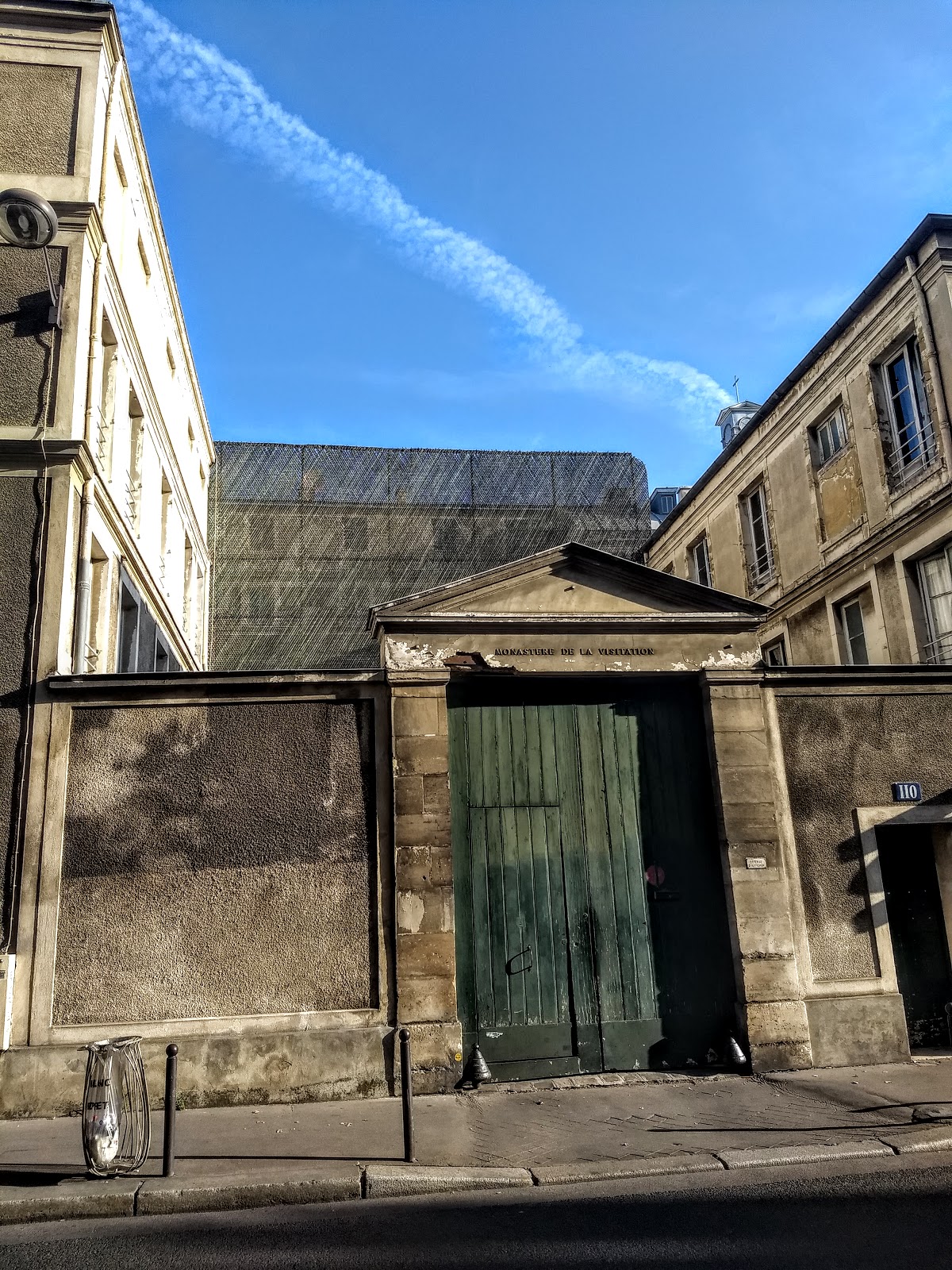
Turning onto the Rue de Vaugirard, I was reminded that I was in church territory; venerable Catholic institutions seemed to be everywhere.  An austere Monastery of the Visitation caught my eye because of its coarse texture and disposition.

Monastere de la Visitation on the Rue de Vaugirard.

After I passed the Institut Catholique and its handsome St. Joseph de Carmes church, I saw the Luxembourg Gardens on my right.  The Rue de Vaugirard follows along the northern edge of that beautiful park, where Tom and I have fond memories because we spent some Septembers in an ancient apartment on the Rue du Canivet, nearby.
The Hotel Luxembourg Parc on the Rue de Vaugirard is where Faulkner stayed in Paris.
Just east of the Palais du Luxembourg, the French Senate's opulent building, the Rue de Vaugirard's beginning at the Sorbonne was where I left it.  At the boulevards St. Michel and St. Germain, I admired the recent restoration of the Roman baths at the Cluny.

Restored Roman baths at the Cluny (medeival museum).
The Rue Dante led me away from the Boulevard St. Germain toward the ancient center of Paris.

You can see the damaged top of Notre Dame as you walk down Rue Dante.

Where Rue Dante becomes Rue du Fouarre, you can see Notre Dame's towers.
Square René Viviani is to the left.

I finally stopped near the edge of the Seine, looking over at the horribly fire-damaged Notre Dame de Paris from the Square René Viviani, the site of Paris's oldest planted tree (a 400-year old Locust) and oldest church (St. Julien le Pauvre).
Square René Viviani.

The Square is next door to the legendary bookstore, Shakespeare and Company.  I was not expecting the bookstore to be open at 9AM, but it was.  Now that Bob's Bake Shop is operating out of the bookstore, being open at breakfast time makes sense.  Since I was still fasting, I turned away.

The walk to Old Paris took me a little over an hour.  I strolled back to the Boulevard St. Germain where I caught the line 10 metro at Cluny-La-Sorbonne to go home.  This was my first metro ride of the summer!

When I exited the metro at the Avenue Emile Zola station, I crossed the street to buy bread at the bakery.  Like an old villager, I selected a Pain Rustique (small country-style sourdough loaf).  The fast was over, and it was time to go home.

The fire-damaged cathedral of Notre Dame de Paris, in the harsh morning light. 
Photo taken from the corner in front of Shakespeare and Company bookstore.
Students of stone masonry at the Henri Guimard school, less than three miles away, are working
on the Cathedral's restoration.
***
Last night's dinner at La Gauloise was outstanding, just like it always is at that classic French restaurant on the Avenue de la Motte Picquet.  I dined on Coq au Vin, and Tom had beef filet, followed by profiteroles for me, and a sumptuous soufflé au Grand Marnier for Tom.  La Gauloise is one of our longtime favorite places.  The restaurant is beautiful, so we always want to dine indoors there (away from the outdoor smokers).  The service is mature, professional, and gracious.  Perhaps this resto is a little expensive, but at La Gauloise, you get what you pay for.  We highly recommend this restaurant!  Here are some photos for you foodies:

The lovely and spacious interior of La Gauloise.

The Coq au Vin arrived at the table in a cast-iron pot (below), and the puréed potatoes came in a separate bowl.
You spoon this classic dish onto the plate yourself.  This is the best comfort food imaginable!  And
La Gauloise does it absolutely perfectly.


Tom's beef filet was tender, juicy, and topped by truffle shavings.
It was served atop a potato pancake of sorts, with a pool of rich, dark sauce.
The profiteroles are filled with the famous ice cream from Berthillon,
 and the sauce is so rich and good that I think it must be made with Valrhona chocolate.
Tom's soufflé au Grand Marnier, after it was punctured and more
Grand Marnier was poured into it.  This is divine dessert!

Saturday, July 20, 2019

Good things to come

The City of Paris plan for transforming the Trocadero, Pont d'Iéna, and Champ de Mars into a unified park is much more that it appears at first glance.
Last night we dined at Le Select, a bistro very near our apartment on the Avenue Emile Zola.

The plans will add 5 acres of green space to what is already there, and it will reach out to both sides in the creation of vegetated pedestrian ways and other amenities.

Where it reaches out into the 15th arrondissement (the tower itself is in the 7th arrondissement), the plan calls for a Promenade Bir Hakeim all along the Quai Branly, from the Eiffel Tower to the Bir Hakeim bridge and metro station.

Ports are down at the riverbank level; a quai is up at the street level.  So while the river bank is already pedestrianized in this area, the quai is still mainly for cars.  The Quai Branly has much potential for a promenade plantée because the pedestrian space is there; it just needs to be improved with trees, shrubs, and flowerbeds to separate the people from the cars.
We each ordered a sea bass filet with a perfect beurre blanc sauce.

Public art will be added here and there along the promenade, and so will informative/educational signs or plaques.

A soccer field called the Stade Emile Anthoine will remain, but its ample extra space will be used to house a youth center, a gastronomic center, and the offices for the company that operates the Eiffel Tower.

The center for  "haute gastronomie" interests me.  Is it a cooking school?  I hope so!

The triangular space in the intersection of the Rue Jean Rey and the Quai Branly will become a new public square, the Place Emile Anthoine -- a perfect place for Tom and me to rest after we've been walking for a half an hour or so.

This promenade and the Place Emile Anthoine are just two small pieces of the grand plan for this huge, unified park.  The total price tag for the park is about $80 million, and the completion is scheduled for 2024 -- in time for the Paris Olympics.

Paris can do it.  I am thrilled to be able to see this transformation in the coming years.
Wild paintings in the window of Espace Ysmailoff on the Avenue de Suffren.

Friday, July 19, 2019

Paris at the gentle speed of walking

Paris is still the territory of flaneurs like us -- people who love to walk.  We have the time to walk.  We let the city soak in at that gentle speed of walking.

For those who need to move faster and who want to stay above ground, out of the subway, bicycles and scooters are available everywhere for a minimal rental fee.

Walking home along the Rue Mademoiselle last night, toward the church of St. John the Baptist of Grenelle.

The City of Paris has been making improvements to bicycle lanes and paths at almost every opportunity.  This morning, I noticed the bike lane on the broad Quai André Citroen, which is said to be representative of the City's currently favored type of bike-way.  It is part of a network that includes bike-ways paralleling the full, parabolic length of the Seine in the city, connecting the suburb of Issy-les-Moulineaux on the west to Ivry-sur-Seine on the east. 

Bi-directional bike lane on the Quai André Citroen.  The
same type of lane was created this year on the Quai de Grenelle.
Many narrower one-way streets in Paris have bike lanes that go in the opposite direction -- the contre sens.  The Rue du Commerce, where we walk most often, is one of those streets.  As pedestrians, we must always remember to look both ways when crossing this street since this contre-sens bike lane was painted.  That's easy to forget.  A number of serious accidents have resulted from these opposite-direction bike lanes.  So the elected officials of the 15th arrondissement have "denounced the quality of the implementation of the opposite-direction bike lanes."  Subsequently, the Paris City Council has recommended improvements to be made.  We shall see . . . .
Foot-operated bike tire pump in the Place St. Charles.

This year, we have noticed that City has installed bike tire pumps in many public squares.  How nice!

Tom and I think bicycling in the city is still too dangerous for us, and we do not own bike helmets.  One should never bicycle without a helmet when surrounded by concrete, metal, and stone!

We walk.  Our goal is about 5 miles a day.  If we walk much more than that, we risk damaging Tom's hip and my knee.  But I consider 5 miles of walking to be a minimum amount of daily exercise. 

Parisian women are increasingly wearing sneakers instead of stylish shoes.  I do have sneakers that I wear here sometimes -- but they have a floral pattern, so I think they're acceptable.  I bought them last year, right here on the Rue du Commerce.

Yesterday, we made the mistake of putting our walk off until evening.  Then it rained enough to nix the long walk after dinner that we'd planned.  Even so, we walked over a mile just to go to dinner and back.

Dinner was at Bacco, and French-Italian restaurant on the Rue Mademoiselle, near the old center of the former village of Grenelle.  We began by sharing a Burratina (Italian cheese that's better than mozzarella), and then proceeded with milk-fed pork and risotto for Tom and prawns with risotto for me.  It was all very good, if a bit too salty, and the service was warm and professional.

Bacco, a French-Italian restaurant on the Rue Mademoiselle.
I like the modern decor of Bacco, plus the fact that the old wood beams of the old village-y building are still visible on the ceiling.

Cochon de lait (milk fed pork) and risotto cubes at Bacco.

Prawns with risotto at Bacco.

The welcome rain intensified as we walked home, hugging each other under my little umbrella. 

This morning, I walked the full length of the Rue Saint Charles outdoor market (Tuesdays and Fridays).  Then I strolled up to the Beaugrenelle shopping area, and down the ramp to the Port de Javel to get a look at the Statue of Liberty's face before I went home; I usually see her back, from the Allée des Cygnes.


There she is, lighting up the world with the promise of welcome to the tired, the poor, the huddled masses yearning to breathe free.


Thursday, July 18, 2019

Swan's Way to OZ, then dinner in the Cosmos

The somewhat neglected but nevertheless lovely Île aux Cygnes is getting the attention it deserves, at last.

Here's a translation of recent happy events announced in the town hall's magazine for the 15th arrondissement:

The Seine, on the 15th arrondissement side.
The Île is now protected as a UNESCO World Heritage site. Following a vote taken in the Paris Council in November 2018 by the municipal majority of the 15th at the initiative of Claire de Clermont-Tonnerre, the emblematic island of our arrondissement has just been integrated into the protected perimeter of the Banks of the Seine project, following a vote of the Paris Council in June. This artificial dike, dominated by the famous Statue of Liberty illuminating the world, is an exceptional place of biodiversity with the presence of 250 trees, including about sixty different species from the whole world (China, Japan, ...).  It should be noted that a renovation project was submitted as part of the 2019 Partial Budget by the Emeriau/Zola Neighborhood Council.

The "Swan's Way" (Allée des Cygnes) is the walkway that courses straight down the middle of the long, narrow island, connecting the Bir Hakeim and Grenelle bridges.  Swan's Way is our favorite place to walk during the late afternoon rush hour on a warm summer day.  The Allée is lined by those 250 trees, and the island is surrounded by the serene waters of the Seine instead of automobiles driven by people in a hurry.

Allée des Cygnes, or Swan's Way.
The headquarters of UNESCO are not far away -- they're even partly in the same arrondissement.  I wonder what took so long for this recognition to happen.

For a while, it was unclear as to which arrondissement the island belongs to.  Neither one seemed to take much responsibility for it.  The island has probably always been officially in the 15th, because it was created as part of a project to benefit the ports on the 15th's side of the Seine.  Nevertheless, several French journalists would refer to it as a part of the 16th, perhaps because so many people from the 16th use it for their daily walks and jogs.

That part of the 16th is deprived because it does not have a decent place to walk on the bank of the Seine; instead, it has a highway named for Georges Pompidou.  This stretch of the 15th, however, has -- in addition to the Île aux Cygnes --  a very walkable bank where two long ports are located -- the ports of Javel and Grenelle, which are home to many houseboats, a yacht club, sightseeing boats, and even river cruise ships.  This bank is an awesome place to walk and to ride a bike -- never-mind the cobblestones.

Last night, Tom and I walked the length of the island and strolled back toward home on the Rue Saint Charles.   Tom came to a standstill in front of 18 Rue Saint Charles.  What stopped him was a sign on a barbershop offering haircuts to men for only 12 euros.
Tree on the Rue Saint Charles.

That's even less than the 13 euros he's been paying at Look Coiffeur, a barbershop on the considerably less scenic Rue de la Croix Nivert.

This barber shop on the Rue Saint Charles -- named Coiffeur OZ -- is a little bigger and a little nicer than Look, too.  The owner came to the doorway to see if Tom was a customer, and Tom asked if the shop was going to be open long enough for him to get a much-needed haircut.  The answer was yes, so I promptly said I'd wait down at the square (intersection of the rues Saint Charles and Théatre).  The barber in the doorway seemed to be relieved when I said this.  

I think that wives do not wait inside barber shops like Look and OZ, which are run by men from North Africa.  How do I know this?  Just by instinct, I guess.  At any rate, I'd rather have a small glass of wine on a brasserie terrace on the peaceful square while I wait, thank you.

I'd not even finished that small glass when Tom came strutting down the street, newly and neatly shorn.  He described a funny conversation he'd had with the barbers as he tried to explain why his hair was growing in wildly different directions -- it is because of the medication he's taking.  It took a while for the mystified barbers to understand the relationship between the medication and Tom's crazy hair.

But they did seem to be satisfied with the explanation after a while.  Then the haircut was quick and efficient, resulting in very short hair.  I call Tom my Velveteen Rabbit, partly because of his short, silver hair, and partly because he is like the Energizer bunny (complete with drums and cymbals), and partly because Tom really likes rabbits.  He used to have a pet rabbit when he was a kid.

I digress.  

As we walked from the square toward home, we decided to try one of the brasseries very close to our apartment, on the Avenue Emile Zola.  We selected Cosmos, where all the tables on the sidewalk were occupied, and one nice table in the corner window seemed to be available.

Le Cosmos Café, a neighborhood brasserie where people drink cold beer on warm evenings.

We were welcomed and seated at that table, which had no other tables near it.  The bar was close by.

At the bar, a woman in flip flops was seated, with her two quiet, little, fluffy dogs nestled beneath her barstool.

The dogs were quiet until food arrived at our table -- a rack of lamb for me, and a burger with fries for Tom.
Two little dogs, trying to behave in the brasserie.

The dogs then began to whimper, whine, and beg.  After several minutes of listening to this pathetic serenade, Tom and I began to laugh.  We couldn't help it.

The food?  My rack of lamb and green beans were delicious, and the sautéed potatoes were terrible.  Tom's hamburger and fries were good.  Cosmos is obviously popular in the neighborhood.  Most people there were drinking large glasses of beer.
Rack of Lamb at Le Cosmos.

Hamburger and fries at Le Cosmos.

What a fine way to finish a warm summer day.

Wednesday, July 17, 2019

Solidarity, served cold

Remember how you felt when you got your first library card of your very own?  You felt like the world was now accessible to you, right?

We were almost that excited to get our library cards at the American Library of Paris yesterday.  Because this is a private library, these cards cost us about a hundred euros for a four-month family membership.
La Terrasse brasserie, where we had a simple dinner on Monday.
Two of the books we needed for work were there, on the shelves in the open stacks.  We checked them out for a few weeks. 

We noted that the library, which is open Tuesday through Saturday from 1pm to 7pm, is air conditioned.  This may come in handy next week when we are supposed to have another three-day heat wave.  Brains work better when heads are cool.

The second edition of Norton's Huck Finn was edited just by
Tom, even though first edition editors' names are still on the book.
The other book is Tom's Ivory Leg in the Ebony Cabinet:  Madness,
Race and Gender in Victorian America
.  Ever wonder where our
nation's current racism comes from?  This book will tell you.
The library is a 30-minute, gentle walk from our apartment, on the other side of the Eiffel Tower and Champ de Mars -- in the 7th arrondissement, which is home to so many important institutions.  The address is on the little Rue du Général Camou, which has a great view of the Eiffel Tower at one end, and a lovely view of the ultra-Art Nouveau building designed by Lavirotte at the other end.

When we arrived home, books in hand and library cards in pocket, we had just enough time to rest and clean up for dinner at one of our favorite restaurants, L'Ardoise du Quinzieme -- another 30-minute walk away.  The name of the place means Blackboard of the 15th -- the blackboard referring to the slate where the daily specials are listed.

We both selected the Pluma d'Ibérique --- a Spanish or Basque cut of tender pork -- for the main course.  It was sautéed and served with a sauce made from its juice, accompanied by a delicious pile of gently cooked peas, lima beans, tomatoes and carrot slices.  The dish was colorful and tasty.  Because there was more meat than we eat in a meal, we slipped a couple plumas in a plastic bag to take home.  We fight against gaspillage, or the wasting of food.
Pluma d'Iberique at L'Ardoise du Quinzieme.

Dessert was a brioche perdu (like French toast with caramel sauce) for Tom, and a peach melba for me.  These were both absolutely delightful.  The peach was covered in a raspberry sauce that could not have been better.

Over dinner, I told Tom about an article I saw on a City of Paris web site about "frigos solidaires" (unity fridges).  These are glass-doored refrigerators placed out in front of a restaurant or other business during the day to provide refrigerated food to those in need.  The food is donated by businesses or residents in the neighborhood.

Peach Melba at L'Ardoise du Quinzieme.

Here in Paris, this aspect of the anti-gaspillage movement was started by a young restaurateur, Dounia Mebtoul, who had seen them in use in London, where she had worked for a while.

Food in the unity fridges can be fruits, vegetables, biscuits, groceries, and products with an expiration date that has not passed and that are still in their packages.

The first of these unity fridges was placed in front of La Cantine du 18e -- the restaurant run by Dounia and her mother, Malika -- in June 2017.   Every day, about 40 donors put food in this fridge.  About 50-some people take food out of it, including students, retirees, people with large families, single-parent households, and homeless folks.

Brioche perdu at L'Ardoise du Quinzieme.
Dounia says the fridge creates ties between the recipients and the donors -- and even the customers at the restaurant.  They have discussions and undertake projects together.  This puts a new spin on the expression "waste not, want not."

Several months after the appearance of this first unity fridge, an organization called Identités Mutuelle became interested in the undertaking.  They formed an association, Les Frigos Solidaires.  As a result, these unity fridges are popping up all over France.  The Paris city council has also committed to financing 15 of these fridges as a part of the city's Tous Récup project.

If even half of these fridges create the kind of good will and synergy that Dounia's first fridge has, the city -- even the world -- will be a better place for all.