The Rue de Vaugirard is the longest street in Paris because it was not in Paris when it was created -- it was the country lane from the edge of the city to the village.
 |
| The beginning of Rue de Vaugirard, across from Place de la Sorbonne. |
The country lane began on the Roman road that is now called the Boulevard Saint Michel. At this intersection you find the Place de la Sorbonne, the stately square overseen by the Sorbonne's iconic dome.
From that Place -- which almost anyone in Paris can find -- the Rue de Vaugirard takes an almost perfectly straight path to the west/southwest, all the way to the Place Henri Rollet, which was the site of the original Saint Lambert church, at about the center of the former village of Vaugirard.
 |
Apartment with arched windows for sale on
the Rue Mademoiselle in the 15th. |
The Rue de Vaugirard then continues to the Porte de Versailles near the edge of the modern-day city, where the street finally ends. It does, indeed, point the traveller in the direction of Versailles.
This morning, I walked the route that a person from Vaugirard would take in ancient times, to go to the burgeoning City of Paris.
But since I was starting from the former village of Grenelle, I had to first walk down the rues Mademoiselle, Lecourbe, and Sevres, then jog down the Boulevard du Montparnasse for a bit to pick up the Rue de Vaugirard. Taking this route allows the pedestrian to completely skip the 7th arrondissement. One proceeds directly from the 15th to the 6th.
On the Boulevard du Montparnasse is a classic café called Le Chien Qui Fume (The Smoking Dog). Its
terrasse is outlined by narrow planters full of pink geraniums. On a planter is written "
bac à fleur - non un cendrier" (flower pot, not an ashtray). Evidently, some smokers have poor manners.
 |
| Sign at Le Chien Qui Fume on Boulevard Montparnasse. |
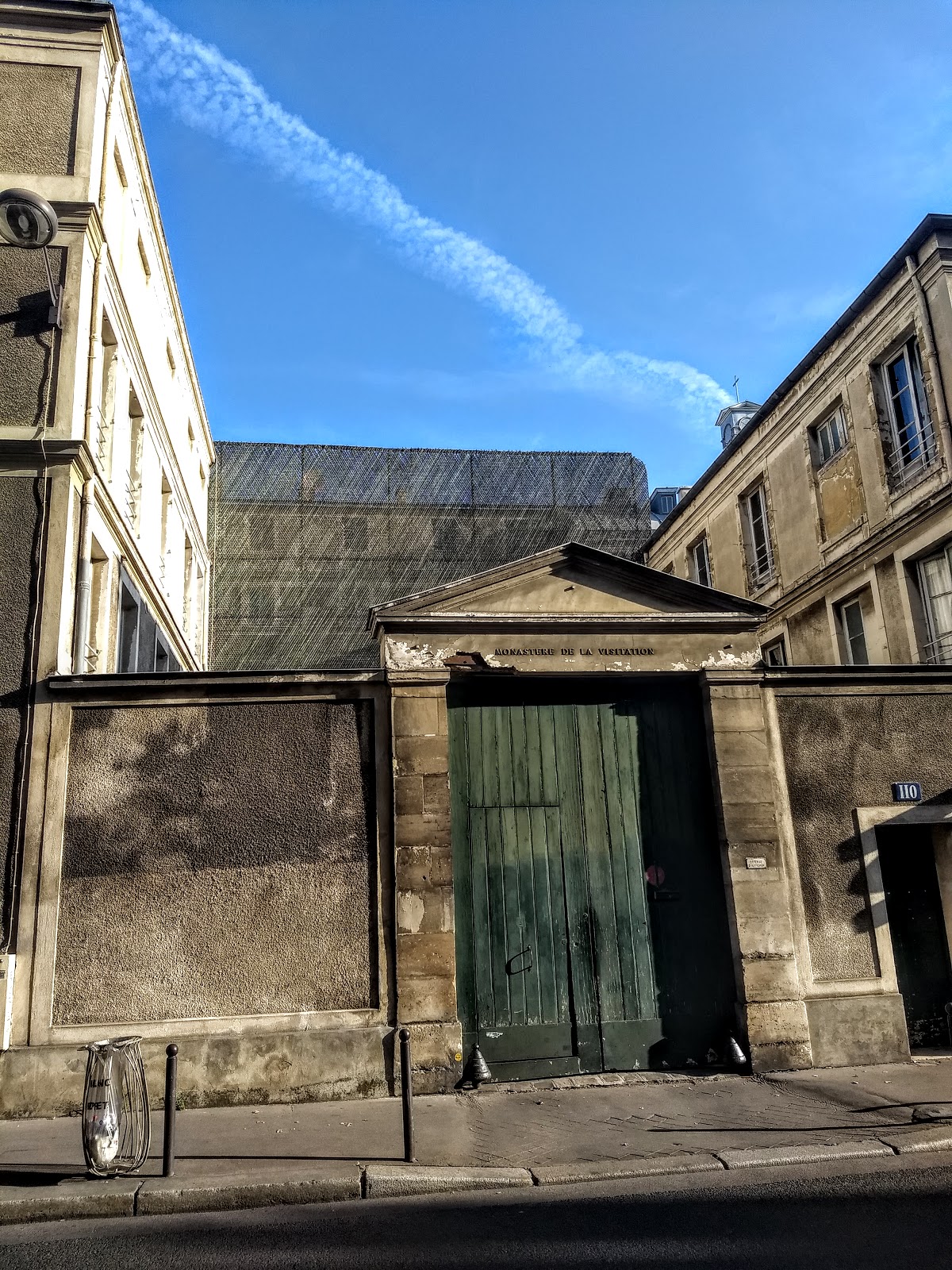
Turning onto the Rue de Vaugirard, I was reminded that I was in church territory; venerable Catholic institutions seemed to be everywhere. An austere Monastery of the Visitation caught my eye because of its coarse texture and disposition.
 |
| Monastere de la Visitation on the Rue de Vaugirard. |
After I passed the
Institut Catholique and its handsome St. Joseph de Carmes church, I saw the Luxembourg Gardens on my right. The Rue de Vaugirard follows along the northern edge of that beautiful park, where Tom and I have fond memories because we spent some Septembers in an ancient apartment on the Rue du Canivet, nearby.
 |
| The Hotel Luxembourg Parc on the Rue de Vaugirard is where Faulkner stayed in Paris. |
Just east of the Palais du Luxembourg, the French Senate's opulent building, the Rue de Vaugirard's beginning at the Sorbonne was where I left it. At the boulevards St. Michel and St. Germain, I admired the recent restoration of the Roman baths at the Cluny.
 |
| Restored Roman baths at the Cluny (medeival museum). |
The Rue Dante led me away from the Boulevard St. Germain toward the ancient center of Paris.
 |
| You can see the damaged top of Notre Dame as you walk down Rue Dante. |
 |
Where Rue Dante becomes Rue du Fouarre, you can see Notre Dame's towers.
Square René Viviani is to the left. |
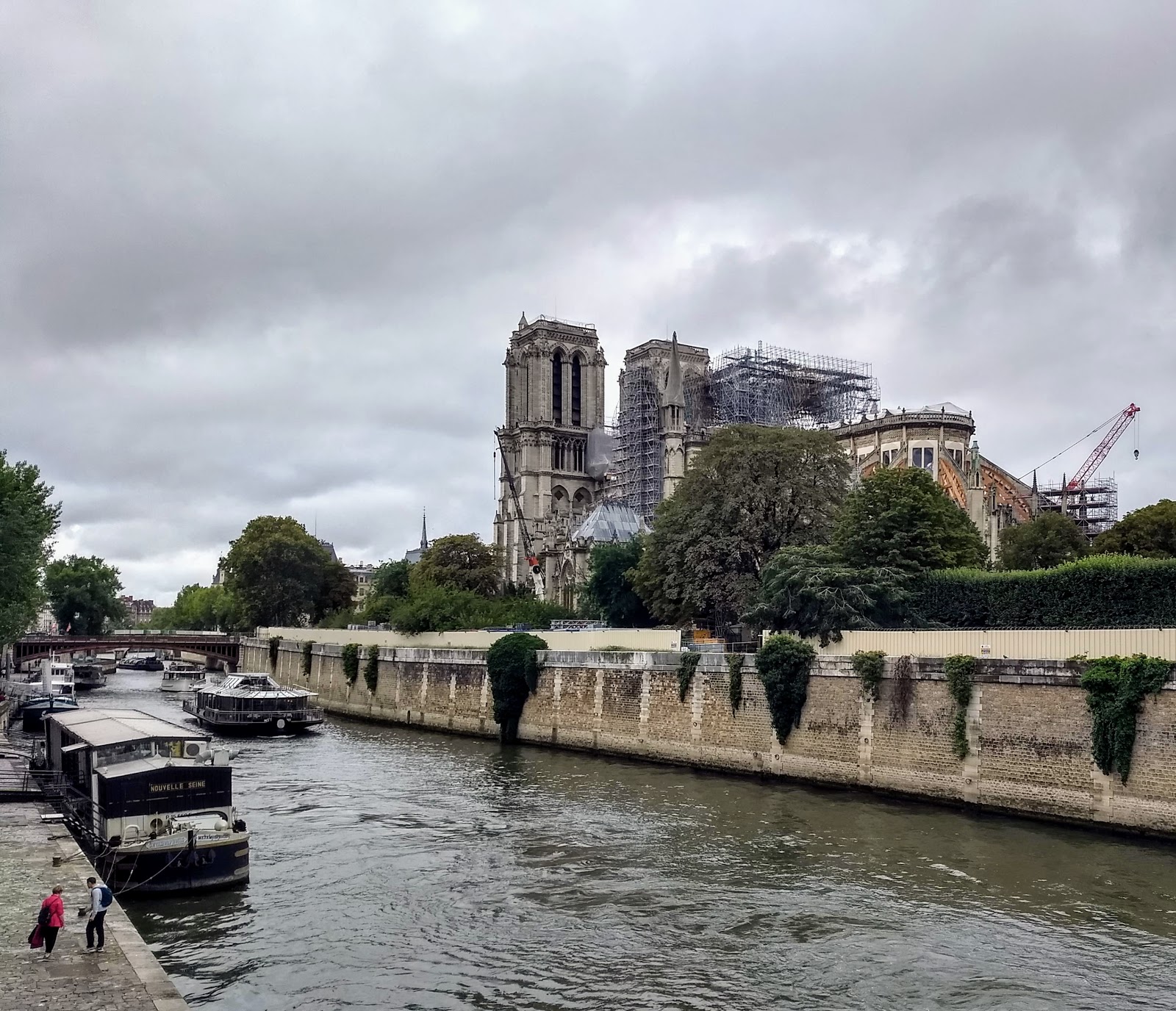
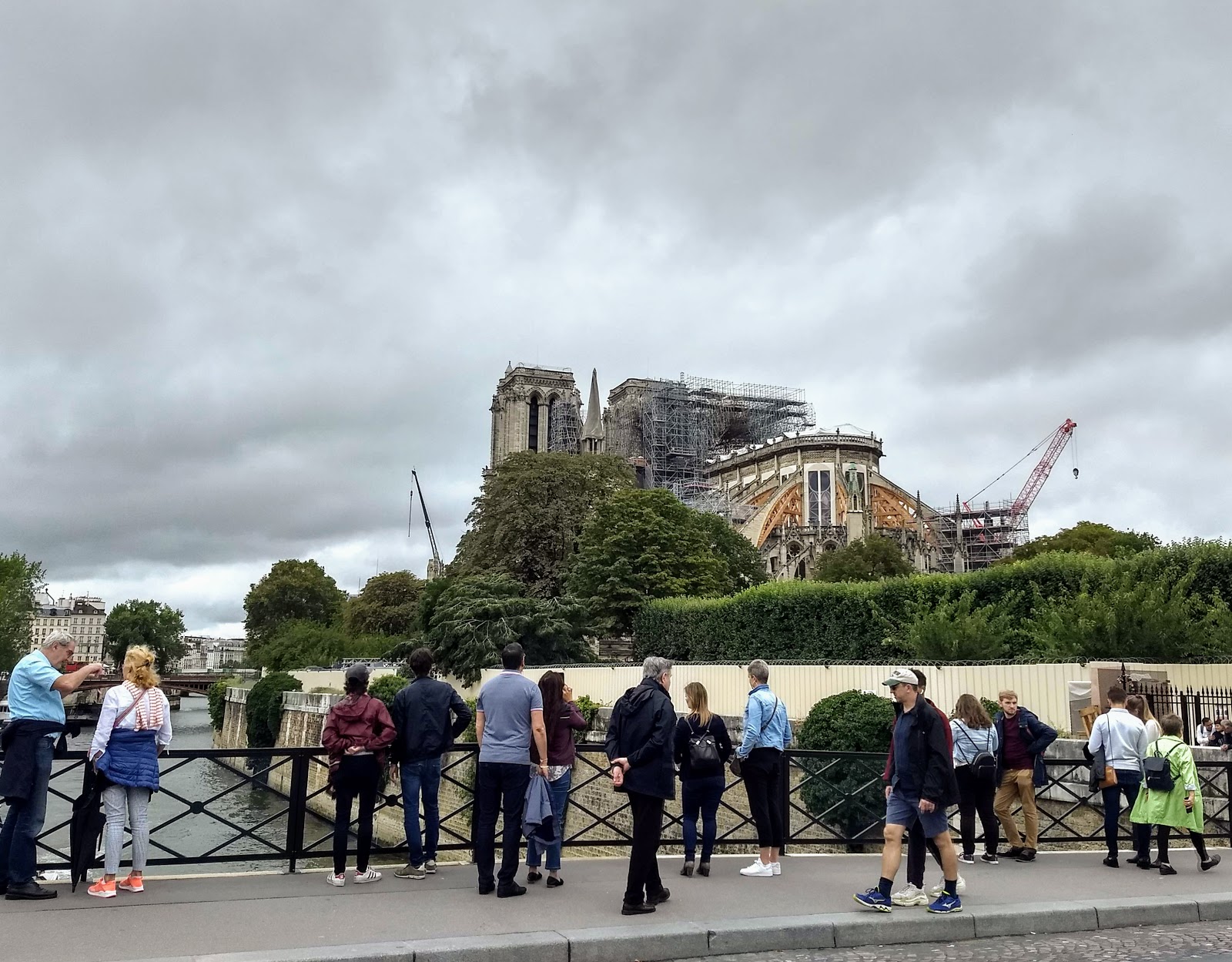
I finally stopped near the edge of the Seine, looking over at the horribly fire-damaged Notre Dame de Paris from the Square René Viviani, the site of Paris's oldest planted tree (a 400-year old Locust) and oldest church (St. Julien le Pauvre).
 |
| Square René Viviani. |
The Square is next door to the legendary bookstore, Shakespeare and Company. I was not expecting the bookstore to be open at 9AM, but it was. Now that Bob's Bake Shop is operating out of the bookstore, being open at breakfast time makes sense. Since I was still fasting, I turned away.
The walk to Old Paris took me a little over an hour. I strolled back to the Boulevard St. Germain where I caught the line 10 metro at Cluny-La-Sorbonne to go home. This was my first metro ride of the summer!
When I exited the metro at the Avenue Emile Zola station, I crossed the street to buy bread at the bakery. Like an old villager, I selected a Pain Rustique (small country-style sourdough loaf). The fast was over, and it was time to go home.
 |
The fire-damaged cathedral of Notre Dame de Paris, in the harsh morning light.
Photo taken from the corner in front of Shakespeare and Company bookstore.
Students of stone masonry at the Henri Guimard school, less than three miles away, are working
on the Cathedral's restoration. |
***
Last night's dinner at La Gauloise was outstanding, just like it always is at that classic French restaurant on the Avenue de la Motte Picquet. I dined on
Coq au Vin, and Tom had beef filet, followed by profiteroles for me, and a sumptuous soufflé au Grand Marnier for Tom. La Gauloise is one of our longtime favorite places. The restaurant is beautiful, so we always want to dine indoors there (away from the outdoor smokers). The service is mature, professional, and gracious. Perhaps this resto is a little expensive, but at La Gauloise, you get what you pay for. We highly recommend this restaurant! Here are some photos for you foodies:
 |
| The lovely and spacious interior of La Gauloise. |
 |
The Coq au Vin arrived at the table in a cast-iron pot (below), and the puréed potatoes came in a separate bowl.
You spoon this classic dish onto the plate yourself. This is the best comfort food imaginable! And
La Gauloise does it absolutely perfectly. |
 |
Tom's beef filet was tender, juicy, and topped by truffle shavings.
It was served atop a potato pancake of sorts, with a pool of rich, dark sauce. |
 |
The profiteroles are filled with the famous ice cream from Berthillon,
and the sauce is so rich and good that I think it must be made with Valrhona chocolate. |
 |
Tom's soufflé au Grand Marnier, after it was punctured and more
Grand Marnier was poured into it. This is divine dessert! |