Tuesday, August 08, 2017

Another lovely day

A beautiful day for photographing the Eiffel Tower.

August 8, 2017 – I’ve been reading “The Lost Mandate of Heaven,” by Geoffrey Shaw, for the past four days – in between all the walking and dining in Paris.  Last week, Tom and I met Nicole, a member of the Ngo Dinh family that figures so prominently in this book about the build-up of the Vietnam War and the assassination of Ngo Dinh Diem in 1963. 

I’d hoped that the book would be more focused on the family, but instead it is more focused on military and political history of that tumultuous time.

For military history buffs, I highly recommend this book.  It is well-written and well-documented, by a historian who has excellent credentials.  For the first time, I feel like I understand how the Vietnam War became the quagmire and disaster that it was.

There are plenty of lessons learned from that era.  I can see how many apply in a country like Afghanistan. 

The square and fountain behind the church of St. John the Baptist of Grenelle.

Tom was in the Naval ROTC program at Duke in the early 1960s, the time period that the first several chapters of “The Lost Mandate of Heaven” covers.  He remembers that most people he knew then had not heard of Vietnam.  But then one day, one of his NROTC classmates said that his father had been shot down over a place called Vietnam.  By 1964, when Tom went into active duty after graduation, he and his NROTC mates were slated to go on a radar picket ship, which would likely go up the Mekong River and be fired upon by the Vietcong.  Then Tom’s orders were changed, unbeknownst to him, because the Navy needed an English instructor in Maryland.  Thank heavens.

To read about the discord and disagreement among the top military and political leaders when it came to the subject of how America should be involved in Vietnam makes me sad, but also makes me hope that history will not repeat itself; much more consideration should be given to saving lives.
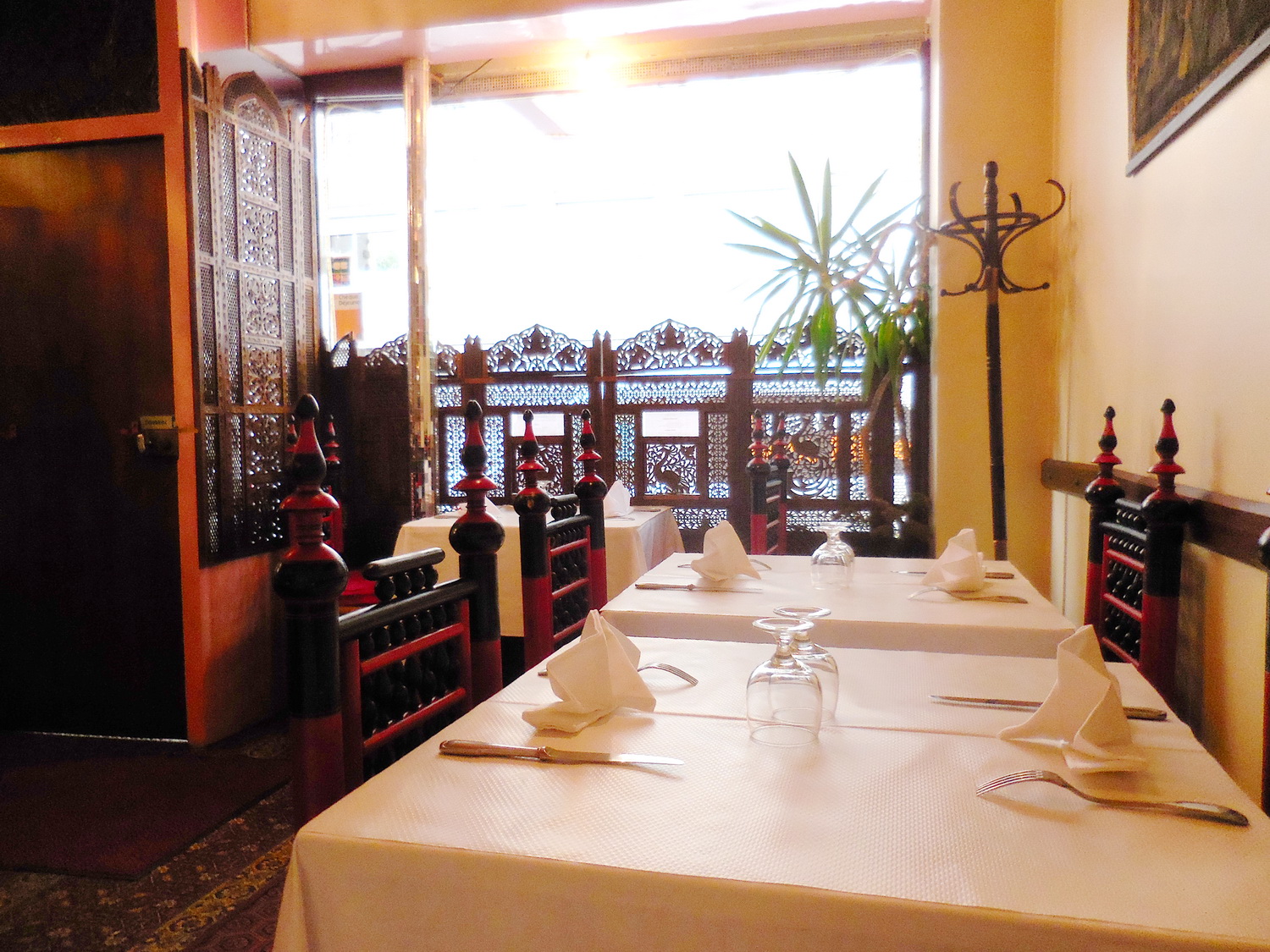
Dining room at Le Tipaza on the rue St. Charles.

I put the book aside for a while yesterday so that Tom and I could go for a great couple of walks in the neighborhood.  First, we wanted to explore Boulanger, the small- and large-appliance store that has replaced the big old hardware store, Zola Color, that we had frequented over the years.

Boulanger did a fabulous job renovating the tired old Zola Color space, which is vast.  Everything about Boulanger is well-displayed and well-run.  The employees are a far more cheerful and helpful lot than those at Darty, its tired old competitor. 

I think the employees at Boulanger must be treated and paid better than those at Darty.

Tom especially wanted to look at the laptop and tablet computers, because he wants to get something smaller than his laptop when we return to the U.S. 

We’d never buy a computer in France because they have AZERTY keyboards instead of QWERTY keyboards, and we are rapid touch typists on the QWERTY boards.  Also, I think computers bought in the U.S. have better encryption, but I’m no expert on that.

In each department that we explored at Boulanger (except for the computer area, where they left us alone), a friendly employee asked if he/she could help us, and after we explained that we were just looking, they did not bother us.  Even the security guard at the entrance struck up a friendly conversation with us.
Dining room at Le Tipaza.

We took our time looking at all the kitchen appliances, big and small.  We’d just renovated our kitchen back home, so this was of great interest.  I especially noticed the brand names – Cuisinart was not among the various food processors on display, and Kenwood makes mixers and blenders.  Go figure.

Boulanger is the place for audiophiles.  The set-up for displaying and listening to speakers is impressive.

All we bought was a nice pair of Sony earphones for Tom. 

Later, we walked along the peaceful Ile aux Cygnes, and then explored the large Zara store at the Beaugrenelle Center.  Time flew by, and we had to walk briskly to dinner at Le Tipaza on the rue Saint Charles. 

We were warmly greeted there, as usual, and we took our seats in the elegant middle dining room.  I noticed that Kir Royals are reasonably priced there, so I had one.  Then I ordered at Tagine Royal, and Tom had the Grillade Royale – a dinner for royals all around.

Tom indulged in the traditional North African pastries for dessert, and I had a heavenly, homemade, dark chocolate mousse.


We both appreciated the long stroll home after that feast.

Sunday, August 06, 2017

Peace on the Promenade Pereire

The Arc de Triomphe, from the avenue de la Grande Armee.
August 6, 2017 – Maps inspire many of our walks in Paris.  In particular, “L’Indispensable,” what I call the “book of maps,” is my indispensable reference.

I no longer take the book of maps with me on our walks.  I simply peruse it in the apartment, settle upon a walk in a particular area, map it out in my head, and, if it is complex, I make an ordered list of metro stations and streets on a small slip of paper which I stuff in a pocket or my camera bag.

We know Paris well enough that if we stray from the planned route, we can always find our way.  We don’t get lost – or, at least, I don’t.  Tom relies on me for the most part when it comes to navigating Paris.

The Promenade Pereire begins behind the
Neuilly-Porte-de-Maillot-Palais-des-Congres commuter train station.
Keeping in mind the arrondissements that we don’t frequent as often, I was staring at the map of the 17th arrondissement and decided that the boulevard Pereire, with its wide green median, might be a promising walk.  To get there, we’d take the line 6 to Etoile and we’d be sure to exit that huge metro station on the back side of the Arc de Triomphe, on the avenue de la Grande Armée.

That avenue seems even wider than the Champs Elysées.  We walked its full, wind-swept length and turned onto the boulevard Pereire at the Place de la Porte Maillot on the northwestern edge of Paris.  A huge concert hall and convention center called the Palais des Congrés presides over that intersection.  Supposedly this modern 1974 monstrosity also contains a shopping center.

The Promenade Pereire
As soon as we were on the boulevard Pereire we were back in Paris, we could tell.  Flowers and trees rule the center of that boulevard, and stately Haussmannian apartments dominate its sides.  Most of the way, we were able to amble through the parks that make up the median of that boulevard.  One small section was closed for repairs, and two other little parcels where what looked like day-care centers were located were also closed off.

The walk down this median is called the Promenade Pereire, clearly a relative of the Promenade Plantée in the 12th arrondissement.  The Pereire, opened in 1989, requires and receives even more maintenance than the Plantée; the lush flowerbeds include plenty of Impatiens, which are known for their thirst.

Impatiens and other flowers along the Promenade Pereire.

The neighborhood around the Promenade Pereire is remarkably calm and quiet, especially in August.  There are very few commercial venues in that quartier; the neighborhood is almost purely residential, with little automobile traffic.  In these ways, the Pereire is also different from the Promenade Plantée.

The beautiful Promenade ended at the rue Alfred Roll, but we continued to walk along the boulevard Pereire to the Place de Wagram, because that stretch was still lovely and quiet, with huge trees lining the banks of a ravine with a railroad track at the bottom; that ravine formed the center of the boulevard.  The track is part of the Petite Ceinture; an abandoned beltway train.  But here, instead of running along the outer border of Paris, the Petite Ceinture goes straight through the middle of the 17th arrondissement, in a chic neighborhood.

The Promenade Pereire.
We walked the full length of the avenue de Wagram, stopping for refreshments at a well-worn but nice restaurant called La Compagnie.  It was the first place we found that was open!  There isn’t much commercial at all in this part of the 17th, and what little there is tends to be closed in August.  Even though it was a little pricey, we appreciated La Compagnie just for being there, but also for the high quality of the bit of food we consumed – luscious raspberries and strawberries with a small side of whipped cream – heavenly.  Tom said his coffee was perfect, and my glass of rosé was crisp and cold.

Fortified, we went on down the hill toward Etoile.  We found our way through the mob around that most famous, giant round-about to the calm avenue Marceau, where the downhill slope became steeper.

We would have visited the church of St. Pierre de Chaillot, but it was closed for the month!  I never heard of a church closing for a month for vacation. 

Carvings on the front of the church of
St. Pierre de Chaillot include a fire-breathing alligator.
As we approached the Pont de l’Alma I noticed that a small crowd had gathered around the flame sculpture there, paying homage to Princess Diana. 

We crossed the Seine, admired the new Russian Orthodox Church again, and walked down the avenue Rapp to the Champ de Mars, where we rested on a park bench for a while.  Tom was very hungry, so he asked me to reserve a table via lafourchette.com at our new, favorite Italian place in the ‘hood, Pietro Commerce.

We had only about a half hour to recuperate in the apartment before leaving it again to walk to dinner.  Fortunately, the restaurant wasn’t far.

Cool apartment with a huge arched window, great balconies, and
 gold decorations at the top of a building on the
avenue Wagram, across from La Compagnie restaurant.

As we sat in the open terrace window across from the church of St. John the Baptist of Grenelle, the bells began to ring loudly for the 7:30PM call to the 8PM mass.  The bells rang again at 8, but not quite as vociferously.  I wondered if church attendance is up during these troubled times?

Aside from the loudly ringing bells, we had a peaceful dinner in the popular neighborhood resto.  Tom ordered the beef carpaccio again; he says it is the best at Pietro.  I ordered calamari and spinach with linguini.  I hadn’t eaten pasta in a long time.  It was great – especially because of the garlic and great parmesan cheese.  Tom had a café gourmand special – an especially generous assortment of little desserts with an excellent cup of coffee on the side.

And so, as we returned to the apartment, another 20,000-step day came to an end. 


Saturday, August 05, 2017

Yesteryear to this year

Mock Roman temple of Sybil in the Parc des Buttes Chaumont
August 5, 2017 – The Buttes Chaumont offers a panoramic view of the north stretches of Paris, along with lots of fresh air, a mountain breeze, acres of sloping lawns, and a forest of mature trees.  At the top of one of its peaks is a folly of a Roman temple of Sybil.  That’s the peak we chose to climb.  Then we walked across a pedestrian suspension bridge designed by none other than Gustave Eiffel. 

Suspension footbridge designed by Eiffel.

The Parc des Buttes Chaumont is majestic, located in a neighborhood that is not majestic.  In fact, the first thing we saw when we emerged from the subway in the Place Col. Fabien was the stark, modern Communist Party headquarters.  We walked past it, up the avenue Mathurin Moreau, to the park.  No other park in Paris gives me the sense of vastness that Buttes Chaumont does (technically, the huge Bois de Boulogne and the Bois de Vincennes are just outside of Paris).

We left the park and retraced our steps to the Place Col. Fabien.  Along the way, we saw the police pull over two different vehicles driven by similar looking men.  Both of them were sent on their way.  The police were evidently looking for someone in particular.  Some of the cops were wearing bullet-proof vests, and they all were armed.  We were mildly and momentarily unsettled about this, but we forgot about it within minutes.

We left the 19th arrondissement behind, and walked downhill into the 10th along the rue de la Grange aux Belles.  Beautiful it is not, but that street is important to us, and to the history of Paris.  It is the location of the enormous Hopital Saint Louis, the public hospital and research institute that specializes in blood disorders (among other things).  This is the place we will go to if Tom starts hemolyzing again as he did in November/December 2015.
The chapel of the Saint-Louis hospital


The hospital seems to be the size of a small city – 2,500 people work there.  It is comprised of many buildings, built in many different eras.  King Henry IV set the first stone for its construction in July 1607.  The hospital’s chapel was completed in 1608.

The original purpose of the hospital was to relieve the Hotel Dieu from having to take all the victims of the plague.  Its location was outside the city at the time, so it offered a place to treat and quarantine contagious patients away from the city center.

The hospital was initially supposed to be temporary; when the plague epidemic ended, it could be closed.  But the need for this huge hospital became year-round, for thirty years.  After those first three decades, the hospital was opened only periodically.  In 1773, following a fire at the Hotel Dieu, the Hopital Saint Louis had 3,600 patients and remained open for good.  Today, its specialties are dermatology, hematology, and cancer.

We did not feel the need to go in; we hope we never do.  Yet it is a great comfort to know that Hopital Saint Louis is there.
Colorful diner on the rue Lancry.
We continued down the hill on the rue de Lancry, and noticed that the neighborhoods were becoming more inviting and colorful as we approached the city’s center.  The rue René Boulanger brought us to the Porte Saint Martin, a grand arch that stands where one of the old medieval gates to the city was once located.

The rue Saint Martin was home to the former Priory of Saint Martin of the Fields, or Saint-Martin des Champs. 

On that site originally stood a chapel dating to the Merovingian dynasty.  A community of monks settled there, but their abbey was destroyed by the Normans in the 10th century.

In the year he died (1060), my ancestor, King Henry I, decided to rebuild the former abbey as a priory.  Its “des Champs” designation refers to the fact that it was outside the city walls at the time. 
The priory’s church was completed in 1135; too bad King Henry did not see it, because it is a Gothic masterpiece.

Saint-Martin-des-Champs church.


A little farther down the rue St. Martin we passed Saint Nicholas des Champs, a flamboyant-gothic-style church which is badly in need of restoration. 

After crossing the busy rue de Turbigo, we slipped into the charming, narrow passage de l’Ancre, lured there by a cute sign for a shop named Pep’s that restores parasols and umbrella’s.  We explored the passage, and then returned to the rue St. Martin.  We stopped for refreshments at a brasserie off the corner of the Place Georges Pompidou, where the famous Pompidou Center presides.

We’ve never seen so many people hanging out in that Place.  It seems uncomfortable, to sit on a slightly sloping surface of hard cobblestones for hours.  But so many young people were doing just that.
St. Merry church near the Pompidou Center.

We walked on to the church of St. Merry, just south of the Pompidou Center.  The church had its huge, red front doors flung wide open!  With its big doors open like this, the church sent a welcoming message. 

Inside the church’s gorgeous interior was a special installation by the Colombian artist Alejandro Tobon Rojas.    It consisted of hanging “nests” made of wood strips collected off the streets of Medellin.  The nests are like the nests of oropendola birds, a threatened species in South America.  A recording of the oropendola songs echoed through the church’s interior.  To see and hear this was an uplifting and moving experience. 
St. Merry Church with the "nests" by Alejandro Tobon.


We spent some time in that holy place, and finally we departed to continue our walk.

The next site was the little park where the beautifully gothic Tour Saint Jacques stands.  We saw two rats in that park.  I managed to photograph one of them.  The other scurried past Tom, and ran directly under the park bench where a man sat.  The man was startled, and raised his legs off the ground, but he did not squeal.

We stood calmly and stared into the shrubs and trees at the remaining rat -- Southwest Floridians who are no longer afraid of large rats.  We just don’t want them in our houses.  So we like snakes that eat rats.  This particular rat at the Tour Saint Jacques park had the look of a wild animal that lives in the woods.  He didn’t seem to be like urban rats I’ve seen before.  I wonder if he is a descendent of the famous rats of Les Halles, the former market that was not far from the park, or if his ancestors moved into the city like Remy’s family did in the movie Ratatouille . . . .

Along the Quai de la Megisserie, we enjoyed strolling through displays of plants and flowers, and then we ducked into the pet store to look at all the cats.  We love cats; however I’m allergic to them and Tom can’t live near a cat box.  Oh well.  We got our cat fix yesterday. 

We crossed the Seine on Paris’s oldest bridge, the Pont Neuf.  I checked to be sure one of my favorite jewelry stores is still there across from the Square du Vert Galant.  It is.

Crossing into very familiar turf in the 6th arrondissement, we window shopped the art galleries on the rue Mazarine and caught the line 10 metro at Mabillon.

In the evening, we managed to go out again on foot to dine at Le Pario, that magical place where the cuisines of France and Brazil are merged.

When we were home at last, we realized we’d walked more than ten miles that day.  Oh my.

 
Porte Saint Martin arch.


Friday, August 04, 2017

Crazy crowds and peaceful places

August 4, 2017 – Crowds – we hope to avoid them – especially crowds so thick you can hardly move.
That’s what we found when we emerged from the Palais Royale Musée du Louvre metro station and moved toward the entrance to the Musée des Arts Decoratifs.  This decorative arts museum is located in the west wing of the Louvre, but it has its own separate entrance on the rue de Rivoli.  If it didn’t seem to be too crowded, we intended to go visit it.  But the extremely long line told us that, even if we’d bought tickets online and avoided the line of people waiting to get in, we would still find a museum that was uncomfortably crowded inside.  

Perhaps it is the Christian Dior special exhibition that is drawing the large crowd.  We will try to go some other time; there is nothing we want to see so much that we’d endure a crowd like that.


Pink flamingos atop the Rosa Bonheure cafe barge, with the statues of the Pont Alexandre III in the background.
We walked down the rue de Rivioli, and on its eastern stretch, we found those sidewalks to be uncomfortably crowded, too.  We would have fled to the streets to the north of there except that Tom wanted to visit the English-language bookstores on Rivoli – Galignani and W. H. Smith. 

On our way from the crazy part of the rue de Rivoli to the bookstore part, we strolled more easily along the stretch that is home to some of the most luxurious hotels in Paris – Le Meurice, for example.  There was room to move there, without so many souvenir shops.

In the bookstores, Tom was looking for some French language books for English speakers.  He didn’t find anything he wanted to buy, but we both enjoyed browsing through the sizeable shops.  W.H. Smith, in particular, is looking much better organized and displayed than it did years ago.  Before the internet became so useful, we used to spend a large amount of money in these two bookstores every summer, along with Brentano’s on the avenue de l’Opera, during our summertime stays.  We did it even though their prices are jacked up.  That spending was necessary, because of Tom’s work on English composition textbooks. 

View from our table on the Rosa Bonheure.

He's still writing textbooks, but can find the readings and samples needed, for the most part, via the internet.

Once we finished looking around at W.H. Smith, we headed for the Place de la Concorde again.  I enjoyed the vast area away from traffic once again, and Tom tolerated the monumental space.  When we reached the Seine, we decided to descend to its banks on the left bank side.  Oh, this part of Paris is so much more serene than that crazy area around the Louvre and Notre Dame!  I guess we’re just naturally left bank people.

At the Rosa Bonheure café barge, we stopped for refreshments, as we often do.  There is more competition for the Rosa now, and half of the barge was closed for repairs.  So we shared the part that was open with only a few other customers.  We like the simple honesty of the Rosa Bonheure space, and its great view of the Pont Alexandre III.

Restaurant/cafe barges along the left bank of the Seine.
The Rosa seemed ready to welcome we South Floridians in particular; there were two pink flamingo floats on its roof.

We took our usual route home, pausing in the garden of the Musée du Quai Branly for a rest in the smooth white shelter that’s occasionally used for classes.

We crossed the Champ de Mars right at the foot of the Eiffel Tower.  The driver of a car pulled quickly onto the sidewalk in front of us and stopped.  That was a nutty thing to do.  We walked on, behind the car, when the driver suddenly put it in reverse.  We each reacted quickly and simultaneously by raising a hand in a “stop” motion and shouting, “HEY!”

Fortunately, the driver stopped and made an apologetic gesture when I turned to look at him as we walked quickly away. 

I thought, moments later, that this could have been one of those incidents when someone drives into a crowd, intending to harm people.  But it wasn’t that, thank heavens.  This was just some frustrated driver using poor judgement, desperately trying to turn around.

Statue representing Lille on the Place de la Concorde.
We should have avoided the crowd at the foot of the Tower.  We will from now on.

The rest of the walk was peaceful and uneventful.  Even a short trip into Monoprix for my V8 juice (the only place I have found it in Paris) was surprisingly serene; usually that Grenelle store is crowded in the late afternoon.  But vacation time is here.  Over in the left bank, at least, Paris is calmer than usual as Parisians close up and head for the countryside for a few weeks.

Meanwhile, tourists from elsewhere flood into Paris.  But they gravitate mostly to the first six arrondissements.  The Eiffel Tower is our neighborhood’s only major tourist attraction.
We’re glad of it. 

The vast space of the Place de la Concorde, in the middle of everything in Paris.


The shops that have not closed for vacation are offering special deals.  The para-pharmacy on the rue du Commerce was once again offering a super deal on liquid soap from Marseilles; just as we did two summers ago, we bought plenty for the apartment – probably enough to last for another two years.

As we dine in our favorite restaurants in the 15th, we dine with locals.  The occasional other English speakers show up, but often we are the only foreigners in the dining room.

Such was the case when we dined at L’Ardoise du XV  last night (70 rue Sebastien Mercier, off the rue St. Charles, just south of the rue de la Convention).  Our shared starter course was a country terrine that was home made.  Our main courses were a roasted guinea fowl breast with spring vegetables for me, and a pluma de negra dish of roasted pork with girolle mushrooms for Tom.  We shared a dessert that was a light version of a strawberry crumble.  As you’d expect in a restaurant run by someone (Maxime Vilatte and his wife Marie) who has earned the maître restaurateur designation, the food was all delicious and freshly made from top-quality ingredients – honest, simple, good food, beautifully presented.

Country terrine at L'Ardoise du XV.

We enjoyed our dinner there very much, and we were pleased that the restaurant is doing so well.  The place filled up with locals.  When the resto first opened just five years ago, it did so on a tight budget, we could tell.  We did not make it to L’Ardoise last year due to our abbreviated stay.  So it had been two years since we’d seen it, and evidently during those two years the resto has done well and built up a reliable clientele of locals.  We’re happy for the owners.

Thursday, August 03, 2017

Good things and good people

August 3, 2017 -- Health care costs are far lower in France than in the U.S.; we aren’t sure what the entire explanation for that may be.  Tom just had blood tests done here in Paris for 39 euros; these would have cost over $390 in the U.S.

We received the results only one day after the blood was drawn.  The blood was drawn at a laboratory that is only a few blocks from our apartment.  These labs are conveniently scattered all over Paris; we pass by them frequently on our walks.

The people working in the lab (the receptionists and the medical technologist) were all super friendly and helpful. 

Looking into Carte Blanche, and installation designed by Jacques Garcia at the Gobelins Galleries.


I won’t say that everything about the French health care system is better than we have in the U.S.  For example, I think the super-expensive medication that Tom is taking now (the one that is keeping him alive and well) is theoretically available in France, but it did not show up on the database of drugs that Tom’s doctor in Paris consulted.  Is that because the national health insurance here does not want to pay for a drug like that?  I don’t know, and I can’t find the answer on the internet.

We were very happy with Tom’s test results on Tuesday, and we celebrated by taking a pleasant walk in the 7th arrondissement, through the neighborhoods on either side of the Champ de Mars, and up the rue Chevert to the Square Santiago du Chili, a charming little park located off the northwest corner of Les Invalides.  We sat there on a park bench for quite a while, soaking in life on a beautiful day.

Looking down at the floor of Carte Blanche.

The Tuesday afternoon walk didn’t seem like much, but it added up to over 10,000 steps.  Then we walked to Le Blavet for dinner.  By the time we returned home, I was surprised to see that we logged over 14,000 steps for the day.  All that walking seemed effortless.

Then we walked all the way home from the 13th arrondissement yesterday, and dined at L’Alchimie which is nearby.  The total for the day was 12,000 steps, yet it seemed like we did more than that.  The moral of this story is that walking some distance to and from dinner is an easy way to increase your step count for the day.

Both dinners were delicious, but L’Alchimie still holds first place in my heart, when it comes to restaurants in Paris. 

Looking up at the ceiling of Carte Blanche.

On Tuesday, we were dining in Le Blavet on the night before it closed for vacation.  So there was only one choice for the main course:  duck breast in sweet-and-sour sauce with au gratin potatoes.  Tom had a delicious gazpacho starter course, and we both indulged in a Dame Blanche for dessert.

My starter was cocotte with foie gras.  I’ve never had cocottes before, because coddled eggs just don’t seem that appealing to me.  However, I enjoyed this dish so much at Le Blavet!  The dinner was all great, but we were one of only two tables occupied in the resto.  The other table was a couple of Americans who did not speak French.  They just stumbled on the place, I guess; they had no reservation. 

Les cocottes at Le Blavet.

As we were leaving, I congratulated them on selected a really good restaurant.  I explained that the limited menu was because the place was closing for vacation tomorrow, but that we’ve been dining there for 20 years, and the place is consistently good, and is a good value.

At L’Alchimie last night, we were given an especially warm greeting when we arrived.  That wonderful sole meuniere was still on the menu, so we both ordered it.  It was just as perfect as before – maybe the best sole meuniere I’ve ever tasted. 

For a starter, we consumed shrimp on a bed of avocado-based sauce.  It was a nice, summery dish.  We also shared a dessert: a rich, warm moelleux au chocolat.  Heavenly.

So that’s goodbye to Le Blavet and L’Alchimie for 2017!  We’ll return next summer.

The grounds at the old Gobelins tapestry factory.

The purpose of yesterday’s trip to the 13th arrondissement was to visit the galleries of the Gobelins manufacturers and the Mobilier National.  I’d been reading about the history of both on the intenet.
The galleries had a special exhibition of chairs and sofas, called “Sièges en Société” (seats in society).  That may seem boring, but it was not.  Fine French furniture dating from 1700 to the nineteenth century is far from boring. 

In a round room off the back staircase leading to the upper gallery was a special installation called “Carte Blanche” by the designer Jacques Garcia.  It made use of mirrored walls, floor and ceiling, as well as a few tapestries, a couple well designed chairs, a fire screen, and a tree hanging upside down, decorated with colored glass ornaments, to create a dazzling and disorienting effect.  As I walked up to it, I had a sense that I might lose my balance and fall into it, as it if it were a deep and magical well.  I looked down at the mirrored floor, which was reflecting the mirrored ceiling, and it was like looking into infinity.  The same was true when I looked up at the ceiling. 

“Carte Blanche” is difficult to describe;  I hope the photos above help.

The courtyard at the Gobelins factory.
After our visit in the galleries, we watched a video about the Mobilier National’s workshops, where fine furniture is still made by hand – all to furnish government facilities like the Elysees Palace.  Then we strolled around the complex, and looked into the Gobelin’s handsome courtyard.

We began our walk home by strolling up the avenue des Gobelins to the boulevard de Port Royal.  We realized that we’ve never walked along that boulevard before.  It is lovely and shady, even though it has big hospitals on either side at the west end of it – the famous Val de Grace military hospital, and Cochin, the ancient maternity hospital.

By the time we crossed the avenue de l’Observatoire, where the boulevard de Port Royal becomes the boulevard Montparnasse, we were very hungry.  We stepped into a Vietnamese resto where we thought we could get something light. 

Gaspacho at Le Blavet.
The name of the place was Chao Sapa (150 boulevard Montparnasse).  As we were dining on two lunch specials (with a glass of wine, only 12.80 euros each!), the couple at the next table struck up a conversation with us.  Philippe and Nicole were their names.  He is a retired executive who is still on the board for Pernod Ricard.  For his work, he travelled all over the world.  She is the niece of the former president of Vietnam.  Her father and uncle (the president) were assassinated in a military coup in 1963.  She told us about a book, “The Lost Mandate of Heaven,” by Geoffrey Shaw, which tells her family’s story.  I plan to read it soon.

We talked with them for an hour.  Early on in the conversation, Philippe sought out our political persuasion.  I told him without hesitation where we stand.  He was pleased with that, and I am sure that is the reason our conversation went on for as long as it did.

Duck breast and au gratin potatoes at Le Blavet.

They both seemed not to have used their English in a while.  They were pleased to meet an English-speaking couple earlier in the day as they waited for an MRI for Philippe.  They were especially pleased to have another conversation with an English speaking couple (us) over lunch.

And so we have a couple of new friends who live in Paris.  They also have a place in Belgium (where Philippe was from originally) which they are trying to sell now, in an effort to downsize. 
Philippe and Nicole are fascinating people.  We look forward to seeing them again sometime.

Dame Blanche at Le Blavet.


Tuesday, August 01, 2017

The things people say

August 1, 2017 -- The things people say are a continuing source of amusement for us as we move through Paris.  We were walking along the rue Norvins on Montmartre, into the thick crowd of tourists and hawkers in the Place du Tertre when I heard an American dad explain to his son, who didn’t see the point in wasting time in a touristy area: “We are just taking in the neighborhood – seeing what the neighborhood is like.”

Sacre Coeur

I’d have to side with the son on this one; the quaint Montmartre neighborhood is not really exemplified by the crazy Place du Tertre, which is not a normal place.  That's one reason we start our Montmartre walks at Lamarck-Caulaincourt.

Later, we heard another American man as we walked past the terrace of a brasserie.  In plain, ordinary American English, he said to the waiter, “What’s your favorite meal on this menu?”  Watch out, I thought.  The server just might say “la tete du veau.”  Actually, I like tete du veau, but I eat unusual things for an American.  I’d recommend that the American man spend a little more time trying to understand the menu.
Statue of the legendary Saint Denis in the Square Suzanne Buisson.

Evidently, people have been saying weird stuff in Paris for a long time.  According to a historical plaque that we at the Square Suzanne Buisson, way back in Merovingian times, priests told tales to help evangelize the region.  One that they loved to embellish was the story of Saint Denis, the legendary first bishop and missionary sent by Pope Clement.  The tales told are so varied that they have St. Denis and the priest Eleuthere being killed in at least four places in the city in 273.  In 840, the Abbot Hiduin relayed the legend, with great success, of “cephalophoria”; he said that, without stopping his preaching, Saint Denis collected his severed head and carried it up to this fountain.  Hence, the statue of Saint Denis holding his head stands over the fountain in this little park.


Beautiful apartment building on rue Jean Baptiste Pigalle.  (Autostitch panorama)
It was my idea to take the metro to the back side of Montmartre, to the Lamarck-Caulaincourt station, and to walk over the hill and all the way back home -- one of our longest walks of the summer so far.
After passing over the peak of the hill at Sacre Coeur, we took the many many steps down hill to the rue de Steinkerque, which was so thick with people walking toward Sacre Coeur that we could barely thread our way down to the boulevard de Rochouart.  I was surprised to see so many people on a Monday; I deliberately selected a Monday for this walk because I know how crowded Montmartre can be on weekends.  Oh well.

The walk was all downhill from there.  We enjoyed having a little more elbow room as we sauntered down the boulevard to the Place Pigalle, where we veered off onto the rue Jean Baptiste Pigalle.  I was delighted by the sight of a beautiful Haussmannian apartment building with particularly beautiful flower boxes on along two of its upper level apartments.


The church of Sainte Trinite

When we reached the church of Sainte Trinité, we entered.  This is such a beautiful place!  I silently took many photographs (no flashes, not ever, in churches!).  I don’t even allow my camera to make a beep or a click.

The grounds in front of this church are now a park with a playground.  It was alive with families with kids.

As we continued our downhill trek on the rue de Mogador, we were amused to see a theater of the same name, featuring a long-running production of that classic musical, Grease.  Tom said, “I should see if they need a drummer!”  He played the drums for the Sanibel School’s production of that musical.
Sainte Trinite church.

Now we were in a chic shopping area, and the crowds grew thicker again.  We walked along the boulevard des Capucines and wandered into a Henckels kitchen supply store.  We’ve been looking for a set of measuring spoons for the apartment’s kitchen.  We checked out a store in the Cour St. Emilion, and now this store in the 9th arrondissement.  So far, we’ve found no measuring spoons.  And I’m surprised the apartment’s kitchen doesn’t have any – it seems to have everything else.

All I can surmise so far is that instead of spoons, French kitchens use small shot glasses with lines marking off centiliters and ounces.  Maybe Christian Vivet or Isabelle Houry can enlighten me about this.
La Madeleine

After walking past La Madeleine, we turned onto the rue Royale.  We walked through the vast Place de la Concorde, a place that Tom always proclaims as “too monumental.”  I had fun rotating in place as I recited all the names, in Parisian French, of all the monuments I could see from there.  I did this dance several times, using the sweetest French voice I could muster.

At last it was 4PM as we crossed the Seine in front of the National Assembly building.  Tea time!  We could take a break at Le Bourbon, amid the deputies and their staffs.  We like Le Bourbon for being a classy brasserie and for its view of the Place du Palais Bourbon, the great space behind the National Assembly building.

Tom had a café gourmand and I had a glass of rosé and lots of sparking water.  Fortified, we were able to take a look at the sourvenir boutique for the National Assembly.  I appreciated the sense of humor and bipartisanship (tripatisanship?) displayed in the items sold.  For example, you could buy red “right” oven mits, or blue “left” oven mits.  Same for socks.  Blue, white, and red multi-colored fold-out paper chickens were also on sale.  So were mugs that said “vote pour moi” (vote for me), buttons that said vote for, and some that said vote against.  All of it was presented in the spirit of good fun.

We still had enough energy that we were able to make it home along the rue Saint Dominique, the Esplanade des Invalides, and the avenue de la Motte Picquet.   

Annapurti

Annapurti

At home, we rested for a short while, and then walked (once again!) to Annapurti, our new favorite Indian resto in Paris.  This was the last night before Annapurti’s annual vacation closure.  When we arrived, the owner told us nicely that there was no lamb.  I understood why; Rungis (wholesale supply market) was closed on Monday, and besides, the resto was going to be closed for a month.

No problem.  This Indian restaurant is so good that I trust them with fish.  After a chicken tikka starter, Tom had the biryani with prawns, and I had a fish masala.  All of it was excellent.  So far, Annapurti seems flawless.

Stay tuned for tomorrow’s tale about an adventure into a French medical laboratory!