|
| Looking toward the Pont Alexandre III from the Pont des Invalides. |
With joy, I showed Tom the Jardin de la Nouvelle France -- the lush and fanciful park tucked behind the Grand Palais.
Walking from the Petit Palais, the first part of the park that we saw was the verdant grassy stretch lined by mature trees and furnished with a few inviting park benches. We entered there, and then walked into the edge of what appears to be a woods.
There the path becomes a series of stone steps leading down into a lushly vegetated grotto, complete with a babbling brook and carp.
 |
| Le Jardin de la Nouvelle France (above and below). |
Of course we'd seen this place years ago, but it had been so many years that we'd forgotten it. I rediscovered it on one of my early morning walks, and wanted to share it with Tom as we walked together yesterday evening.
Here's a translation of the sign at the garden's entrance:
The Garden of New France forms one of the squares of the Champs Elysées. Its history dates back to 1616, when Marie de Medicis decided to create a landscaped alley on a marshland. In 1670, André Le Notre designed the Avenue des Champs-Elysées. Until the beginning of the 19th century, only six houses were built there. The layout of the trees and small bridges of this space summarizes the spirit of the Haussmannian garden, a mixed interpretation of both French and English gardens.
While we were over there, I also showed Tom the monument to Lafayette that was given to France by the schoolchildren of the U.S. This is an excellent equestrian statue by the sculptor Paul W. Bartlett (1865-1925). He was born and raised in New Haven, Connecticut (like my father was). When he was 15, he went to Paris to study, modelling on animals in the zoo at the Jardin des Plantes. At age 22, he was awarded a medal at the Paris Salon (1887), the fine arts academy exhibition. This was just the first of many honors and awards bestowed on him during his successful career.
His equestrian statue of Lafayette was originally installed at the Louvre, where the glass pyramid is now. When the statue was moved to its location on the Cours de la Reine, people discovered that Bartlett included a small turtle near the left hind hoof of the horse. He did this to make fun of himself for taking so long to create this work.
The goal on this walk was the Petit Palais, where we thought we might try the latest version of the museum's restaurant/café and if we felt like it, we might check out the exhibitions of paintings from the Romantic period.
But even though the museum is open until 9PM on Friday nights (when there is a special exhibition), the café was only serving coffee and pastries, and the museum was more crowded than we thought it would be.
We admired the newly renovated and re-organized sculpture gallery after checking out the café. Then we walked downstairs to the gift shop and exit. Near the exit, we were stopped by a young woman who was surveying English speakers about their visit to the museum.
 |
You can just barely see the two swans swimming in the middle of the river in this photo,
looking toward the right bank and the Pont des Invalides. |
We had to explain that we had only stopped for a brief visit, and that we'd return soon to see the Romantic movement show. We added that this is our favorite museum, and that we visit it a couple times every summer. She liked hearing this proclamation.
When we crossed the Seine on the Pont des Invalides, we were surprised to see two swans swimming in the water between that bridge and the Pont Alexandre III. In the past, we have only seen swans by the aptly named Île aux Cygnes, and even there, we only see them once in a long while.
But yesterday evening, two beautiful white swans were swimming and nibbling on aquatic plants rooted in crevices along the sloping concrete edge of the river. We paused on the bridge to watch them for a little while.
After four miles of walking, we dined simply at La Terrasse, entertaining ourselves by watching the people pass through that busy corner. Then we ambled slowly, at the speed of a turtle, back home again.
Here are some scenes from the walk:
 |
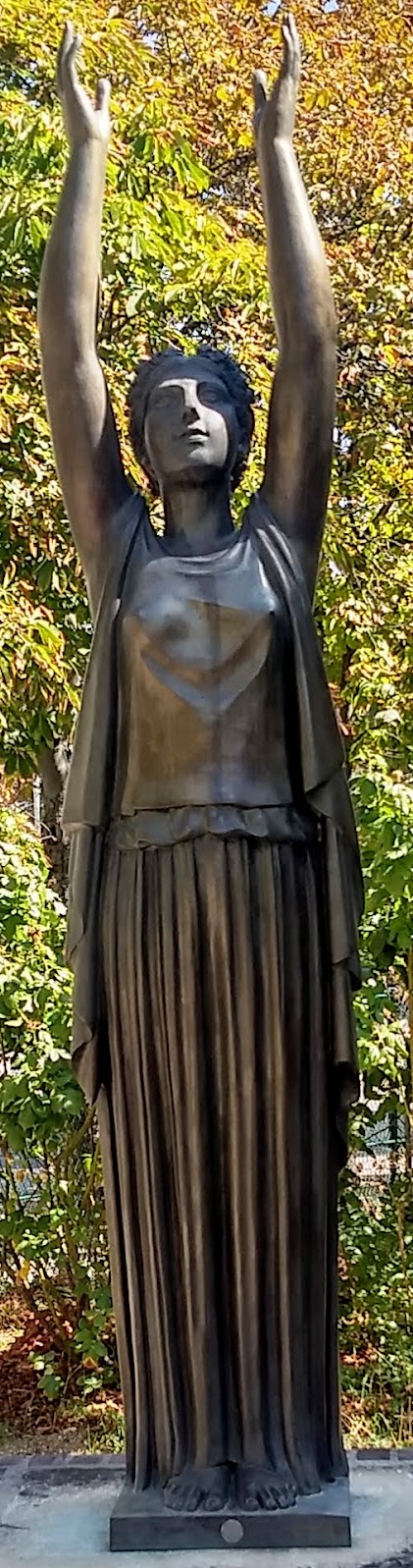
Monument in memory of the Russian expeditionary force
(1916 to 1918) at the western end of the Cours de la Reine. |