Fifteen years ago, we had to leave France early because a Category 4+ hurricane named Charley had hit our island hard. This week, we watch a Category 4 hurricane named Dorian prepare to hit Florida. The 5AM update (Paris time) had our island just barely inside Dorian's cone of uncertainty (that's bad). The 11AM and 2PM updates puts our island just barely outside that cone. That's a little better, so I can relax now and share thoughts and photos with you.
 |
| Sculpture gallery of the Petit Palais, the City of Paris Fine Arts museum. |
We've been doing lunch lately (instead of dinner). Two days ago, we had to go back to the American Library again, so we stopped for lunch just around the corner at Le Relais de la Tour. Tom had typical late morning brasserie fare: a big omelette with ham and cheese, with a side of fries; I had a small filet of sea bass on a bed of heavenly ratatouille (stewed veggies). Then yesterday, we stopped in Le Bistrot du Parc on Rue Balard for a fine lunch of beef carpaccio, a burger, fries and salad. We haven't had beef in quite a while -- or at least,
I haven't.
 |
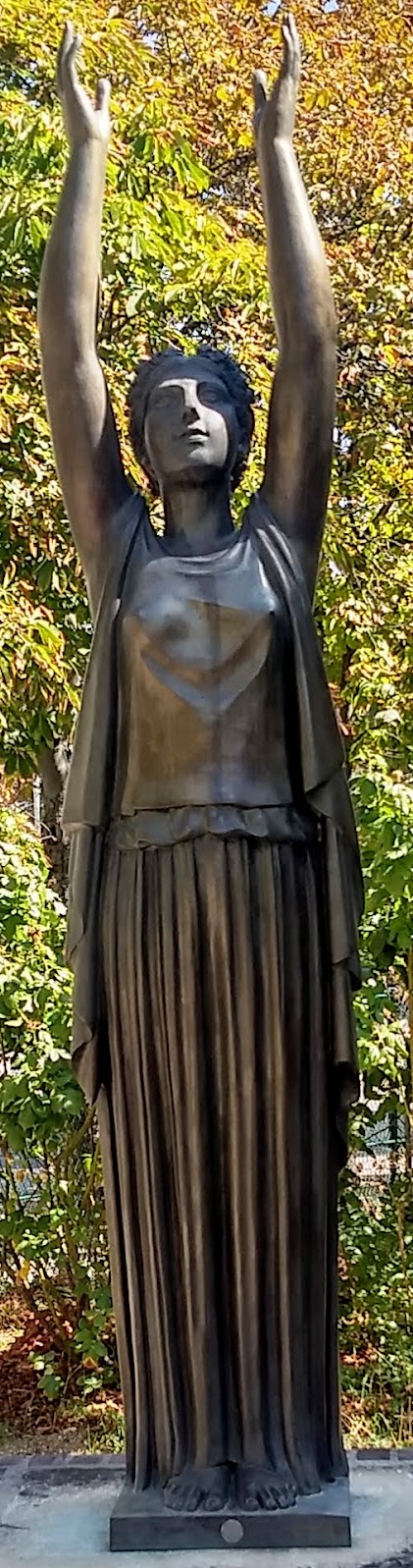
| Esperance (Hope), by Carlo Sarrabezolles |
The reason we were near the Bistrot du Parc was that we'd explored the Square Carlo Sarrabezolles for the first time. It was not that easy to find the entrance to this little gem of a park, but it was worth the effort. The park features much natural vegetation and one of Sarrabezolles' "Esperance" statues in bronze.
At the other end of the park is a monument to Maryse Bastie (photo below), the French "heroine of the air" like America's Amelia Earhart, except Bastie lived a longer life (1898-1952) than Earhart did (1897-1937).
Bastie came from an impoverished background, and was a single mom due to an early failed marriage. Then her child died at a young age. A second marriage to Louis Bastie, a World War I pilot, was good, and it caused her to become interested in aviation. But Louis died in a plane crash in 1926. To support herself, Bastie did aerobatics. She set plenty of records for women in aviation in the 1930s, and for her accomplishments she was inducted in the French Legion of Honor. She started her own flying school, and she served in the French Air Force, achieving the rank of captain. She died when her plane crashed in 1952, and she is one of the notables buried in the Montparnasse Cemetery.
On our way home after lunch we paused briefly in the Grenelle Cemetery. It is much smaller than the Montparnasse Cemetery, but still retains the small town charm that it has always had.
 |
| Grenelle Cemetery |
This afternoon will be very warm/almost hot, so I walked this morning up to the Petit Palais. I went in, walked around in the air conditioned galleries, and took in some of my favorite sights in the Permanent Collections on the main level. By noon I was home, having already walked five and a half miles.
Here are some more photos from the past couple days:
 |
| Monument to Lafayette on Cours de la Reine, on the way to the Petit Palais this morning. |
 |
| A few of my favorite paintings in the Petit Palais permanent collection. The fabulous, enormous painting above, of a scene in Les Halles in Paris in the 19th Century, is by Leon L'hermitte. |
 |
| The flour carriers, by Louis Carrier-Belleuse |
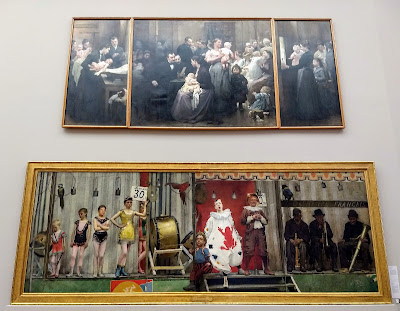 |
The lower painting, Grimaces et Misere -- Les Saltimbanques, by Pelez,
is one of my husband's favorite paintings in the Petit Palais. |
 |
| Flowers in the Grenelle Cemetery |
 |
| Flower shop on Avenue Félix Faure. |
 |
| A fabulous Haussannian building on Avenue Félix Faure. |
 |
| Fountain behind the church of St. John the Baptist of Grenelle. |