Showing posts with label Notre Dame d'Auteuil. Show all posts

Tuesday, July 30, 2019

The Parc Sainte Périne -- pretty and serene

After a good lunch outdoors at Le Cosmos Café, we strolled down the Avenue Emile Zola in the warm afternoon air.  We paused on the Pont Mirabeau to take in the spectacular river views. 

Flowerbeds in the Parc St. Périne are well tended.  Note
the hot air balloon rising above the Parc André Citroen, across
the river.
I told Tom the story behind the bridge.  He told me that Pont Mirabeau is named in literature, history, and song as the site of a number of suicides.  I noted that the railing seemed like it would be easily surmountable.  He said the choice as a suicide site had something to do with the power of the river there, and the strength of the currents.  I recalled that at the time the Pont Mirabeau was designed and built, it was the tallest and longest bridge in Paris.  As we stood at the midpoint of the bridge, we could clearly see how wide the Seine is in that reach to the west of the Île aux Cygnes.   The river must be deep there, too, if the rolling wave action is any indicator.


We continued on to the right bank and the Rue Mirabeau until we reached number 41, a gateway into the recently expanded and improved Parc Sainte Périne.  The site of the park and the surrounding hospitals (Sainte-Perine - Chardon - Lagache - Rossini) was once a huge estate occupied by the monks of St. Genevieve, the patron saint of Paris.  The monks were there from 1109 until the French Revolution. 
The woods in the Parc St. Périne (above and below).


Eventually, the daughters of the Countess of Aubusson owned a diminished version of the estate.  They gave it to the public hospital system in the 1850s.

The park was called Square Sainte Périne until last year when it was doubled in size and greatly improved. 

Tom and I had never been to the square/park, so we decided to explore it yesterday. 

Three sides of the park are hillside; St. Perine is the patron saint of mountain travelers, after all.  The middle of the park, which is the original Square, has stunningly beautiful flowerbeds and curving, paved walkways.  There are two inviting playgrounds for kids.  The once green lawns are being allowed to go natural to save water, reduce fertilizer and pesticide use, and encourage growth of wildflowers for the bees and butterflies.  This is a phenomenon throughout public spaces in Paris.

It is not unusual to see palm trees in Paris parks.

For adults, there is some acreage of raw woodland with unpaved trails on each end of the park.  I think this wooded land is probably what was recently added to this public space.  Educational plaques in the woods explain the importance of various elements in the wooded ecosystem.
This distorted tree in the Parc St. Périne has the remnants
of some kid's improvised "treehouse."  The park's
gardeners have allowed it to remain.

The total size of the park is now a little over 9 acres, we calculated (3.7 hectares).  Even on a perfect summer afternoon, the park was uncrowded and serene.  The park is also open through the night during the warm summer months.  As part of the renovation and expansion, low-energy lights were added to the park so that neighbors can enjoy it after dark.  In addition to a couple long-stay hospitals, some apartment buildings overlook the park.  Tom and I think this would be a fine place to live in Paris.

Do not play ball against this wall! -- That's the message.
After exploring the park, we walked up to see the façade of the Notre Dame d'Auteuil church because Tom had not seen it in a while.  We amused ourselves by looking at a sign on the side of the church -- a message that confused and bemused us in 1998, before we improved our French.

Decades ago, I thought that the walk to Auteuil and back was very far; now I think nothing of this five-mile round-trip.  It is just a walk in the park.

The Parc Sainte Périne.


Sunday, July 28, 2019

Up in Auteuil

One of the more popular French presidents was Sadi Carnot.  He was named after his uncle, Nicholas Leonard Sadi Carnot, a thermodynamics scientist who was named after a Persian poet, Sadi of Shiraz. 
Approaching Notre Dame d'Auteuil from the rue Antoine Roucher.

Before he became a politician, Sadi Carnot was a civil engineer.  So it is not surprising that he decided, when he was president (1887 to 1894) to have a bridge built over the Seine to connect the Javel/Grenelle area on the left bank with the Auteuil neighborhood on the right bank.

At the time it was designed and built, this Pont Mirabeau was the longest and tallest bridge in Paris.  Its two pilings represent boats, one going upstream, and one going downstream.  Each end of each piling is decorated with a magnificent statue by Jean Antoine Injalbert.  These represent the City of Paris, Abundance, Commerce, and Navigation.
Pont Mirabeau, looking toward the Javel neighborhood.

Pont Mirabeau is strikingly beautiful.  Sadly, President Sadi Carnot did not live to see its completion in 1897; he was assassinated by an Italian anarchist in 1894, at the peak of his popularity.  The country was horrified.  Following an elaborate funeral, the body of Sadi Carnot was enterred in the Panthéon.

Notre Dame d'Auteuil church, above and below.


This morning I crossed the Seine on the Pont Mirabeau so that I could walk to what was once the center of the village of Auteuil.  I paused in the little plaza across from the Notre Dame d'Auteuil church to study its stately façade, and to gaze at the strikingly different, modern façade of the Chapelle Sainte Bernadette, which is also part of the Notre Dame d'Auteuil parish.  The Chapelle offers services for the Portuguese and Philippine communities.  (Many guardiens and concierges of apartment buildings in the 15th and 16th are of Portuguese or Philippino background.)
Part of the modern Chappelle Sainte Bernadette façade.

Auteuil was a village whose origins go back to the 13th Century.  At the time of Louis XV, it became a fashionable place for the rich to have a country estate.  Proust was born there, and Victor Hugo and Moliere once lived there.  In 1860, it was annexed to Paris.  (The former villages of Auteuil and Passy make up the bulk of the fashionable 16th arrondissement.)

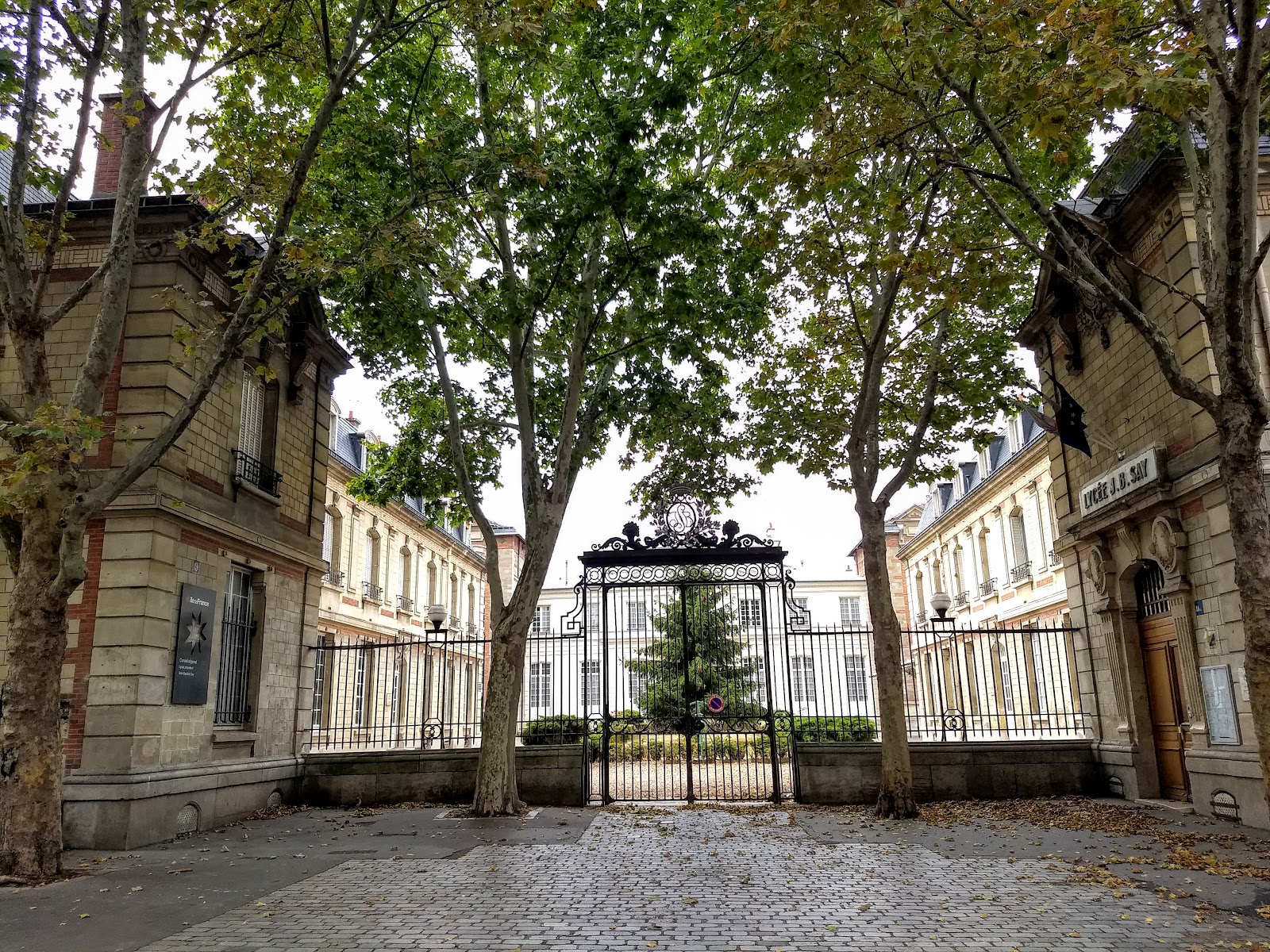
Auteuil is home to the prestigious Jean Baptiste Say school which prepares students for the École Polytechnique, the university where Sadi Carnot received his civil engineering education (in part).

Just to the southwest of the Notre Dame d'Auteuil church is a sprawling geriatrics hospital with a sprawling name:  Hôpital Sainte-Périne - Rossini - Chardon-Lagache.  Part of this sprawling complex was (and perhaps still is?) the Chardon-Lagache retirement community, which was established in 1857 for old people (i.e., over 60) of "modest means."

The Jean Baptiste Say school.
South of the sprawling hospital is the Parc Sainte-Perine, which was formerly Square Sainte-Perine until it was significantly enlarged last year.  Tom and I have never visited that park; I will save that adventure for another day . . . .

Here are many more photos from this morning's walk through cool, damp Paris.

The Seine, from Pont Mirabeau.

This iron gate is just a few doors down the street from our apartment;
the poster is for a current exhibition at the Bourdelle museum.

Guimard-designed Metro entrance at the Mirabeau station.

River cruise boats at the Port de Javel.

The Voie Georges Pompidou has a sigificant bi-directional
bike lane now (above and below).  (You can see the Statue
of Liberty and a piece of the Eiffel Tower in the photo above.)


Street named for Eugene Poubelle, the Prefect of the Seine who introduced
garbage cans to the Paris region, and made their use mandatory (1884).  Garbage cans
(dustbins, in British English) are called Poubelles in France.

The Seine and Eiffel Tower, from the Pont de Grenelle.

Knarly old, trimmed-back olive trees seem to be much loved in Paris.  This sign gives
voice to this tree in a planter on Rue Linois. The sign says, "Ladies and Gentlemen,
I am a living tree. I am neither a Poubelle nor an ashtray.  Respect
me.  Thank you for him.  The Olive Tree [Olivier]."